Oral History Project – Celebrating America’s 250th – Missy Wolfe: Greenwich Historian
By Mary A. Jacobson
Historian: “a scholar who studies and writes about the past and is regarded as an authority on it. Historians are concerned with the continuous, methodical narrative and research of past events.” (Wikipedia)
What, one may wonder, are the qualities and influences which might propel a person to make the study of history a life’s passion? Curiosity? The joy of discovery? Perseverance? Inspiration?
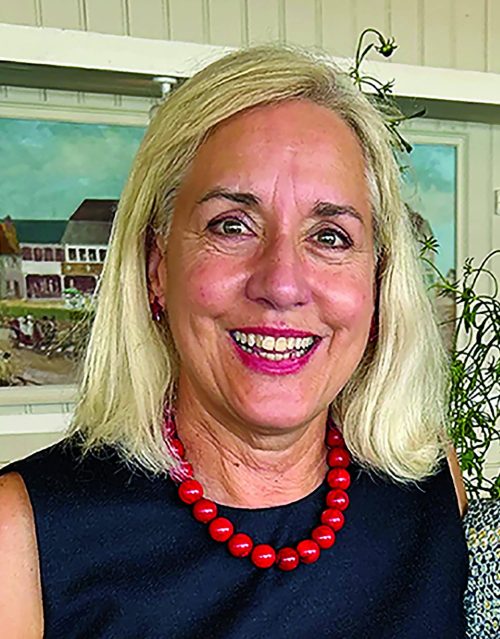
Missy Wolfe, a Greenwich resident, is considered a preeminent Greenwich historian. In 2024, Oral History Project volunteer Caroline Atkins interviewed her to enlighten us about the person behind her work.
Missy Wolfe’s family moved to Greenwich from Louisville, Kentucky, when she was of middle-school age and was enrolled at Central Middle School. “I loved reading and always did; I love nonfiction and biography… I always found nonfiction far more fascinating than fiction because you can’t make this stuff up; it really happened. And that it really happened was intriguing to me.”
After receiving her undergraduate degree in economics and psychology at Indiana University, Wolfe joined her dad, who had a career in advertising, in developing a marketing strategy consulting firm. Their focus was on the concept of creativity, and how their uniquely developed materials could enable consumers of goods or services to create what they wanted to buy. “The creativity process we sold became very successful…Our clients, the companies, would then ask their manufacturers to create our recommendations and their advertising agency to relay our findings.” Missy credits that experience with developing her writing skills. “How do you take a large amount of information, sort it, organize it, structure it, make conclusions about it, and report it in a very efficient way?… So, I guess that really established my ability to organize a lot of data.”
Missy also credits several writers as being major influences on her. They include Antonia Fraser, “famous for her non-fiction histories of female European royalty and the geopolitical games they played and why;” Alison Weir, author of numerous historical biographies of British royalty and personages; and Barbara Tuchman, local author, historian, and Pulitzer Prize winner. “And those were my inspirations… I was always reading them.”
Over the next twelve or so intervening years, Missy obtained an MBA from Columbia Business School, was employed by Ogilvy and Mathers, married, worked additional years with her dad, and had three children. Her husband, an orthopedic surgeon, was also an academic writer. “He taught me the importance of publishing in academic journals to present important discoveries… He is the one who pushed me to write my first academic article on the original Dutch jurisdiction of Greenwich… So that jelled with my love of nonfiction that requires a lot of citation. My great interest in genealogy links with this too.”
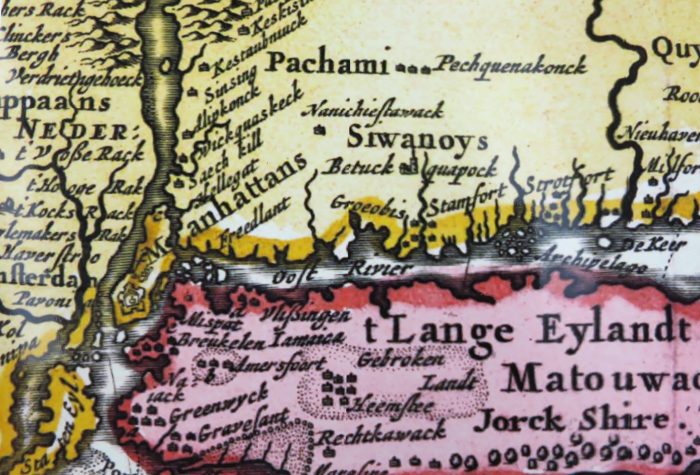
Missy’s hypothesis was that, in its first years, Greenwich was a Dutch territory, that it was not founded by the New Haven Colony. “It was a myth that we were English originally.” She presented her theory to Debra Mecky, then Executive Director and CEO of Greenwich Historical Society. Mecky’s response was, “’Well, do your research and present your proposition,’ which I did.”
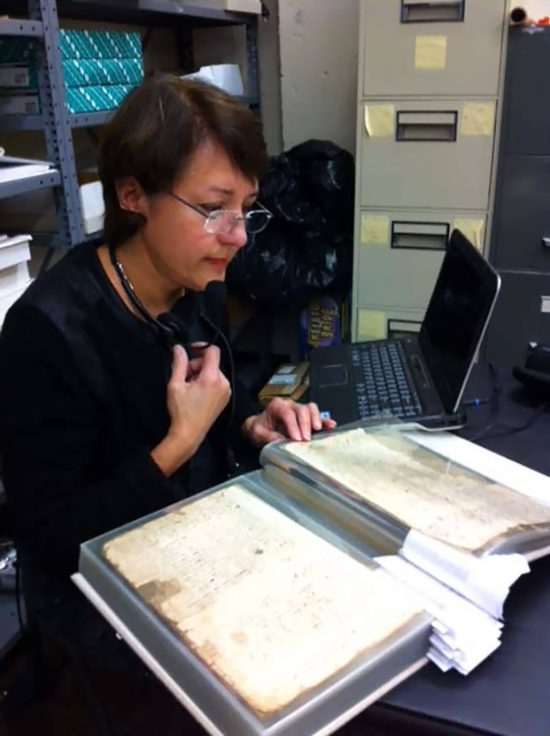
Missy Wolfe’s research took her to the New York State Library in Albany, New York, which “has many of the earliest records concerning Greenwich because of this original (Dutch) jurisdiction; another reason we didn’t know our earliest history very well…These records sat on ships during the American Revolution. They put them on ships because they didn’t want the Dutch or British to burn them. . . getting moldier and wet. It’s amazing they survived.” Later, in the 1800s, the records were retrieved from The Hague, where they had been stored, and were brought back to New York State. Luckily, one man transcribed some records and created an index for most of them, storing them in the New York State Library. Unfortunately, in 1911, a fire damaged or destroyed much of these old 1600s records. “All the original documents that have been transcribed to this day, up there at New Netherland project, all the original documents are burned around the edges.”
In the 1970s these records were conserved and cleaned by Josephine Conboy, founder of the Greenwich Preservation Trust in 2008. “Fifty years after Jo Conboy’s prescient work, I had the technology to digitize them, and in this way, they could be restored to chronological order once again after three hundred and fifty years… It is also amazing that our town archives of Greenwich, that live down in our town hall, that we have them at all is a truly wonderful thing!”
In 2015, Missy’s article The First Dutch Jurisdiction of Greenwich was published in the Connecticut History Review. “So now it is accepted by all of academia that that is true. We were (initially) a part of New Netherland; a part of Dutch New York.” Missy further stated, “People were upset because they had invested in the English heritage of Greenwich… Everything I’ve written is cited. You can refer to the original source document where this information comes from.”
Missy Wolfe’s publications include Insubordinate Spirit, chronicling the history of early settlers Elizabeth Feake Winthrop Hallett and family when Greenwich was still part of New Netherland; The Hidden History of Colonial Greenwich, describing the creation of the community of Greenwich in early American colonial times; and The Great Ledger Records of the Town of Greenwich, Connecticut 1640-1742, a two-volume “transcription of town hall records… a very large project of photographing, transcribing, ordering, and indexing hundreds and hundreds of colonial records.” Missy is now working on volume three and is up to 1768. The factual information and historical revelations presented in these books have added immeasurably to the knowledge that we now have about our local history.
For Missy Wolfe, the fascination of Greenwich is of “the lost Greenwich, the Greenwich that we never knew, radically different from today.” And the inner propulsion to uncover its history? “I can’t explain it. It’s like an obsession that just came over me. It was like I was teed up because of my life experiences to be the person to do this work.”
The Oral History Project is proud to present blogs derived from its collection of recorded interviews as part of the Project’s celebration “America’s 250th|Greenwich – Greenwich History is American History.” Visit the website at glohistory.org. Interviews may also be read in their entirety or checked out at the main library. They are also available for purchase by contacting the OHP office. Our narrator’s recollections are personal and have not been subjected to factual scrutiny. Mary Jacobson serves as blog editor.