By Anne W. Semmes
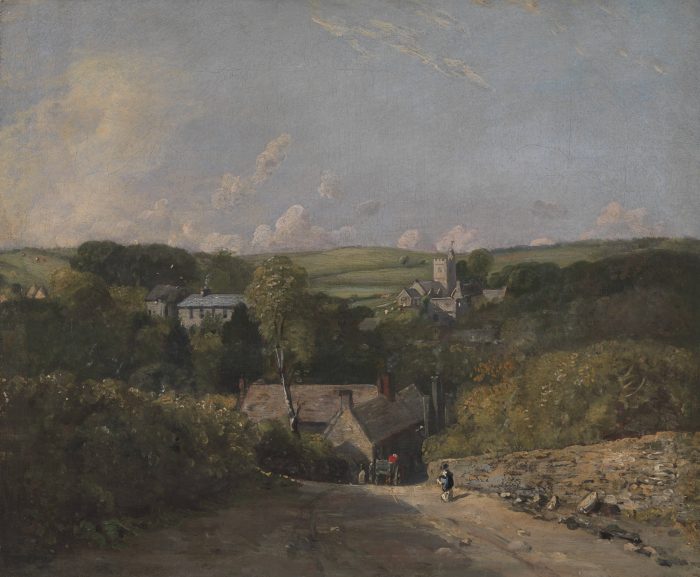
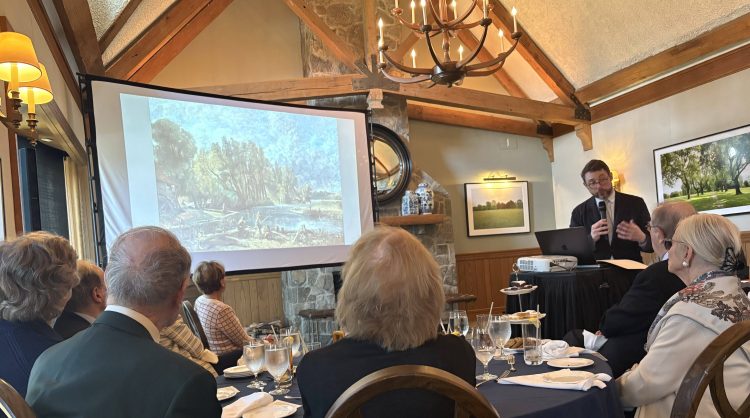
Last Wednesday week, on a summery spring day at the Round Hill Club in backcountry Greenwich, 70 members and guests of the Greenwich Branch of the English-Speaking Union were being treated to the art of British landscape painter John Constable. In this 250th celebratory year of his birth, his work is to be featured in a forthcoming exhibit, “John Constable: The Landscape Reimagined” this September at the Yale Centre for British Art (YCBA).
“We are honored to have Dr. Edward Town as the YCBA assistant curator of paintings and sculpture,” introduced Natalie Pray, president of the Greenwich Branch. “And as you probably know, the Yale Centre has the most important collection of English art outside of London.”
“So, this exhibition follows the journey of a painter who had a profound impact on the development of landscape painting,” began Town. “Born in rural Suffolk in 1776 into a family who were corn merchants, mill owners, and farmers,” Constable would turn away from the family business to attend the Royal Academy in 1799. And “in 1802, Constable made the bold decision to make the study of nature his life’s work, choosing his birthplace in Suffolk as his subject,” told Town.
Constable would “set out sketching the places of his childhood, returning repeatedly to reimagine landscapes that he knew intimately… His astonishing capacity was to reproduce not only the appearance of nature, but also ‘the feel of nature’ in his words,” and to “open the expressive potential of landscape painting for others, reimagining and reshaping the genre for generations to come.”
Along with Constable’s landscape painting approach, Town added, “He was part of a generation of artists shaped by the romantic movement, led by the likes of the poet, William Wordworth, introduced by a mutual friend, to his romanticism, privileged emotion, individualism, and imagination… as well that an artist might suffer from his art, something Constable felt quite strongly.”
Also, in the upcoming exhibition will be “a large section on Constable’s work as a printmaker… Constable very much sought to emulate the commercial and critical success of his counterpart JMW Turner, who’d made a good amount of money making reproductions for his paintings in print. Constable’s attempt, which is called English Landscape Scenery, was neither a critical nor a commercial success, but it gives us great insights into what he was trying to achieve.” And a favorite example of Town’s is “Weymouth Bay.” Located in Dorset, “This is where Constable had his honeymoon,”
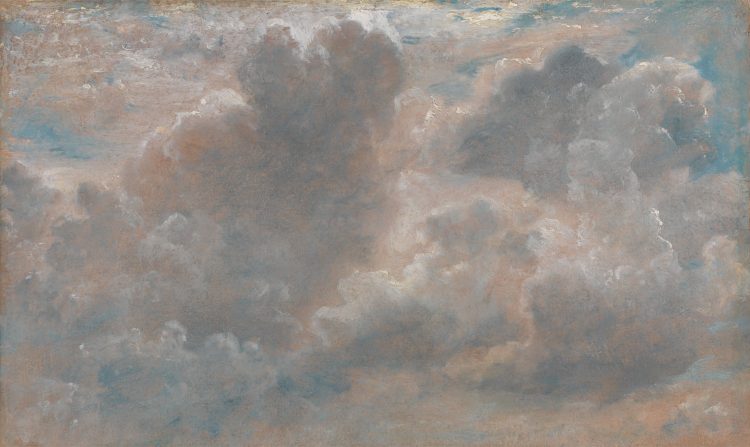
He next showed a slide featuring the extraordinary cloud studies Constable made in North London. “This is one of the most famous works in the YCBA collection. What is remarkable about these cloud studies is they’re made in a very intense period of painting, which Constable called “skying.”
Town noted that Constable was “a fair-weather artist. He preferred working in the summer, and each morning would go out very early and make a succession of these cloud studies, working on paper rapidly… No one could paint as quickly as he … He’s making each of these studies in about an hour.” And, also remarkable, “He’s recording the date, the time, the atmospheric conditions, and the weather that proceeded and followed what he did experience. So, he’s going about this in a very scientific fashion.”
Town referred to “a famous review by Constable, in which he set out his conviction that the sky was of the utmost importance in the composition of the landscape. Not only was it the chief source of light that ‘governs everything.’ It was also, ‘The chief organ of sentiment.’ In other words, the sky needed to be of a piece in both mood and expression as the rest of the composition.”
Town would address a Constable painting to be featured in the closing section of that forthcoming exhibition, that was an ongoing challenge for the artist. The work was to depict an 1817 ceremonial opening of Waterloo Bridge in central London, meant to be “A grand image that views the genres of history and landscape painting in the tradition of Claude Lorrain.”
A sketch of that painting Town would show is half the size of the to be six-foot canvas that would frustrate Constable throughout the 1820s. To accomplish the larger size, “Constable would use a grid… Artists would use grids for centuries to either scale up or make one-to-one copies of their paintings.”
But Constable’s “star” would rise in 1820 – and bring a series of crises in the Constable family. With a son’s illness there would be a move from London to the “cleaner air” of Brighton. “The coastline of Sussex became a new subject for Constable,” with the painting of storm clouds… seen on the south coast mirroring the precarity of his wife’s health and the artist’s increasingly perilous mental health.”
Town showed a final painting Constable would make in Brighton before moving his ill wife and family to Hampstead Heath in the north of London. Constable would be using a “forceful application of paint, not with the brush, but with the pallet knife, that mirrors the anguish the artist must have felt. This memory of that tempestuous sea may have led him to arrive on the subject of Hadleigh Castle,” done after his wife’s death in 1828.
With his first exhibited painting as a “full member of the Royal Academy Constable was nervous about how Hadleigh Castle would be received,” Town told. “It marked a departure from the controlled finish of his earlier work, and in its abandon realized the full expressive potential of landscape painting.”
“To reinforce the theme of nature’s power that surges through the composition,” concluded Town, “Constable had lines from the poem, “The Seasons” by the rural poet James Thompson included in the exhibition catalog. “The poem speaks of ‘melancholic bounds, rude ruins, all of which resonated with Constable’s sense that without his wife, he was “himself a ruin.”