By Liz Leamy
This week, the Greenwich Historical Society hit the proverbial golden ball out of the park once again in regard to its paramount role of the town’s celebration of America’s 250th with the opening of its remarkable costume exhibit, ‘Fashioning America: 250 Years of Greenwich Style,’ at its renowned Strickland Road campus based in Cos Cob.
This exhibit, which opened on April 22nd and is slated to run through January 2027, features all the stuff of a golden celebration honoring fashion in America with it showcase of clothing dating from the Revolutionary War era up all the way up through the present that reflect the character, culture, spirit and persona of the country, as well the New England, New York City and Greenwich areas.
“We are absolutely delighted to share our extensive costume collection with the public for the first time in 30 years,” said Carol Cadou, Greenwich Historical Society Executive Director and Chief Executive Officer. “This exhibition affirms our longstanding commitment to preserving the most fragile reminders of Greenwich history and provides a telling window into our town’s cultural and social transformation over the last 250 years.”
Certainly, this presentation has been well worth the wait, as it represents an expression of the story of our country’s history via fashion from the perspective of Greenwich, which had been first settled in 1640 by the agents Robert Feake and Captain Daniel Patrick and then declared a township 25 years later by the Connecticut General Assembly in Hartford on May 11th, 1665.
“We’re looking at the role of fashion since the American Revolution and how fashion can really tell us so much about American history,” said Kathleen Craughwell-Varda, Senior Curator of the Greenwich Historical Society and Curator of the exhibit. “In this exhibition, fashion mirrors pivotal events in American history.”
Certainly, the pursuit of life, liberty and happiness through the Continental Army’s courageous and formidable fight for political freedom and independence against Great Britain is a message and statement that has been boldly reflected through the fashions on display at this memorable exhibit.
“We’ve intentionally created backdrops that place the clothing in the eras when they were worn,” said Craughwell-Varda. “This provides us with the opportunity to talk about these pieces and how clothing from the past to the present provide a means of understanding people and their experiences.”
In her introduction of the exhibit to media members, Craughwell-Varda graciously credited those generous individuals and organizations who helped make the event happen.
“We worked with a fabulous group of people,’ said Craughwell-Varda. “Our credit panel highlights the people who have been so generous in their financial support with this exhibition as well as our generous lenders which includes members of our Board of Trustees as well as area museums and our amazing exhibition team.”
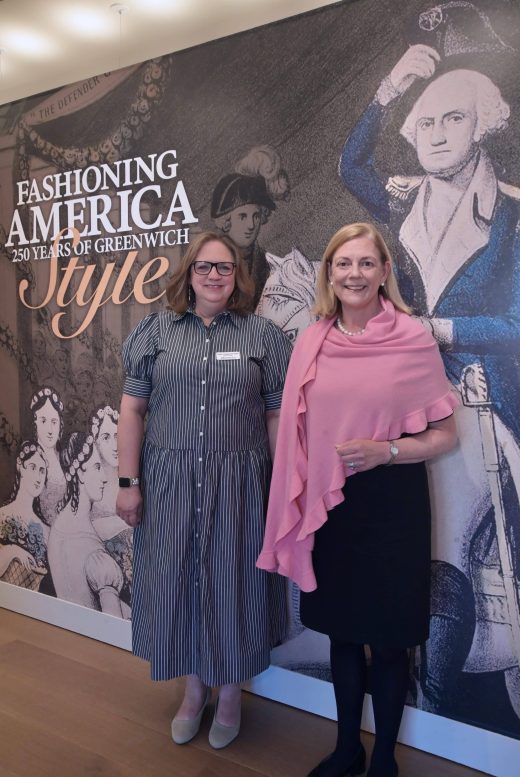
Upon walking into the exhibit in the spacious showroom located on the second floor of the Greenwich Historical Society’s main building, there is a giant wall portrait of George Washington in which he is being greeted by ladies of Trenton, New Jersey, who are holding big baskets of flowers as he rides on horseback on route to his first presidential inauguration in New York City.
“This is a print commemorating George Washington when he traveled from Mount Vernon to New York for his first inauguration and passed through Trenton, New Jersey,” said Craughwell-Varda. “The ladies of Trenton met him with baskets of flowers as he came through archways with banners proclaiming him as defender of the country.”
This stunning exhibit, notably, is comprised of seven different installations with each depicting the fascinating and impactful evolution of American fashion from the 18th and 19th through to the 20th and 21st centuries in relation to the Greenwich area, respectively.
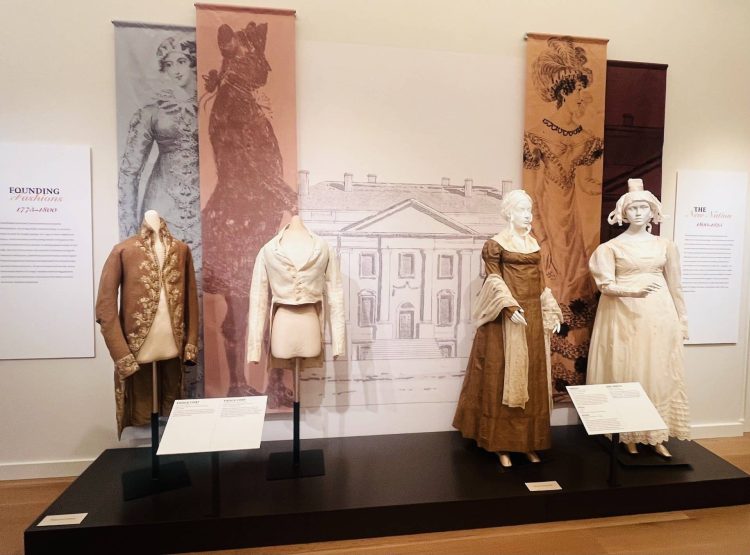
The first installation is centered around the 18th and early 19th century.
It features a men’s frock coat of imported English silk with intricate silk embroidery alongside a linen frock coat made in America to reflect the patriotism of wearing locally manufactured textiles.
Displayed alongside these two men’s coats are dresses inspired by Napoleon Bonaparte’s wife, Josephine de Beauharnais, the first French Empress, crafted in the fluid and sophisticated empire style.
One of the dresses, a gift to the Greenwich Historical Society from Oleva Mead, is made of brown silk with a linen drawstring and is reflective of the conservative styles preferred by New England women at that time.
The second installment, ‘The First Fast Fashion 1825-1850,’ features colorful dresses adorned with collars and aprons from that time that reflect the industrialization and surging economic growth of the country during the post-Revolutionary War era.
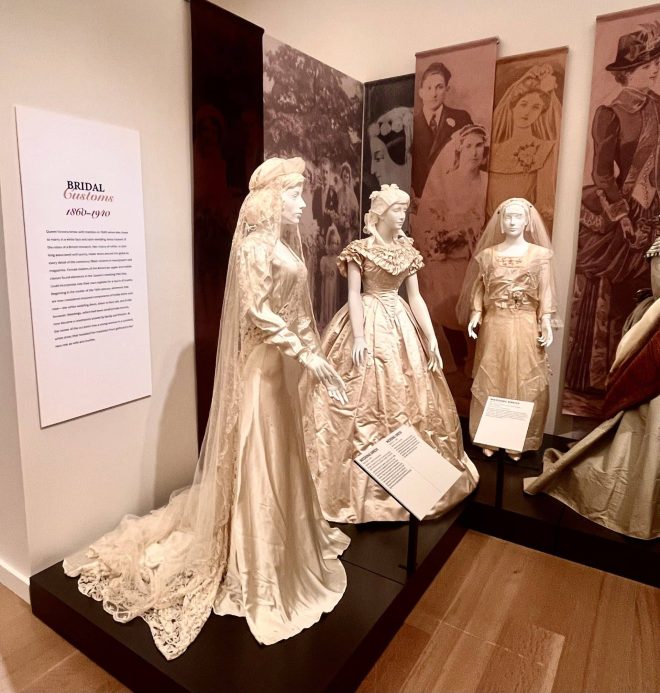
The third installment, ‘Bridal Customs 1860-1940,’ centers around the history of the bridal gown and its impact on women in America and also in Greenwich.
Notably, it features a beautiful wedding gown and veil that Lydia Ferris wore for her wedding to Granville Lester on June 11th, 1938 at the Second Congregational Church on East Putnam Avenue. (The dress was purchased from the estate of Lydia Ferris Lester by Hugh and Claire Vanderbilt, with Claire Vanderbilt, who passed in 2005, having been a pivotal leader and benefactor of the Greenwich Historical Society having served its organization for more than 50 years.)
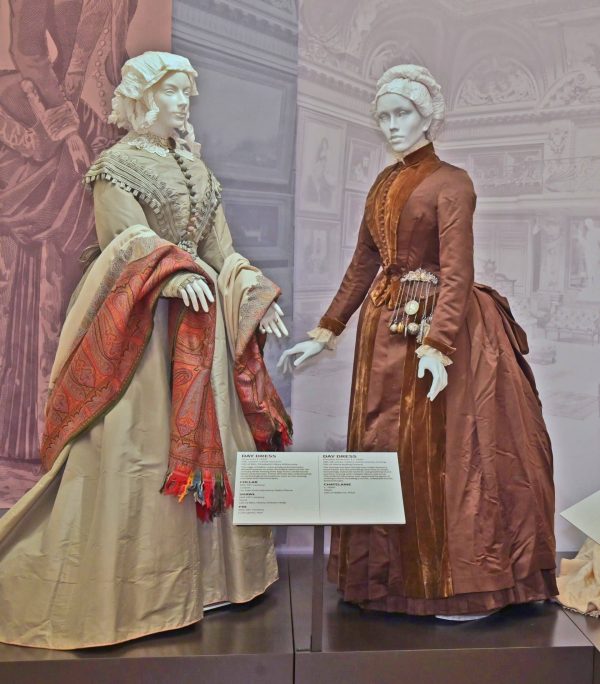
The fourth installation, ‘Conspicuous Consumption 1860-1900,’ depicts dresses worn by Greenwich women during the fabled Gilded Age.
During this era, Greenwich became the home of many business titans and their families, including such well-known residents as the Vanderbilts, Rockefellers, Havemeyers and Carnegies, among others.
This collection features two exquisite day dresses, as well as a lovely tea and dinner dress, all of which are made from beautiful silks, velvet and lace and donned with intricate detailing of glass beads and metallic threads.
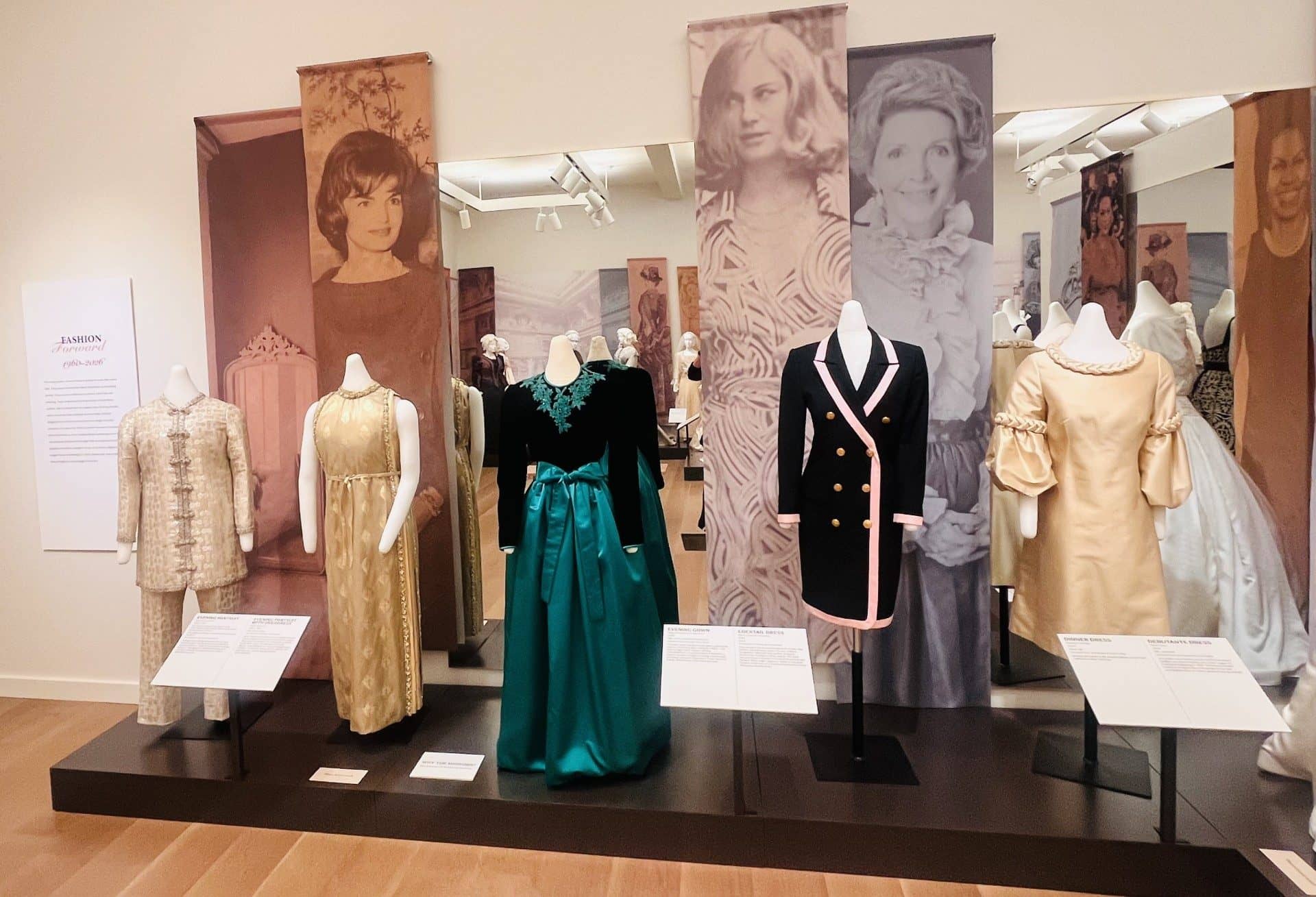
‘Fashion Forward 1960-2026,’ the final grouping in the exhibition, features eight stunning dresses and pantsuits created by some of the most brilliant and decorated American and European fashion designers from the modern era, including Valentino, Oscar de la Renta, Yves Saint Laurent and Adele Simpson, who lived in Greenwich for many years.
Integral to this installation are the background mirrors that help create a truly interactive experience for visitors.
“The mirrors are here to reflect our visitors and include them and their personal styles in the exhibition,” said Craughwell-Varda. “We see how people have dressed over time and how American history impacts and influences what we wear. It’s important that our visitors see themselves as part of the story of American fashion.”
Craughwell-Varda further elaborated on how American fashion reflects the ‘life, liberty and happiness’ intent written in the Declaration of Independence, as each person’s journey is a reflection of their efforts to live out the ideals of our founding fathers.
“Greenwich’s proximity to New York City always made the best goods and fashions available to its residents,” said Craughwell-Varda, adding that it was ‘whether it was when the town was an agrarian/maritime community or when the railroad came bringing goods from around the work with industrialists who left their mark on Greenwich. “For more than 250 years, the people of Greenwich have lived and worked here creating a dynamic community. We hope our visitors leave the exhibition with a better understanding of our shared history and how much we can learn by looking at what people wore.”
For more information on the exhibit, please visit: www.greenwichhistory.org