By Charlie Shapiro
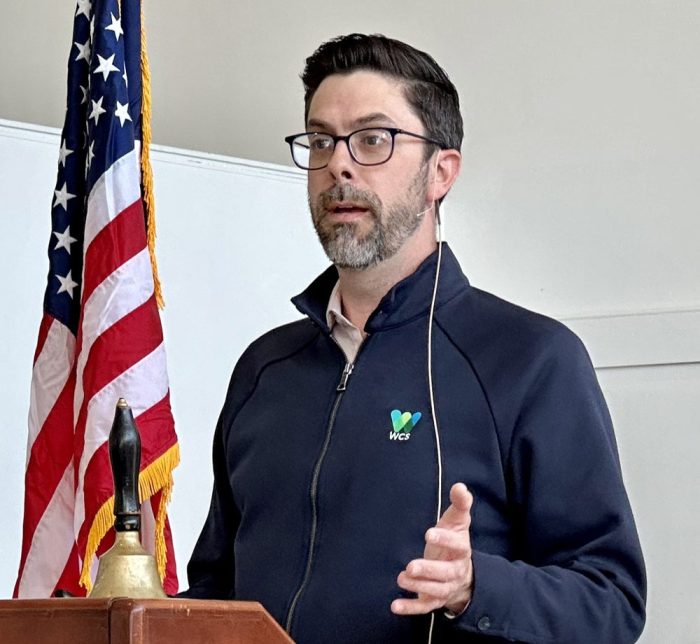
On April 8, in a quiet room filled with listeners, Spike Lipschutz of the Retired Men’s Association introduced a man whose life has been a bridge between the wild places of the world and the urban heart of New York City. Stephen Ham, the Senior Vice President and Chief Development Officer of the Wildlife Conservation Society, did not begin his presentation with charts or figures, but with the memory of a boy in Kentucky who was obsessed with the woods. He grew up catching turtles and dreaming of Africa, which led him to lead a major conservation organization.
The trajectory of Ham’s career was set in motion by a handwritten letter. As a precocious thirteen-year-old, he wrote to Dr. Jane Goodall, the world-renowned primatologist and anthropologist, after reading her memoir. To his surprise, she wrote back. Their correspondence lasted years until Ham met her in person during high school. Goodall, recognizing a kindred spirit, told the young man he would one day work for her. He eventually did, serving as her assistant and “roadie” during her global lecture tours, an experience he credited with teaching him that every individual has the power to make a difference.
Ham’s presentation, titled “Saving Nature’s Strongholds,” was a journey through the 130-year legacy of the Wildlife Conservation Society, which began its life in 1895 as the New York Zoological Society. He explained that the organization is the steward of a New York empire of nature: the Bronx Zoo, the Central Park Zoo, the Queens Zoo, the Prospect Park Zoo, and the New York Aquarium. But the mission, he noted, has always reached far beyond the city’s five boroughs. Today, the society manages the world’s largest conservation field program, protecting nearly half of the planet’s known biodiversity across more than 50 countries.
For example, William T. Hornaday, the founding director of the Bronx Zoo, successfully lobbied for the Fur Seal Treaty of 1911 to prevent the extinction of the northern fur seal. He recounted the exploits of William Beebe, the society’s first curator of ornithology, who in 1934 descended 3,028 feet into the waters off Bermuda in a steel bathysphere to observe deep-sea life never seen by human eyes. Ham also paid tribute to George Schaller, the legendary field biologist who was the first to scientifically study mountain gorillas, snow leopards, and giant pandas. Schaller, now in his nineties, remains the foundational figure for every wildlife biologist who has followed in his footsteps.
Ham described how the society’s zoos have evolved from simple menageries into “assurance colonies” for endangered species. He pointed to the African Plains exhibit at the Bronx Zoo as a revolutionary design that replaced steel bars with natural gullies, allowing predators and prey to live in a shared, healthy landscape. He also highlighted the Congo Gorilla Forest, an immersive exhibit that has raised over $15 million for field conservation by directly linking ticket sales to the protection of gorillas in the wild. One of the society’s most striking success stories involved the Kihansi spray toads of Tanzania. When a dam threatened to wipe out their tiny, waterfall-fed habitat, the society’s scientists collected the remaining population. For years, the toads existed only in the Bronx and a zoo in Ohio, until they were successfully reintroduced to the wild once their habitat was restored.
The conversation turned toward the modern pressures facing the natural world, from the “96 Elephants” campaign—a movement the society helped lead to stop the daily slaughter of elephants for ivory—to the recovery of tigers in India. Ham noted that tiger populations have finally begun to increase because scientists focused on a simple, data-driven solution: protecting the prey base the big cats need to survive. However, the tone grew more serious when Ham addressed the political and financial challenges of conservation. He described the “catastrophic” impact of the sudden loss of federal funding during the Trump administration, noting that $48 million in annual support for global programs was withdrawn within twenty-four hours of the inauguration. While the society managed to stave off disaster through private fundraising and its dedicated trustees, Ham warned that such funding gaps allow “bad actors” to fill the void in regions with low governance.
Despite these hurdles, Ham remained anchored in the philosophy he learned from Jane Goodall. He then spoke of “Nature’s Strongholds”—large, intact landscapes where wildlife can find refuge and eventually rebound. He invited the RMA to see the Bronx Zoo not just as a weekend destination, but as a headquarters for a global effort to ensure that the world’s most iconic species do not become mere memories. As he finished his talk, he left the audience with the image of humpback whales returning to the waters of New York Harbor, a sign that when nature is given even a small amount of protection, it possesses a remarkable ability to heal.
Stephen Ham has spent his life dedicated to global conservation. Whether trekking mountain gorillas in Rwanda or whale watching in Antarctica, he is a passionate advocate for wildlife and the wild places they inhabit, particularly for Africa. He received a degree in anthropology and environmental studies from the University of North Carolina at Chapel Hill. He is a returned volunteer with the United States Peace Corps where he served in Ghana. Before WCS, he was Senior Director with the African Wildlife Foundation. When not looking for animals, Stephen lives in New York with his wife and two daughters.
Although most past RMA presentations can be viewed by going to the association’s website at https://greenwichrma.org and clicking on “Speakers,” this one was not recorded.
The RMA’s next presentation, “The Spy and the State: The History of American Intelligence” by Jeffrey P. Rogg, PhD., JD, is scheduled for 11 AM on Wednesday, April 29, 2026. RMA presentations are held at Christ Church Greenwich, Parish Hall, 254 E. Putnam Avenue, Greenwich, CT 06830.
Dr. Jeffrey Rogg will present a history of American intelligence services from the Revolutionary War to the present day, as part of the year-long celebration of programs in Greenwich commemorating America’s 250th birthday. Dr. Rogg explores the origins and evolution of intelligence in America, including its overlooked role in some of the key events that shaped the nation and the historical underpinnings of intelligence controversies that have shaken the country to its constitutional core.
Jeff is a Senior Research Fellow at the University of South Florida’s Global and National Security Institute. Previously, he was an assistant professor at the Joint Special Operations University (U.S. Special Operations Command) and The Citadel. He was also a postdoctoral fellow in the National Security Affairs Department at the U.S. Naval War College. He is vice-president of the Society for Intelligence History and associate editor of the journal, Intelligence and National Security. He recently joined the Jack Miller Center’s network of scholars, which is dedicated to teaching America’s founding principles and history. His work has appeared in several academic journals and volumes as well as media such as The Wall Street Journal, The Washington Post, The National Interest, The Hill, and the Los Angeles Times. His book, The Spy and the State: The History of American Intelligence, was published in June 2025.
Jeff has a BA in Latin and ancient history from Swarthmore College, a JD from Villanova University School of Law, an MA in security studies from Georgetown University, and a PhD in history from The Ohio State University. He served six years in the Massachusetts Army National Guard as an infantryman.
To stream the presentation by Jeffrey Rogg at 11 AM on Wednesday, April 29, click on https://bit.ly/30IBj21. This presentation will also be available on local public access TV channels, Verizon FIOS channel 24 and Optimum channel 79.
Note: The views expressed in these presentations are those of the speakers. They are not intended to represent the views of the RMA or its members.
RMA speaker presentations are presented as a community service at no cost to in-person or Zoom attendees, regardless of gender. Any member of the public who would like to receive a weekly email announcement of future speakers should send a request to members@greenwichrma.org. The RMA urges all eligible individuals to consider becoming a member of our great organization, and thereby enjoy all the available fellowship, volunteer, and community service opportunities which the RMA offers to its members. For further information, go to https://greenwichrma.org/, or contact info@greenwichrma.org.