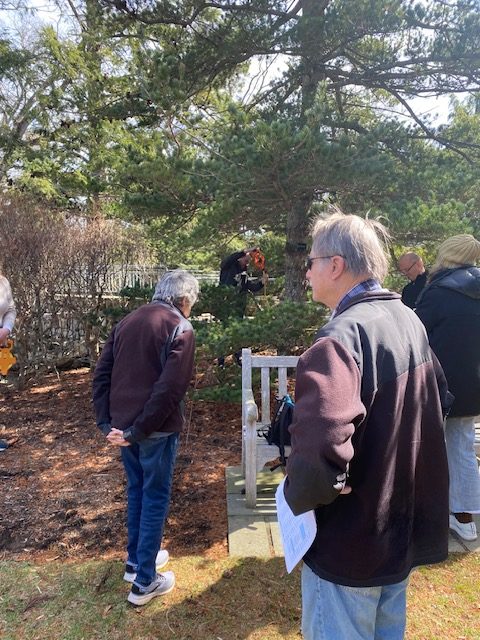
A group of residents stood beneath a towering Japanese white pine on a recent March afternoon, watching as a small team measured its trunk and canopy with practiced precision. The demonstration, part of the Greenwich Tree Conservancy’s Notable Tree Program, drew attendees to the Greenwich Botanical Center.
The gathering focused on something easy to overlook in daily life: the trees that have stood in place long before the town’s roads, homes, and schools were built. These trees, some of them recognized as the largest of their kind in Connecticut, have become markers of both time and stewardship.
Greenwich is well-represented in the database, with 208 trees total, of which 151 are confirmed to be extant. 32 are champion trees and 12 are co-champions, meaning that they were determined to be the largest examples of their kind found in Connecticut. To find out more about the Connecticut Notable Trees project go to: https://oak.conncoll.edu/notabletrees/
The program maintains a database of significant trees across Connecticut, and Greenwich holds a prominent place within it.
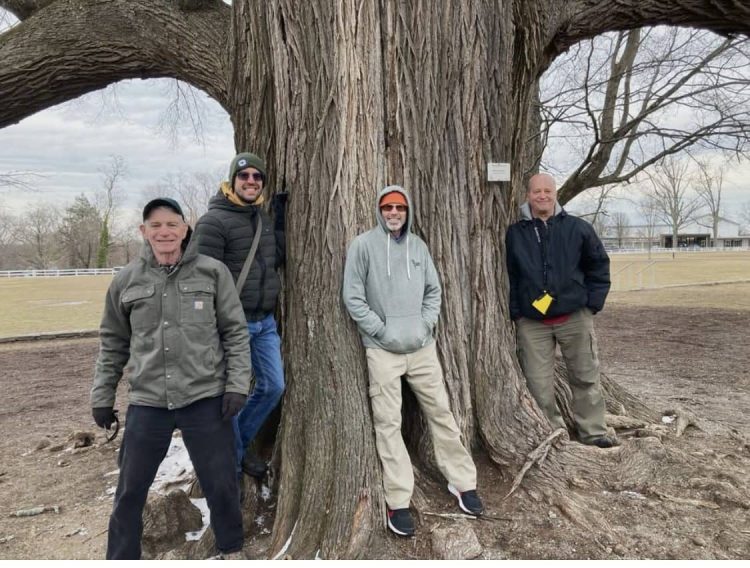
Frank Kaputa, co-chair of the statewide Notable Tree Program, led the presentation alongside team members John Kehoe, Marty Aligata, and Kyle Dougherty. Over the course of an hour, the group outlined how trees are identified, measured, and cataloged, and why the effort has grown into a statewide resource.
Inside the Botanical Center, the presentation moved through slides of towering oaks, sprawling beeches, and carefully documented specimens tucked into neighborhoods and public lands. Outside, the work became more tangible. Lisa Beebe, the Conservancy’s arboretum curator, joined the visiting team to demonstrate how measurements are taken — a process that requires both technical skill and patience.
A tape stretched around the trunk. A clinometer was raised to gauge height. Observers leaned in, some asking questions, others simply watching the quiet process unfold.
There was no rush to the demonstration. The pace matched the subject. Trees, after all, operate on a scale that does not align with the rhythms of meetings or calendars.
The Notable Tree Program, maintained through Connecticut College, serves as both a record and a guide. It allows residents to locate trees on public land and to nominate others that may qualify. The criteria include size, species rarity, historical significance, and overall condition.
But beyond the measurements and classifications, the program reflects something less formal. It speaks to a habit of care that has taken hold in Greenwich over time.
“Greenwich has a significant number of Notable Trees because so many in the community are committed to caring for their trees,” the Conservancy noted.
That commitment is not always visible. It happens in the decisions to preserve rather than remove, to maintain rather than replace. It appears in the work of volunteers and professionals who monitor tree health, manage disease, and advocate for preservation when development pressures arise.
At the Botanical Center, those efforts came into focus in small ways. Attendees lingered after the formal program ended, walking slowly through the Montgomery Pinetum, stopping at trunks marked by decades of growth.
The trees themselves offered no explanation. Their presence was enough.
The Notable Tree Program suggests a kind of continuity, one rooted in patience and attention. The results are not always immediate. But the outcome, measured over years and decades, becomes visible in the shade cast across a field or the broad trunk of a tree that continues to stand.
Residents interested in learning more about the program or identifying notable trees can visit the Greenwich Tree Conservancy’s website. https://greenwichtreeconservancy.org/notable-trees/