By Anne W. Semmes
At Audubon Greenwich last Monday evening a panel of three women leaders in our state, Denise Savageau, Alicea Charamut, and Amy Blaymore Paterson described ways to use nature to deal with the challenges of climate change and loss of biodiversity. The challenges were laid out by the panel moderator, Robert LaFrance, Director of Policy for Audubon Connecticut.
The occasion was a monthly meeting of Pollinator Potluck, a notable forum (with volunteered food and wine) for focusing on the needs and realities of our natural world, first kicked off in 2016 by Kim Gregory. Monday’s meeting brought 120 attendees including Rochelle Thomas, who heads Greenwich Audubon, Will Kies, head of Greenwich Land Trust, and JoAnn Messina, recently retired director of the Greenwich Tree Conservancy, and Steve Mesker State Representative.
“The concept here is how to use nature for a resilient Connecticut,” began LaFrance, “If we manage and do a better job managing our forests reforestation through natural forest management and a few other kinds of concepts, we can make major strides.” “It’s not only electric cars,” he continued, “It’s not only moving to offshore wind, it’s also using nature in a way that helps us reduce our climate gases. Its restoring and expanding our forest to account for climate benefits …. It’s nature-based solutions.”
LaFrance introduced Denise Savageau, former Conservation Director for the Town of Greenwich for 20 years and now president of the Connecticut Association of Conservation District and chair of the Connecticut Soil on Water Conservation.
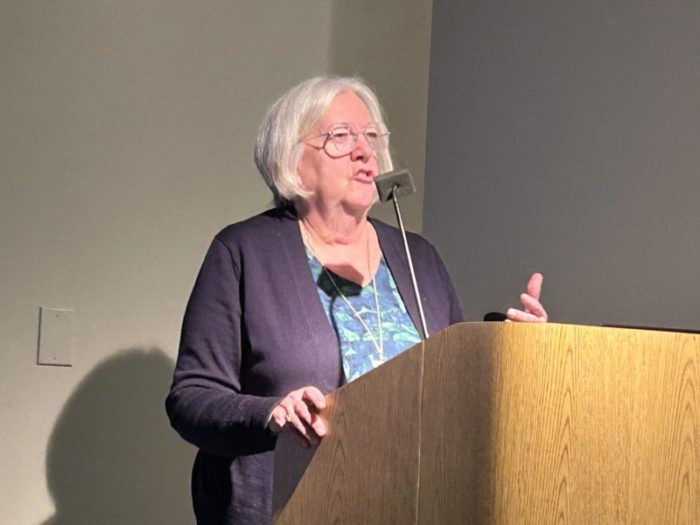
Denise Savageau
“The time I spent here,” Savageau began, “was really important in terms of understanding things that happen at the local level…When it comes down to it, it’s about what we do individually. We need to make sure people understand there are two crises happening at the same time. There’s a climate change crisis and there’s a biodiversity crisis and they’re feeding on each other…but we can’t separate these two… So, with climate change, we’re only focusing on the energy piece. How do we reduce those greenhouse gas emissions but we’re forgetting the biodiversity piece.”
“Climate change is a major driver of biodiversity, she says. “But if we lose biodiversity, we are not going to have the decomposers that are shredding, that are making us have carbon sequestration. We’re not going to have the forest that moderates the temperatures…We need to plant trees… We need to have green solutions as part of this climate change mitigation…It’s the climate modification piece like what wetlands and forests do for us.”
She praised the efforts of the Greenwich Land Trust, the Greenwich Tree Conservancy, and Audubon Greenwich…because it all starts here at the local level.” “So, one of the pieces of legislation that we’re looking to pass,” she said, “is making sure that towns are considering climate change as part of their plan of conservation and development,” and, “not just to be talking about renewables…but to be talking about the nature-based solutions. Because if I protect the forest, if I protect the wetlands, I’m also protecting flood control.”
“We want to make sure we have clean water,” she said, “and we know in Greenwich the challenges with the water supply. So how do we make sure that when we have these 20 inches of rain one day and then three months of hot dry weather, now we’re in a drought again…we need to have those green solutions.” And she added, “We need to be making sure that we can grow our own foods. If we learn nothing from the pandemic, our food system in this country is not healthy. We had food shortages because we couldn’t ship it where it needed to go. And we know that local food systems are dependent on healthy soils that sequester carbon and that promote biodiversity with all the amazing things and microbes that live in soils and macro invertebrates.
“These [connections] are really important,” she noted, “and the planning for this comes down to the local level…We always think it’s top down, but really it’s bottom up,” she ends. “So why do we need to change the legislation? It is to make sure at the state level that we’re saying this is important that all municipalities are doing this.”
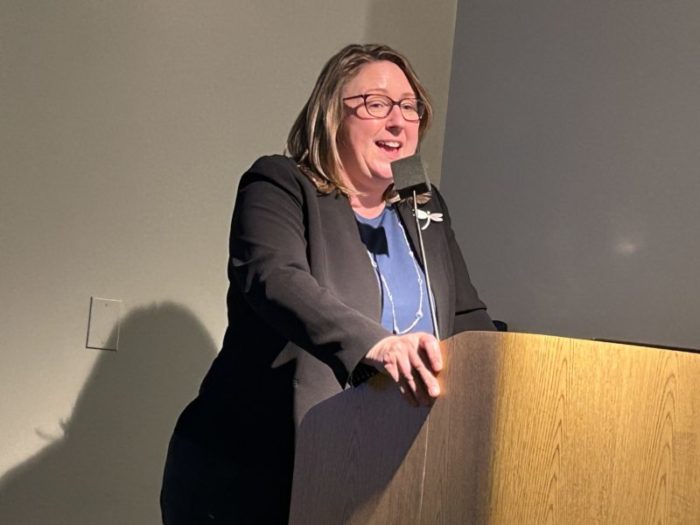
Alicea Charamut
“Our next topic is Riparian Buffers,” introduced LaFrance, “and Alicea Charamut has a long history of working on water and water related issues.” Charamut is executive director of Rivers Alliance Connecticut, serves on the advisory board of the Connecticut Institute of Water Resources, and is a co-chair of the Water Planning Council, “which Denise also works on.”
“So, stormwater has replaced point source pollution [from pipes and industrial sources] as the main source of degradation in water quality over the last few years,” Charamut began. And “more frequent rainstorms are bringing flooding and also pollution to our waterways. So, Denise started broad with ecosystem services and I’m going to focus on one particular ecosystem service that is going to help us get a handle on this and that is riparian buffers.”
A slide shows a dip in a landscape allowing for a stream channel to a lake or pond, with vegetation growing on each side. “It doesn’t have to be used for a stream,” she said. But this forested area or vegetated area is the riparian buffer.” And “As we see these high intensity storms frequency increase, they protect the stream beds from erosion, they filter pollutants from stormwater runoff.”
The buffer she explained “helps decrease your nitrogen, your phosphorus, your bacteria. It reduces flood damage because it slows storm water down and keeps all of it from going into these surface waters. It creates wildlife habitat, great for bird migration. It provides shade to streams. Temperature is pollution. I know we always think about chemicals and nutrients, but temperature pollution has serious impacts on habitat, and it does improve the aesthetic value of landscapes.”
So what are we doing in Connecticut to protect riparian buffers,” she asks? “Pretty much nothing at the state level. We are the only state in New England that does not have either a established buffer zone or minimum setbacks. Riparian Buffers does not exist in our regulatory and statutory framework. We are working to change that. And so we are proposing a task force…as a lot of folks see this as a taking of their property, and we know there’s a solution and we’ve been working on this for a couple of years now.” And to help such matters “we can create our own buffers in our backyards.” To do so visit: www.conservect.org/ctrivercoastal/resources/
Amy Blaymore Paterson
Amy Patterson was introduced as “very involved with all of the land trusts” as first executive director of the Connecticut Land Conservation Council (CLCC). She also co-chairs the Connecticut Natural Heritage Open Space and Watershed Land Acquisition Review Board.
“The CLCC is the umbrella for all of the land trusts here in Connecticut,” Paterson began. “And our mission is to elevate and strengthen land conservation here in the state…we are advocating for land conservation and we’re working to ensure that everyone everywhere has access to the benefits of nature.” But “We’re not meeting our land conservation goals by statute, the state is required to conserve 21-percent of its land area – the target to do that was 2023.” And it will take decades, she noted, “for us to meet that goal.”
“Natural and working lands are being lost at an alarming rate due to fragmentation development, invasive disease, and the impacts of climate change,” she shared. “Connecticut is heavily forested with approximately 61-percent of the land identified as forest. But 72-percent of that forest land is held in private ownership with no protection. Connecticut’s largest forests are declining rapidly. We’ve lost about 120,000 acres of core forests in the last 30 years to fragmentation and development.” Add to that, “There are other threats, whether they be invasives of non-native species disease, severe weather, including windstorms and droughts and other impacts of climate change. Local farmland is also at risk. We’ve had 23,000 acres developed or compromised in just the last 15 years, putting Connecticut in the top four states naturally nationally for the percentage loss.”
Her sad list continued. “Wildlife is struggling with more than 35 threatening endangered species of birds, mammals, reptiles, and amphibians in the state…Hence the interconnectedness between climate change and biodiversity loss. Wetlands in the state has suffered staggering losses of up to 65 percent.” Summing up, “Connecticut ranks lowest in New England and is at the bottom nationally in its combined conservation funding per capita…Nature needs us, it needs you to speak up for it.”
“The good news,” she noted, “is that there are calls to action to protect nature at every level globally.” Addressing the recent COP 28 at the UN Conference on Climate, “there was a global call to action and nature-based solutions took center stage at that conference.” And add to that, “Nationally, President Biden has issued an effective order for forest land protection, recognizing the value of mature and all growth forests. These executive orders compliment the America the Beautiful initiative, whereby countries are committing to conserve 30-percent of land and water in their countries by the year 2030.”
She named the Department of Interior as now emphasizing “nature-based solutions.” And the US Department of Agriculture “is wanting to integrate mature and old growth forest in national management plans. “So we’re seeing it globally, we’re seeing it nationally. All of us here are involved with the Governor’s Council on Climate Change. We were all members of different subgroups. I was a member of the forest subgroup, Denise, a member of the wetlands, and Alicia as well with rivers. And Robert with financing. We have been very involved.”
The next Pollinator Potluck will return to Greenwich Audubon on February 29, featuring “Cleansing Currents.”