 By Anne White
Greenwich’s suspended school-zone speed-camera program returns to Town Hall tonight at 7 p.m. with a more precise question than whether drivers should slow down near schools.
The question is whether the town can restart a program that Police Chief Jim Heavey says is working as a safety tool, while answering residents who say the cameras were introduced with too little public vetting, unclear signage, opaque appeals and lingering questions about vendors and money.
The public hearing will focus on the town’s safety plan and the school-zone cameras already installed. New cameras are not scheduled. The town’s May 8 notice says the program remains suspended but will return after state requirements are met. The hearing will not address the vendor contract or potential refunds for prior tickets, and public comments will be limited to two minutes per speaker. The town also says the session will not be a question-and-answer meeting.
Heavey, in an interview with the Sentinel on Wednesday, said the premise of the program has not changed: Greenwich drivers are going too fast, and traditional enforcement cannot be everywhere.
“Tickets are not for one or two miles over the limit,” Heavey said. “It’s for at least 11 miles over the limit.” The town’s website says the cameras record violations at a threshold of 10 mph or more over the speed limit.
If you do the math on that, it means that if you are going the normal speed limit in any zone at any time, you will not get a ticket.
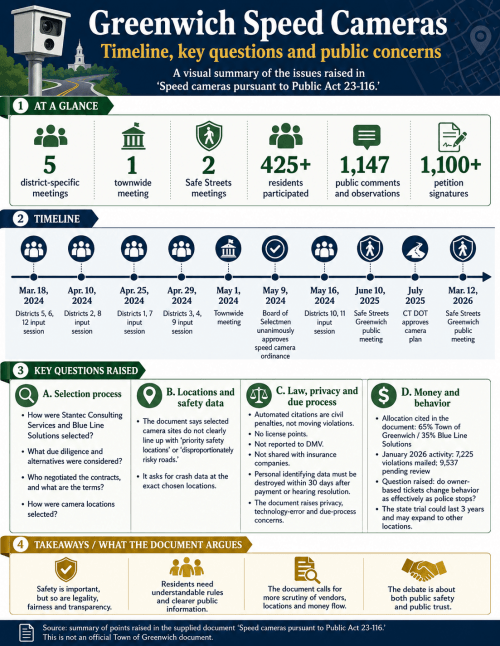
The program grew out of a 2023 Connecticut law that allows municipalities to use automated traffic enforcement safety devices in approved locations. Under state law, the devices may record images of a vehicle’s license plate, date, time and location when a vehicle exceeds the posted speed limit by 10 mph or more, or fails to stop at a steady red signal. Greenwich’s current program concerns speed in school zones, not red-light enforcement. Greenwich’s Board of Selectmen approved an ordinance in 2024.
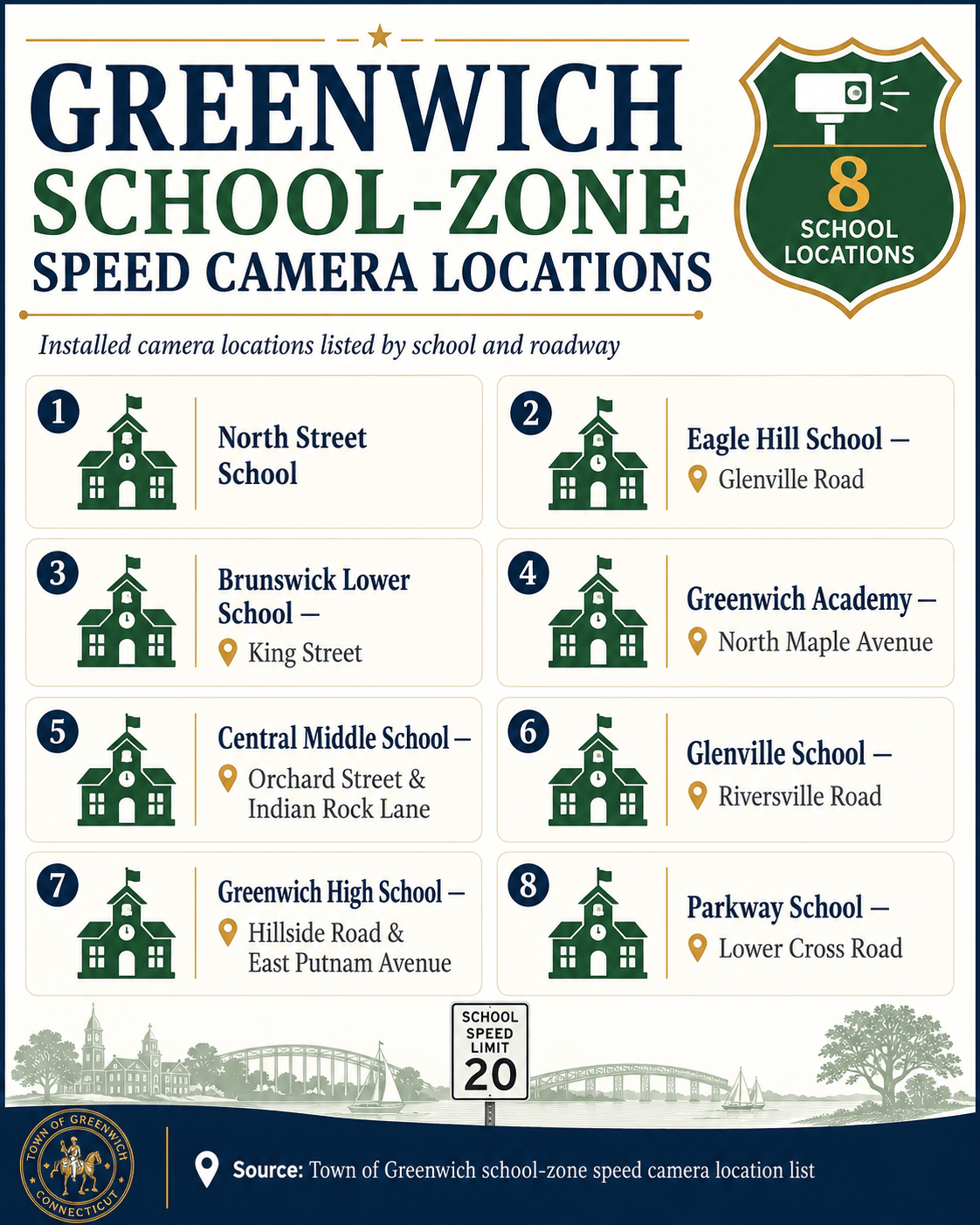
Connecticut DOT approved the town’s plan on July 7, 2025, and Greenwich is one of 15 municipalities with approved automated enforcement plans listed by CTDOT. The cameras have been installed at Central Middle School on Indian Rock Lane and Orchard Street, Glenville School on Riversville Road, Parkway School on Lower Cross Road, North Street School, Brunswick Lower School on King Street, Eagle Hill School on Glenville Road, Greenwich Academy on North Maple Avenue, and Greenwich High School on Hillside Road and East Putnam Avenue.
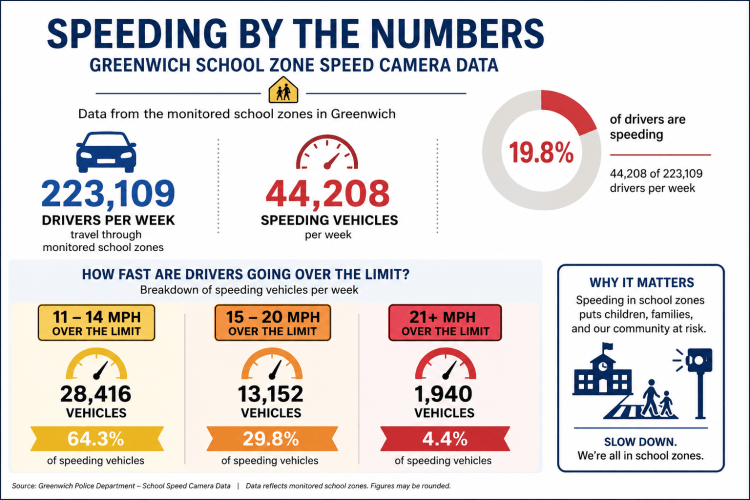
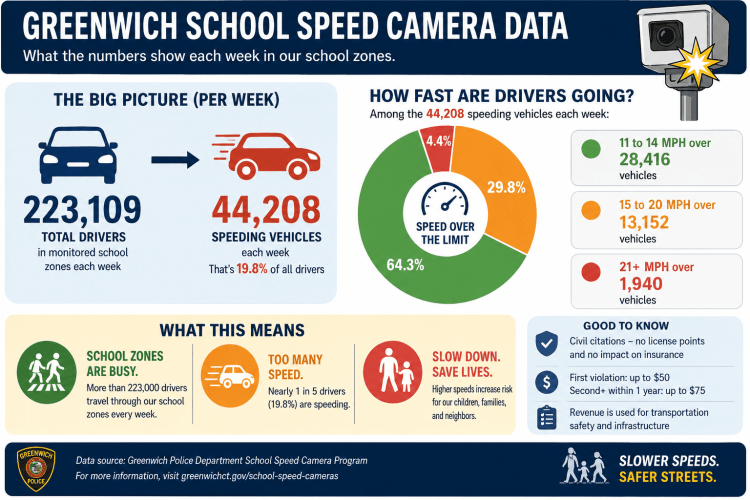
The town’s website lists those locations and says all cameras issue citations when active. The posted town data explain why police wanted the cameras. “Working together, we can achieve our Vision of ZERO: Zero crashes, Zero injuries, and Zero fatalities.” According to the Greenwich Police Department’s school-speed-camera page, the monitored school zones saw 223,109 drivers per week, including 44,208 speeding vehicles. Of those speeding vehicles, 28,416 were 11 to 14 mph over the enforceable speed limit, 13,152 were 15 to 20 mph over, and 1,940 were 21 mph or more over.
Those are large numbers for roads with children, backpacks, buses, parents, crossing guards and morning tempers. They are also large enough to make residents ask the next Greenwich question: who is paid, who reviews, who appeals and who decides?
Heavey said the vendor, Blue Line Solutions of Chattanooga, Tenn., which invested over $1 million in the camera infrastructure, is paid a $20 processing fee for each observed violation, whether or not Greenwich police ultimately approve a citation.
“If they process a hundred violations and we only issue 50 tickets, they still get $20 for every violation,” Heavey said.
That distinction matters because state law says a vendor may design, install, operate or maintain the system, but the vendor’s fee may not be contingent on the number of citations issued or fines paid. The statute also caps fines at $50 for a first violation and $75 for a second or later violation within one year, with a possible electronic processing fee of up to $15.
Heavey said the long-term goal is not revenue but compliance.
“We don’t want to make money,” Heavey said. “We want people to slow down.”
The town says mailed camera citations are civil penalties, carry no license points and do not affect insurance. The town website also says the registered owner of the vehicle is responsible for the violation and that a citation cannot be transferred to another driver.
 Heavey said each potential citation has several filters before it reaches a vehicle owner. Blue Line reviews the recorded observation first, he said. If there is doubt, obstruction or another irregularity, the vendor can reject it at that stage. The file then goes to Greenwich police for a second review.
“Once we approve that it is in fact a violation, then they get sent the violation notice,” Heavey said.
Heavey said the ticket shows the vehicle’s speed and that the system verifies both the laser calibration and whether the school-zone flashing lights were operating when the violation was recorded.
The review process is one of the main questions raised by camera critics. A resident analysis supplied to the Sentinel asks how much time officers spend on each review, how many tickets an officer reviews per day and whether the electronic system creates an assumption that the machine is right. The same analysis says residents have been confused by the school-specific speed schedules and enforcement windows, and it calls for clearer signage because each school can have different normal speeds, reduced speeds and active times.
That document also argues that the public process did not give speed cameras the attention they deserved before the program was adopted. It says Greenwich held five district-specific traffic and pedestrian safety meetings, one townwide meeting and two Safe Streets meetings, with “over 425 Greenwich residents participating in Town-hosted in person and virtual meetings” and “1,147 comments and observations from the public.” It then says there was “little overt discussion of speed cameras during the recorded meetings.”
The Northeast Greenwich Association has made a similar argument in more formal language. In a statement provided to the Sentinel, the group said it shares the town’s commitment to traffic safety and acknowledges speeding as a legitimate concern. It also said “support for safety objectives should not be understood as blanket approval” of the current program or how it was adopted.
It said its criticisms were directed at policy and implementation, not individual public servants, and wrote, “Raising difficult questions should not be conflated with hostility or bad faith.”
Heavey said the town’s proceeds must be used for traffic safety. State law says money received by a municipality from fines must be used to improve transportation mobility, invest in transportation infrastructure improvements or pay costs associated with automated traffic enforcement devices.
Heavey said possible uses include education, engineering and enforcement, including flashing crosswalk signs that residents often request. He said that spending would require approval through the town budget process.
The town suspended the program in April after an internal review found the approval process had not been completed entirely as required. The town said a public hearing and additional local approval were necessary before implementation. It also said most complaints had been found without merit, while some led to further evaluation.
First Selectman Fred Camillo, in an interview with the Sentinel on Wednesday, said a town study and years of complaints to the Board of Selectmen showed that speeding is a major local issue, especially around schools. “Speeding is one of the major issues in town,” Camillo said.
Camillo said conversations with residents, including members of the Northeast Greenwich Association, have been helpful. He said most people agree that action is needed, while differing over the details of automated enforcement.
On the procedural issue, Camillo said the town is using tonight’s meeting to fulfill the public-hearing requirement for the safety plan. “It’s not about tickets,” he said. “It’s about the safety plan.”
The pause, he said, is also being used to improve the program. Camillo said the town is looking at clearer signage, including signs showing hours of operation. He said the cameras will return.
“They’re going back on,” Camillo said. “It’ll be tweaked, it’ll be better.”