By Frank Scarpa
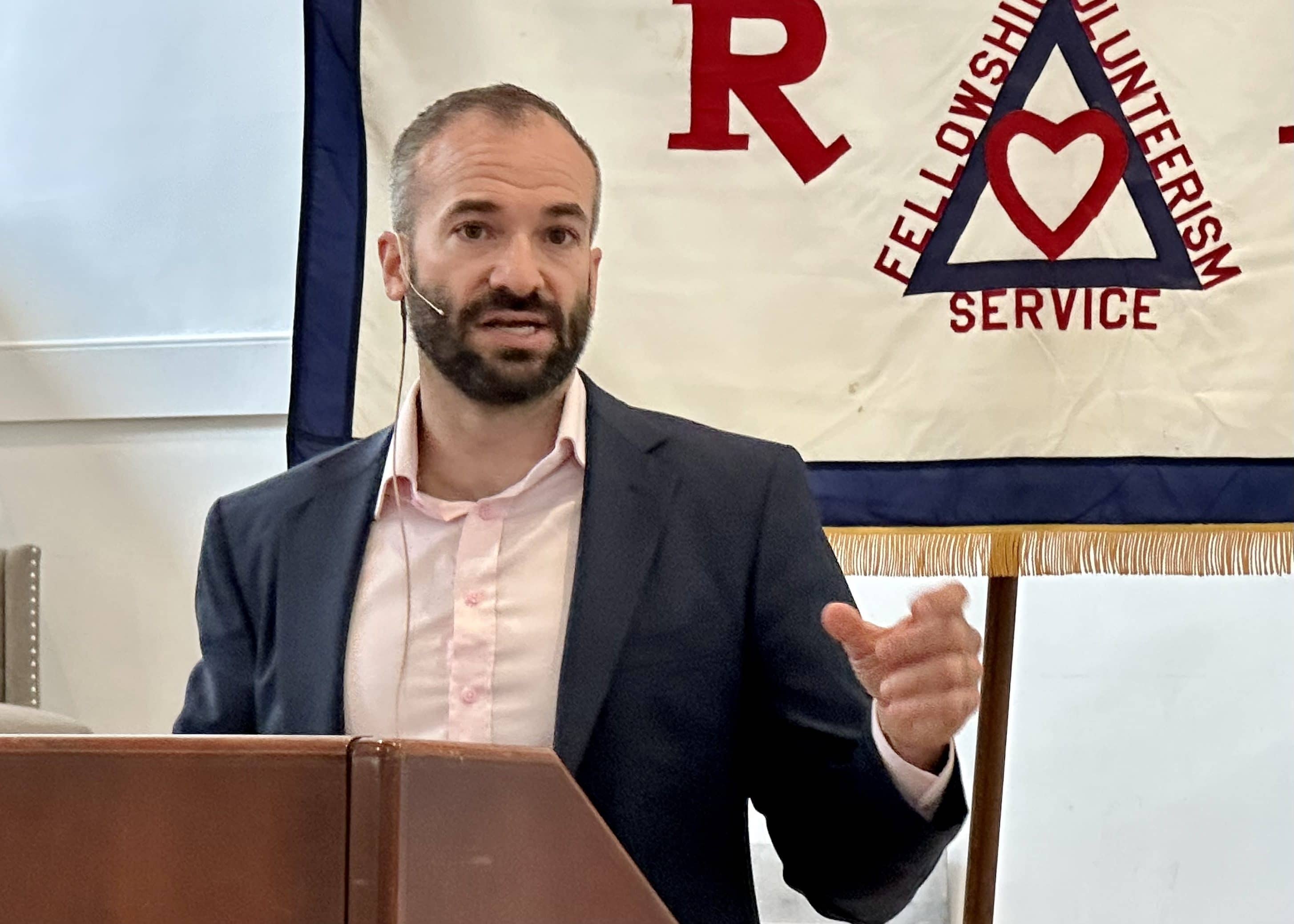
At the April 29 meeting of the Retired Men’s Association Bob Rimmer introduced speaker Jeffrey P. Rogg, PhD, JD, Senior Research Fellow at the University of South Florida’s Global and National Security Institute. Jeff holds a B.A. in Latin and ancient history from Swarthmore College and a JD from Villanova, an MA in security studies from Georgetown, and a PhD in history from Ohio State University. He is vice-president of the Society for Intelligence History and associate editor of the journal, Intelligence and National Security. His book, “The Spy and the State: The History of American Intelligence,” was published in 2025 and was the basis of his talk.
Dr. Rogg, an intelligence historian, addressed the audience with a singular mission: to reinsert the spy into the mainstream narrative of American history. He argued that if we truly wish to understand the birth of the United States, we must first understand the clandestine world that shaped its survival.
The speaker began with the haunting figure of Nathan Hale, a name familiar to many but often stripped of its strategic context. Standing outside the Yale Club in New York City years ago, Rogg found himself struck by a plaque commemorating the execution of Hale, a Yale graduate of the class of 1773. He reminded his audience that while Hale is now honored with a statue at CIA headquarters in Langley, his intelligence mission was actually a total failure. Hale’s relevance today lies in his internal conflict; he was an officer who initially hesitated to take on a role he considered dishonorable, eventually concluding that any service necessary for the public good becomes honorable by that very necessity.
Before the Continental Army had even fully formed, intelligence was already acting as a catalyst for war. Jeffrey Rogg spoke of the Mechanics, a shadowy artisan intelligence network including the silversmith Paul Revere, who met at the Green Dragon Tavern to monitor British troop movements. However, the revolution was nearly strangled in its crib by Benjamin Church, a leading figure with colonial roots who was secretly feeding information to the British military governor, Thomas Gage. Church’s betrayal was discovered only after a coded letter was intercepted in Newport, revealing that Gage had used the traitor’s intelligence to target the munitions depot at Concord—an act that sparked the first shots of the war.
The human cost of these operations was sometimes measured in blood rather than secrets, as seen in the story of Samuel Whittemore. Rogg recounted how the eighty-year-old Whittemore grabbed his rifle to fight the British during their retreat from Concord, surviving multiple bayonet wounds and a shooting only to live until the age of ninety-eight. While soldiers fought in the fields, the Continental Congress worked to codify the risks of the secret war, passing a resolution in 1775 that ordered the death penalty by hanging for those providing intelligence to the enemy.
Across the Atlantic, the American effort to secure a French alliance was a complicated mess of mutual suspicion. Dr. Rogg introduced the audience to Silas Deane and Arthur Lee, two diplomat-spies who famously loathed one another. Deane was an operative who leaned into covert action, paying the saboteur James Aitken—historically known as John the Painter—to firebomb British dockyards. Meanwhile, Lee’s paranoia led him to distrust even Benjamin Franklin; yet both men were oblivious to the fact that their own secretaries, such as Edward Bancroft, were British informants. This environment of secrecy also birthed the first American leak of classified information when Thomas Paine, serving as a secretary for the committee, published a pamphlet that exposed French aid to the American cause, nearly costing the colonies their most vital alliance.
The figure who best synthesized these chaotic elements was George Washington. Dr. Rogg described a commander-in-chief who was obsessed with secrecy, recruiting Quakers like Robert Townsend to serve in the Culper Ring and even encouraging the interception of mail (considered a radical ethical violation in those times). Washington’s most successful intelligence operation was his ultimate deception: making the British believe he intended to attack New York City when his target was always Yorktown. Supporting this domestic front was John Jay, who led a committee tasked with detecting and defeating conspiracies. Rogg noted that Jay, later the first Chief Justice of the Supreme Court, operated a counterintelligence system that lacked due process, fueled by the zeal of everyday citizens who were eager to report their neighbors as British spies.
The speaker concluded by linking this history to the birth of the American spy novel. He recounted how James Fenimore Cooper wrote “The Spy” after hearing stories from his family friend, John Jay, about a double agent named Enoch Crosby. Even as the book became a bestseller, the American public remained uncomfortable with the “meanness” associated with espionage. Rogg observed that this contradiction—loathing the spy while relying on their work—remains a defining feature of the American character, echoing Washington’s own words that the most delicate secrets of the revolution would remain confined to the perishable remembrance of the few.
Jeffrey Rogg then hosted a lively Q and A session, which included topics like “Wild Bill Donovan” and the founding of the CIA, the concept of Westchester County as “neutral ground” during the Revolution, and the ongoing disputes over the ethics of surveillance.
The talk can be viewed by going to the RMA website at https://greenwichrma.org, clicking on “Speakers,” then “Past Speakers,” and then “RMA Vimeo Library.”
The RMA’s next presentation, “Family Centers Inc.: Driving Results for Greenwich and Beyond for over 135 Years” by Louis Josephson, Dennis Torres, and John Midy, is scheduled for 11 AM on Wednesday, May 13, 2026. RMA presentations are held at Christ Church Greenwich, Parish Hall, 254 E. Putnam Avenue, Greenwich, CT 06830.
In this presentation three representatives of Family Centers in Greenwich will cover a short history of the Centers to set the stage for its current service model, operating a federally qualified health center that provides medical, mental health, and dental care to our most vulnerable residents. They will also discuss plans and strategies for the next decade.
Louis Josephson, PhD, is President and CEO of Family Centers Inc. He is a clinical social worker who began his career in New York City as a therapist, then moved into leadership roles at mental health and social services organizations in New York, Boston and Los Angeles. He holds a BA from Tufts University, a MSW from Columbia University, and a PhD in Social Work from NYU.
Dennis Torres, JD, LCSW, is the Chief Health Officer at Family Centers Inc. With nearly 30 years of leadership experience in the nonprofit and healthcare sectors, he oversees school-based health clinics, behavioral health services, HIV programming, and early childhood health consulting serving communities across lower Fairfield County. He holds degrees from SUNY Fredonia, Pace University School of Law, and Columbia University.
John Midy, MBA, is the Director of Medical/Dental at Family Centers, overseeing integrated programs that expand access to high-quality care for a diverse patient population. In 2025, he played a pivotal role in supporting the expansion of integrated medical services in collaboration with Greenwich Hospital and Yale New Haven Health. He serves as Co-Chair of the Access Committee for the Greenwich Community Health & Improvement Partnership, addressing regional strategies. John holds an MBA from Quinnipiac University and brings a multidisciplinary background in healthcare, finance, and higher education.
The Center website is https://familycenters.org/.
To stream the presentation on Family Centers at 11 AM on Wednesday, May 13, click on https://bit.ly/30IBj21. This presentation will also be available on local public access TV channels, Verizon FIOS channel 24 and Optimum channel 79.
Note: The views expressed in these presentations are those of the speakers. They are not intended to represent the views of the RMA or its members.
RMA speaker presentations are presented as a community service at no cost to in-person or Zoom attendees, regardless of gender. Any member of the public who would like to receive a weekly email announcement of future speakers should send a request to members@greenwichrma.org. The RMA urges all eligible individuals to consider becoming a member of our great organization, and thereby enjoy all the available fellowship, volunteer, and community service opportunities which the RMA offers to its members. For further information, go to https://greenwichrma.org/, or contact info@greenwichrma.org.