By Brian Brady
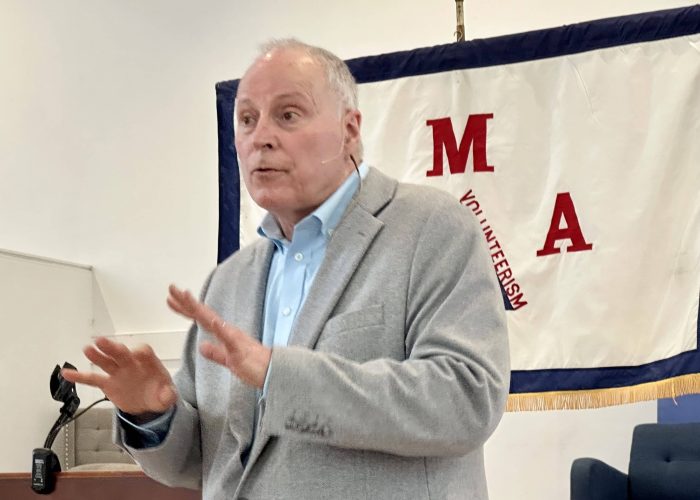
The speaker at the Retired Men’s Association on April 15 was author and music critic Lawrence Schulman. After a brief introduction by his close friend and colleague David Parker Pengilly, Schulman first thanked the RMA, and Tim Brooks in particular, for inviting him for a third visit. In recent years, Schulman has written about a variety of popular music artists inside and outside the Great American Songbook. He stated his interest in many kinds of music, including classical, and at this point in his life, he has written more about those other artists than about his original focus, Judy Garland, about whom he authored two volumes in 2023. After thirty years of writing about Garland for the ARSC Journal—the publication of the Association for Recorded Sound Collections—he found a new sense of liberation. His recent books, Free and Unfettered, both subtitled Words on Music by a Hi-Fi Critic in an MP3 World, signaled a departure from the 1930s and 40s toward what he calls “new standards.” Schulman asked us for a spirit of openness towards pop music that may be totally alien to us, but at the same time “rest assured, I will not be showing Taylor Swift or Bad Bunny.”
Schulman offered a philosophy that good music has no era. He began with Paul McCartney, the former Beatle who, at age 70, recorded a ballad titled “My Valentine.” Schulman explained that the song, dedicated to McCartney’s wife Nancy Shevell, utilizes the classic 32-bar AABA format favored by legendary composers like Cole Porter and Jerome Kern. Watching a live performance taped at Capitol Records, the audience saw McCartney supported by a group of elite jazz musicians, including the world-renowned pianist Diana Krall and the virtuoso guitarist John Pizzarelli. For Schulman, this was a “UFO of a Song”—a piece of artistic excellence that could have been written a half-century earlier but was born in 2012.
The presentation then shifted to Carly Simon, whom Schulman had recently profiled in an article for the spring 2026 issue of the ARSC Journal. He championed her performance of “Coming Around Again” at Grand Central Terminal in 1995 as a moment of “monumental interpretation.” Simon, who rose to fame in the 1970s with hits like “You’re So Vain” and “Anticipation,” demonstrated what Schulman called an “unearthly, rich voice.” He argued that her work, particularly when performed in such an extraordinary venue, deserved the same scholarly respect as the classic standards.
Perhaps the most challenging figure for the Greenwich audience was Amy Winehouse, the British soul singer who died of alcohol poisoning at the age of 27. Schulman presented her 2007 American television debut on the Late Show with David Letterman, where she performed her signature hit, “Rehab.” He noted that her breakout album, Back to Black, had been selected in 2025 by the Library of Congress for the National Recording Registry, cementing its status as culturally and historically significant. He described her as an “unclassifiable artist” who seamlessly blended Motown, Jazz, and Hip-Hop into a sound that was both hypnotic and troubling.
Schulman moved on to a discussion of George Michael, the Wham! frontman who died in 2016, recounting a “cosmic connection” that Michael made with the 1984 hit “Everything She Wants.” He also highlighted Michael’s live version of “Calling You,” a haunting song by Bob Telson from the 1987 film Bagdad Cafe, which has been covered by artists ranging from Barbra Streisand to Natalie Cole.
The session concluded with the flamboyant Australian singer-songwriter Peter Allen, the first husband of Liza Minnelli. Schulman, who has written a book about Allen, analyzed Allen’s 1980 track “Bi-Coastal,” co-written with the prominent producers David Foster and Tom Keane and engineered by the legendary Humberto Gatica. Schulman viewed the song’s infectious disco beat as a “somber prelude” to the tragedy of the AIDS crisis that would soon devastate the artistic community.
In the Q&A, Schulman was asked if he had considered artists like Lady Gaga, whom he admitted had a “good voice” but had yet to make it into his “gut,” for selections to explore and highlight. He reflected on other artists he admired, such as the folk-experimentalist Tim Buckley and the country icon Patsy Cline, who, like Winehouse, were taken too soon. Quoting Duke Ellington, Schulman reminded those gathered that there are only two kinds of music: “Good music and the other kind.” He urged his audience to remain “young at hearing” leaving behind the “cobwebs of history” to find the beauty in the music of today.
The talk can be viewed by going to the RMA website at https://greenwichrma.org, clicking on “Speakers,” then “Past Speakers,” and then “RMA Vimeo Library.”
The RMA’s next presentation, “The Spy and the State: The History of American Intelligence” by Jeffrey P. Rogg, PhD., JD, is scheduled for 11 AM on Wednesday, April 29, 2026. RMA presentations are held at Christ Church Greenwich, Parish Hall, 254 E. Putnam Avenue, Greenwich, CT 06830.
Dr. Jeffrey Rogg will present a history of American intelligence services from the Revolutionary War to the present day, as part of the year-long celebration of programs in Greenwich commemorating America’s 250th birthday. Dr. Rogg explores the origins and evolution of intelligence in America, including its overlooked role in some of the key events that shaped the nation and the historical underpinnings of intelligence controversies that have shaken the country to its constitutional core.
Jeff is a Senior Research Fellow at the University of South Florida’s Global and National Security Institute. Previously, he was an assistant professor at the Joint Special Operations University (U.S. Special Operations Command) and The Citadel. He was also a postdoctoral fellow in the National Security Affairs Department at the U.S. Naval War College. He is vice-president of the Society for Intelligence History and associate editor of the journal, Intelligence and National Security. He recently joined the Jack Miller Center’s network of scholars, which is dedicated to teaching America’s founding principles and history. His work has appeared in several academic journals and volumes as well as media such as The Wall Street Journal, The Washington Post, The National Interest, The Hill, and the Los Angeles Times. His book, The Spy and the State: The History of American Intelligence, was published in June 2025.
Jeff has a BA in Latin and ancient history from Swarthmore College, a JD from Villanova University School of Law, an MA in security studies from Georgetown University, and a PhD in history from The Ohio State University. He served six years in the Massachusetts Army National Guard as an infantryman.
To stream the presentation by Jeffrey Rogg at 11 AM on Wednesday, April 29, click on https://bit.ly/30IBj21. This presentation will also be available on local public access TV channels, Verizon FIOS channel 24 and Optimum channel 79.
Note: The views expressed in these presentations are those of the speakers. They are not intended to represent the views of the RMA or its members.
RMA speaker presentations are presented as a community service at no cost to in-person or Zoom attendees, regardless of gender. Any member of the public who would like to receive a weekly email announcement of future speakers should send a request to members@greenwichrma.org. The RMA urges all eligible individuals to consider becoming a member of our great organization, and thereby enjoy all the available fellowship, volunteer, and community service opportunities which the RMA offers to its members. For further information, go to https://greenwichrma.org/, or contact info@greenwichrma.org.