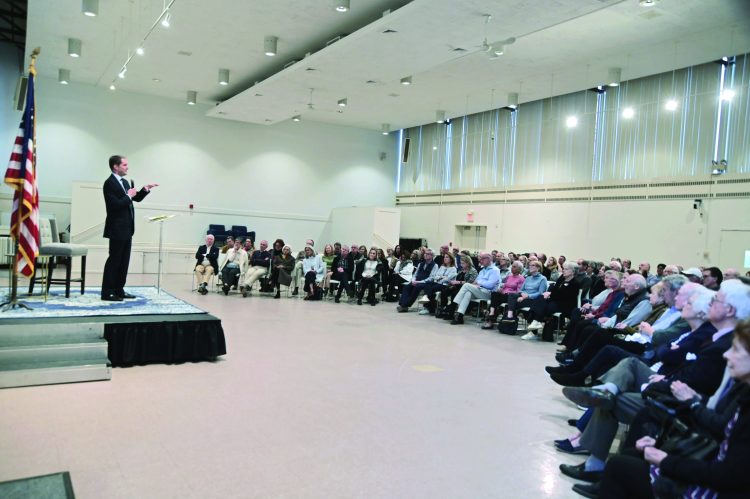
Congressman Jim Himes told the audience at Christ Church Greenwich that the United States is entering a more volatile global era defined by rising competition with China, unpredictable conflicts in the Middle East, and growing economic and technological pressures at home.
Himes, a Democrat representing Connecticut’s Fourth District and the ranking member of the House Permanent Select Committee on Intelligence, spoke for nearly an hour Monday evening in a discussion hosted by Rector Marek Zabriskie and followed by a wide-ranging question-and-answer session with residents.
The event drew dozens of community members to the church parish hall for a conversation on global security, U.S. foreign policy, and the broader question posed by the evening’s theme: whether the United States is more or less secure than it was a decade ago.
“We’re in a very different world than any of us grew up in,” Himes said. “Most of us grew up in a bipolar world: the United States and the Soviet Union. That obviously collapsed in 1989 into a unipolar moment when, for a brief period of time, the United States was the colossus astride the globe.”
That era has ended, he said, replaced by a geopolitical landscape in which China is emerging as a near-peer competitor while regional conflicts and technological disruption create new risks.
The congressman began his remarks by addressing the recent U.S. and Israeli military actions targeting Iran, describing Tehran as a destabilizing force in the Middle East while also warning that military interventions in the region have often produced unpredictable results.
“It’s hard to think of a regime as evil or as destabilizing or as dangerous, particularly to the state of Israel but to the region and to the world, as Iran,” Himes said.
At the same time, he cautioned that history offers few examples of successful military interventions in the Middle East. “No one in this room can name for me an example of military intervention in the Middle East that ended up going quite the way we would want,” he said.
Himes argued that policymakers often underestimate the difficulty of determining how military conflicts end and what political conditions follow.
“Even when you can affect militarily your military goals, there are two very difficult questions: how do you get out and what comes next,” he said.
Drawing on his role in intelligence briefings with senior national security officials, Himes described internal debates over the rationale for the recent strikes and their potential consequences, including instability in energy markets and the possibility that Iran may accelerate efforts to obtain nuclear weapons.
“The enemy gets a vote on this,” he said. “Just because the United States declares victory and goes home doesn’t mean that the Iranians say this is done.”
He also warned that the conflict could strengthen Iran’s determination to pursue nuclear deterrence.
“If you’re sitting in Tehran looking at what just happened, you might conclude that the one thing that prevents a conventional military attack is nuclear weapons,” Himes said.
The congressman broadened his remarks to examine global security trends, particularly the growing strategic rivalry with China.
While the United States remains militarily dominant, he said the most significant competition may occur in technology and innovation rather than traditional military strength.
“We spend a trillion dollars on our national defense every single year,” Himes said. “If you add the Russian and Chinese military budgets, you don’t get half of that number.”
Yet technological leadership, he said, will likely determine the long-term balance of power.
“It’s really, really important that we be on the technological forefront,” Himes said, citing artificial intelligence, bioscience, and quantum computing as fields that could reshape global power.
During the question-and-answer portion of the event, audience members raised concerns ranging from cybersecurity threats to the potential for future conflicts with China, Russia, or countries in Latin America.
One attendee asked about rising oil prices following the Iran conflict and whether the situation could benefit Russian President Vladimir Putin.
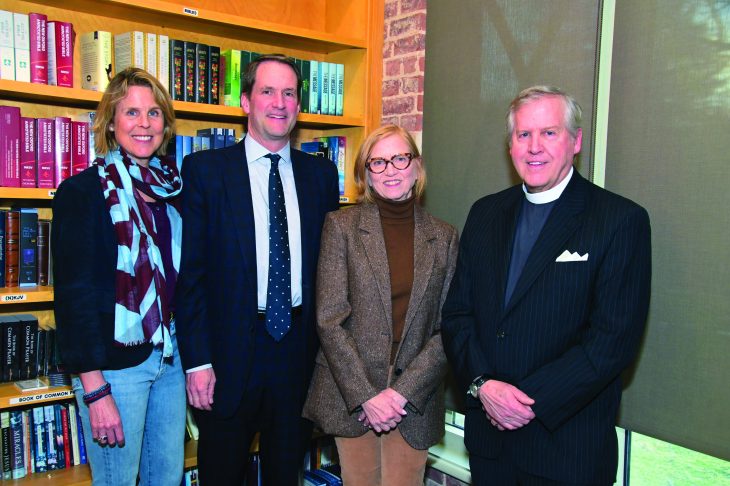
Himes acknowledged that higher energy prices could provide economic advantages to Russia but said the broader dynamics of the war in Ukraine are unlikely to change dramatically.
“The Russians are expending a thousand dead soldiers for every couple hundred yards of territory that they take,” he said. “That fundamental dynamic isn’t going to be radically altered.”
Another audience member asked whether China might move militarily against Taiwan while the United States remains focused on other global conflicts.
Himes said Beijing is carefully weighing the risks of confronting the U.S. military.
“If you’re Xi Jinping, you are commanding an army that hasn’t fought a war in decades,” he said. “And you’re looking at what the United States military can do.”
Immigration also surfaced as a national security topic when an audience member asked how immigration affects America’s global leadership.
Himes argued that immigration has historically strengthened the country’s economic and technological innovation.
“Show me a technology company and I bet you it’s led by a first- or second-generation immigrant,” he said.
He emphasized that the United States must balance secure borders with a welcoming immigration system.
“We are a nation of immigrants,” Himes said. “That is who we are.”
Zabriskie said the church hosted the event as part of its mission to encourage civil public discussion.
“As a faith community, we are committed to thoughtful, civil dialogue and open to voices and perspectives from all sides of the important civic conversations,” Zabriskie said.
Himes closed the evening by noting that global challenges—from technological competition to economic disruption— will shape American security as much as traditional military threats.
“We really need to keep our innovative capacity,” he said. “Right now we are doing China’s strategic work by whittling away at that innovative capacity.”