By Anne W. Semmes
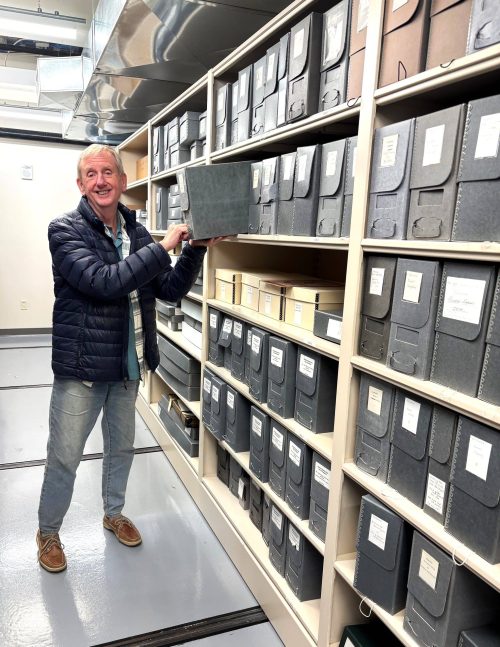
Since 1931 the Greenwich Historical Society has been collecting thousands of ephemera, those “items of collectible memorabilia…typically written or printed …originally expected to have only short-term usefulness or popularity.” As of Friday week, a first time and intriguing selection has been laid out on tables in its Archive Library, with docent-led tours ongoing to March 28.
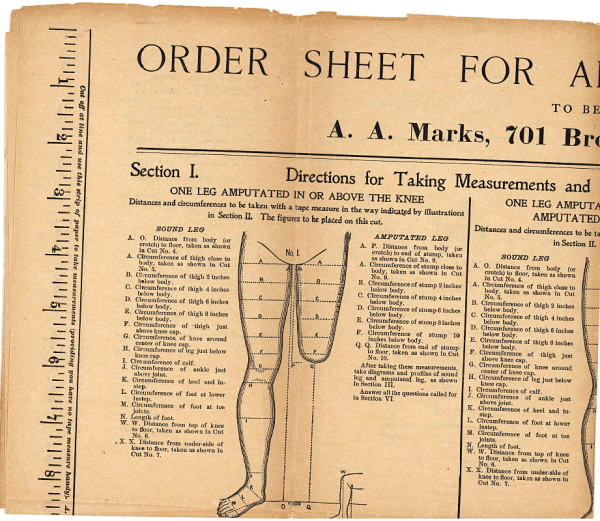
“I’m excited to give our first ever tour of this brand-new exhibit,” began Docent Ellery Leary. “There’s so much to read of a lot of printed material because that’s kind of what ephemera is…But we should all wash our hands – it’s about the oil in your hands being destructive.” And yes, take care with that delicate tissue-like “Order Sheet for Artificial Limbs” revealing an extraordinary Old Greenwich entrepreneur.
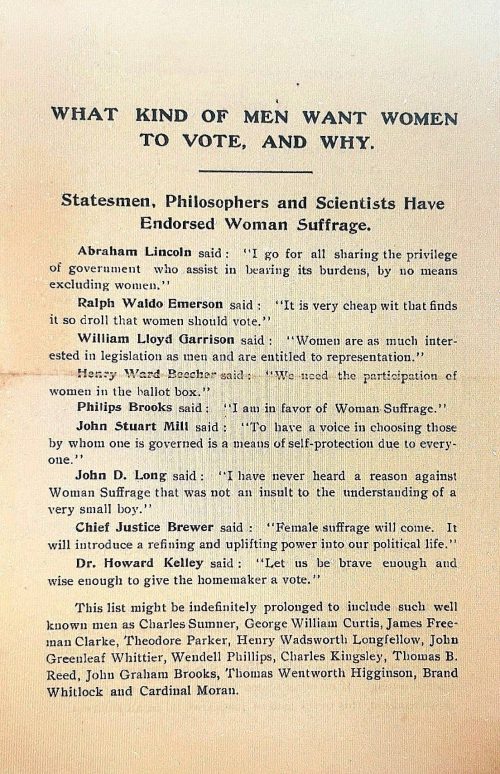
“And did you know,” Leary continued, “there was an exact replica of the Petit Trianon in Versailles on North Street,” so pictured on an invitation to a “Mystery Club” event. But it was that “League of Women Voters – Government Pattern – Connecticut Style” pamphlet that captivated. “It’s sort of framed as being about sewing!” said Leary. Dated 1949, it read, “The pattern of government should fit and suit every woman who sews,” bringing laughter from onlookers as did another nearby leaflet entitled, “What Kind of Men Want Women To Vote, and Why?”
Other surprises – an 1884 illustration of the Indian Harbor Hotel (now the Indian Harbor Yacht Club” announcing its new season opening in June. A knockout 1975 “Greenwich Audubon Bicentennial Trail Book” with its American flag design cover, and full of “Trails For Walking…Riding…Biking.” And just where is the John Sargent Woodland?
Leary noted, how with ephemera, “It’s seeing the prices of things, how they go up over time.” Surely seen in “The Pickwick Hotel Menu” with a full Shore Dinner costing $4.75!
Definitely eye catching was that 1920 invitation to a Havemeyer Auditorium concert featuring “The Celebrated and Unequalled Interpreter of Songs,” Yvette Guilbert! And at the present time there’s a push to bring back that original Havemeyer auditorium performing history!
What surprised Leary was coming across a 1994 retrospective exhibit program on puppeteer Jim Henson. “I had not known that Jim Henson lived in Greenwich,” he told. “You know he lived in the house of [painter] John HenryTwachtman.”
But Leary noted that the ephemera on exhibit was not all “the most beautiful things,” including that monkey valentine card he found “a little unsettling.” “You don’t want to give people the impression that everything in the past was more beautiful. We also have laid out much more workman-like plain ephemera.”
Fellow docent Kate Loh was finding attendees ‘drawn in deeper than they thought.’ You know, we all forget things.” She loved the memorabilia from the Pickwick Arms Hotel. “That was a favorite of mine as a child. My grandparents used to come and stay there.” She also cited the souvenirs from “places no longer here like the Clam Box or Outdoor Traders.”
With some visitors on their way to the next-door Bush-Holley House exhibit, they had found related items of ephemera. “There are actually records and correspondence from the Holley House,” told Loh, “and members of the family writing back and forth to each other.”
What had gripped Loh was discovering that “Order Sheet of Artificial Limbs” with its diagram and pictures of artificial limbs. She learned that a Mr. Abraham Mark of Old Greenwich had discovered on his estate “Willowmere” that his willow trees offered “a light-in-weight hardwood… which is an advantage for a prosthetic.” Mark would create a sawmill by Willowmere Lake… He would saw the willow trees…fashion a limb and load them up on a barge that sailed from Greenwich into New York City where his store was, and there they would finish off the prosthetic. He did this as a result of so many injuries from the war.”
“He was the go-to prosthetic man,” Loh learned. “What he did was to champion the cause that you need to take a look at the prosthetic and how it needs to work before you do your surgery. Because the way you do an amputation would be different based on the type of prosthetic. He transformed the way the surgeries were performed. They would look at the end result first and then work backwards. I thought that was really interesting.”
With the number of fascinating items on display both Docent Loh and Docent Leary had addressed what might happen to all that ephemera in this digital age. Leary had touched on how the next generation would deal with their family ephemera. Might they engage with “Swedish Death Cleansing” in their decluttering?
“Something to think about with ephemera,” said Docent Loh, “is the impact technology is having on it. So many things are created and stored digitally – evites, pictures, correspondence. In the future will they exist? If so, might they have been modified. What does that mean for history?”
The “Behind the Scenes Ephemera Tour” at the Greenwich Historical Society will continue to March 28.