 Memorial Day asks Greenwich to do something simple and difficult: remember the dead with the seriousness their sacrifice deserves.
The holiday has become, for many, the threshold of summer. Families gather. Boats return to the water. Grills are lit. School calendars begin their descent toward June. There is nothing wrong with any of it. A free people should know the blessings of ordinary days. But Police Chief Jim Heavey, a Veteran, reminds us regularly that the day itself is not ordinary. It is not Veterans Day. It is not a general salute to service. It is a day set aside for those who died in war defending the United States.
Greenwich has never lacked for ways to remember. At Town Hall, the names of local service members who died in uniform stand as a civic ledger, engraved not only with loss but with obligation. Each name represents a life, a family, a neighborhood, a school, a church, a set of friends, a place at a table that was never filled again. The town’s duty is to keep those names from becoming mere inscription.
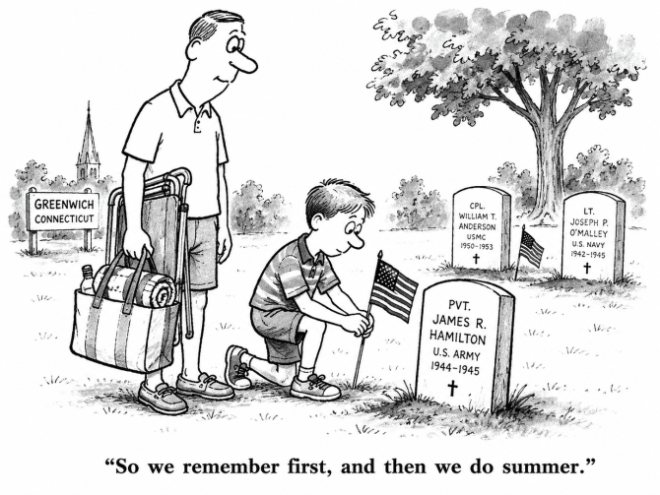
That duty is carried out in public ceremonies, but it is also carried out in smaller acts. One of Greenwich’s most important traditions is the placement of American flags at veterans’ graves before Memorial Day, led by American Legion Post 29 and carried out with help from local Girl Scouts and Boy Scouts. The gesture is important because it teaches reverence by participation. Children learn that citizenship is not only learned in classrooms or invoked in speeches. It is practiced, grave by grave, name by name.
Two members of the Greenwich Police Department died while serving in World War II. Police Officer Bernard McGillian, a rookie officer hired in January 1943, left Greenwich to serve in the U.S. Army Air Corps. He was killed in action in the Pacific on June 5, 1945, when his B-29 aircraft failed to return after a mission over Japan.
Police Captain John Trufel had joined the Greenwich Police Department in June 1926 and later commanded the detective division. He entered the U.S. Army at age 42 and was killed in Germany on May 8, 1945, the day of Victory in Europe. The date is almost unbearable in its poignancy: peace declared, victory marked, and one Greenwich life ended in its final hour.
McGillian and Trufel wore the uniform of this town before they wore the uniform of the nation. They knew Greenwich streets before they knew war zones. Their service connects the local and the national in the most direct way.
The work of Memorial Day is therefore more demanding than attendance. It asks for instruction. It asks parents to tell children why flags appear in cemeteries. It asks public officials to preserve ceremonies without turning them into routine. It asks residents to choose remembrance even when the holiday calendar offers easier pleasures.
Greenwich should enjoy the long weekend. But it should first keep faith with the reason the weekend exists.
Chief Heavey calls it a Memorial Day challenge: spend time with friends and family, but also take part in at least one of the town’s acts of remembrance. That is sound counsel. A parade, a wreath-laying, a cemetery visit, a pause at Town Hall—these are modest acts, but civic life depends on modest acts performed with fidelity.
Memory is not self-sustaining. It must be renewed by each generation, or it recedes. Memorial Day gives Greenwich a chance to renew it with discipline and gratitude.
The dead do not ask much of us. They ask only that we remember what they gave and why they gave it.