By Elizabeth Barhydt
Greenwich’s own Frank Murray has many remarkable stories to tell. This one is almost unbelievable. Yet it is all true.
Baseball’s origin story will be challenged at the National Baseball Hall of Fame this Memorial Day weekend when handwritten 1857 rules, once dismissed as curiosities and stored for years in Frank Murray’s desk drawer, go on display in Cooperstown.
The documents, known as the “Laws of Base Ball,” are scheduled to be formally unveiled Friday, May 22, in the Hall of Fame’s Taking The Field exhibit. Their debut comes one day after this newspaper’s Memorial Day issue reaches readers, giving the story a rare kind of timing: a new public display of very old paper, and a renewed argument over the authorship of the game Americans think they already know.
The exhibit has also drawn national notice this week. The New Yorker published Ben McGrath’s account of Murray’s campaign online May 18 for its May 25 issue, giving fresh attention to a collector’s long effort to change how baseball assigns credit for its own beginnings.
Murray is expected in Cooperstown this weekend for an unveiling that he sees as more than a museum event. To him, the documents are evidence in a long-running case. The question is whether Alexander Cartwright, whose Hall of Fame plaque calls him the “Father of Modern Base Ball,” should still be credited with establishing nine innings, nine players to a side and 90 feet between bases — or whether that honor belongs chiefly to Daniel Lucius “Doc” Adams, a physician, Knickerbocker club president and early baseball organizer who left a heavier paper trail, one that is arguably more compelling.
Murray’s case is that the Cartwright attribution is simply wrong.
Murray’s tone can be playful, but his argument is not. The old papers, in his reading, do not merely add detail to baseball’s beginnings. They move the authorship of the modern game away from a familiar figure to the man who chaired the 1857 convention, wrote the first draft of the rules and spent years hand making the equipment that allowed the game to become standardized.
Baseball has always preferred a clean creation story. The sport once gave Abner Doubleday a pasture in Cooperstown and a myth to go with it. Later, Cartwright became the more respectable founder, the Knickerbocker associated with the diamond, with order, with New York baseball’s rise over older bat-and-ball games. But games do not usually arrive whole. They accrete. They are argued into shape by committees, players, scorers, captains, secretaries, men with ink on their fingers and calloused hands from making equipment that is the same for everyone playing (i.e.: fair).
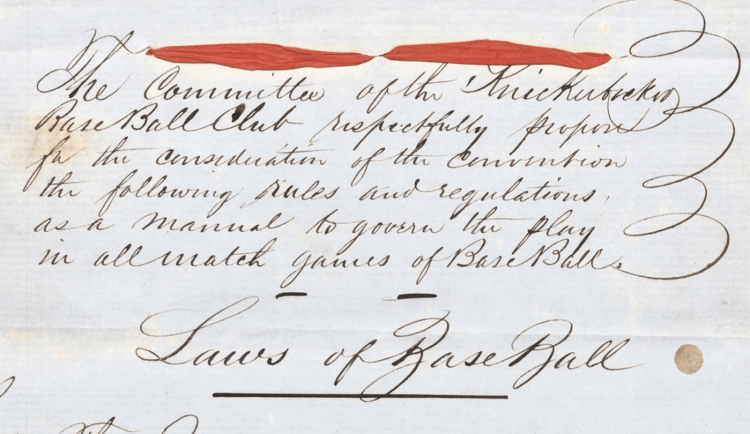
The sheet Murray has spent years studying begins in that formal 19th-century hand: “The Committee of the Knickerbockers Base Ball Club respectfully proposes for the consideration of the convention the following rules and regulations, as a manual to govern the play in all match games of Base Ball.” Beneath that ceremonial opening is a working document. Lines are crossed out. Words are inserted. Rules are adopted, debated, rewritten, refined.
The first rule concerns the ball itself. It must weigh between six and six and one-quarter ounces, measure between 10 and 10¼ inches in circumference, contain India rubber and yarn, and be covered with leather. The bat, the second rule says, must be wood. Before reliable baseball manufacturers, Adams made balls himself and supervised bat production. He was not only discussing the rules of the game; he was helping produce the objects by which the game could be played.
Murray came to the documents almost by accident. In 1999, while in Texas, he received a call from Sotheby’s about an upcoming document auction. He remembered being interested in an item number but not its subject. A representative described a baseball document. Murray loved baseball and, almost on a whim, he put in a bid.
Afterward, experts told him he had bought an interesting relic, not an important one. “Sorry, you overpaid,” Murray recalled being told. He put the papers away, uninsured, believing he had acquired a curiosity.
Years later, he looked again. “This is interesting,” he remembered thinking. “The rest is history.”
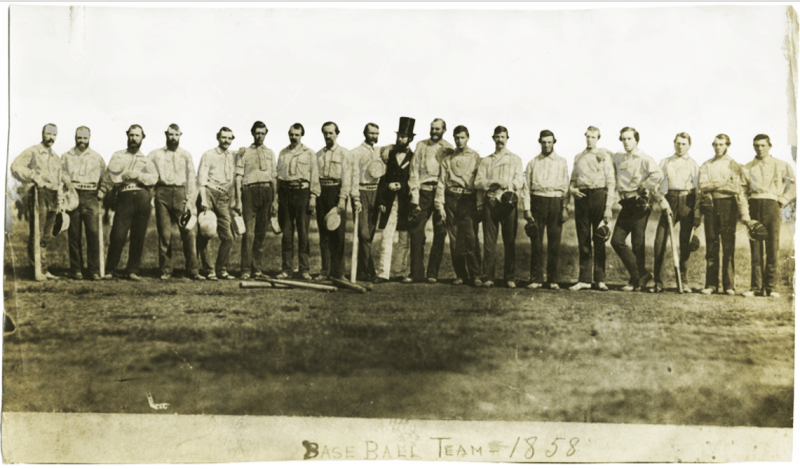
Murray’s research led him through old baseball newspapers, Knickerbocker minutes, box scores, handwriting samples and the Spalding Collection. He studied the game as it existed before the 1857 convention: informal, inconsistent and often closer to club recreation than modern competition. Some games were played to 21 runs. Team size varied. Bat shape was not fixed. The distance between bases was given in paces, an all too variable measurement that depended on the legs doing the pacing.
The 1857 documents changed that world. They addressed the length of games, the number of players, the distance between bases, player movement between clubs, umpires, betting, equipment, foul balls, outs and the rules governing base runners. They helped take baseball from a social exercise to a reproducible sport.
Murray’s key claim rests on authorship. He compared a rough draft with the formal copy presented to the convention and found, he said, that the formal copy followed corrections already made in the draft. That meant the clean version was copied from the rough one, not the reverse. He then compared the rough draft’s handwriting with known Adams letters and receipts. His conclusion was that Adams wrote the originating draft, while William Grenelle, another Knickerbocker with much better hand-writing, copied and preserved the final convention document.
“It’s irrefutable,” Murray said. “Nobody can argue with this analysis.”
The Library of Congress reached a similar broad conclusion when the documents appeared in its Baseball Americana exhibition: Adams drafted rules in December 1856, Grenelle prepared another document, and the Adams rules, with some Grenelle material, were compiled into the “Laws of Base Ball” used and edited at the 1857 convention. According to the National Baseball Hall of Fame and Museum, the rules documents formalized nine players to a side, addressed game length and clarified regulations left unaddressed in earlier rule books.
The case against Cartwright is also chronological. According to the Hall of Fame’s biography, Cartwright served the Knickerbockers as secretary in 1846, vice president from 1847 to 1848 and a member of the club’s rules committee in 1848. He left New York in 1849 for the Gold Rush and later settled in Hawaii. The 1857 convention came eight years after his departure.
Cartwright remains an important early f igure. The issue is not whether he mattered, but whether his plaque claims too much. John Thorn, writing for the Society for American Baseball Research, has said Cartwright did not establish the three central rules attributed to him in Cooperstown: 90 feet between bases, nine innings and nine players. Those rules belong to the later convention era, where Adams’s role has become harder to ignore.
Adams’s own life gives the story a Connecticut turn. Born in New Hampshire in 1814, educated at Yale and Harvard Medical School, he built a medical practice in New York and joined the Knickerbockers soon after the club’s founding. He later moved to Ridgefield, where he served in the state House of Representatives, became the first president of Ridgefield Savings Bank and helped establish the Ridgefield Library.
He also created, or at least first occupied, one of baseball’s most distinctive positions. The shortstop began not as the balletic infielder of the modern game but as a relay man, a short fielder placed between the outfield and the bases when throws were too light and the ball too soft to travel far on its own.
The late former Major League Baseball Commissioner Fay Vincent, a longtime New Canaan resident, helped steer Murray toward Thorn, Murray said. Thorn’s response after reviewing Murray’s presentation was blunt enough to become part of the story. “This changes the history of baseball,” Murray recalled him saying. “Just changes everything.”
The Memorial Day setting gives the Cooperstown unveiling a deeper measure. The rules were written on the edge of the Civil War, and the game they helped define soon moved through soldiers’ camps, prison yards and postwar towns. Baseball became a national habit because the New York game had been made portable; not because one man invented it, but because it had been regularized—there were rules that everyone could follow. So men carried it, remembered it, and could teach it.
That is the moral proportion in Murray’s campaign. Correcting the record does not require shrinking baseball. It enlarges the game by making room for the committee room, the copied page, the doctor who made the balls, the scribe who preserved the papers and the players who needed rules clear enough to carry from one field to another.
Adams is not in the Hall of Fame. In 2015 voting for the Class of 2016, he received 10 of 16 votes from the Pre-Integration Era Committee, two short of election. Murray wants that corrected. The documents going on display this weekend do not put Adams on a plaque. Still, they do something profound and powerful: they put his work before the public.
In Cooperstown, where baseball’s myths have long had a home, visitors will soon be able to look at the page for themselves; the measured beginnings of a game still decided right now, night after night, by the same numbers: nine, nine and 90.
Play ball!