 By Fred Wu
The scene at the May 6 presentation at the Retired Men’s Association was set by Tim Brooks, who welcomed the audience to a deep dive into the musical soul of a nation. When Mark Clague, a professor of music from the University of Michigan, took the virtual stage, he did not just talk about a song; he treated “The Star-Spangled Banner” as a living entity, a cultural biography that has witnessed the trajectory of American history almost since its inception. He spoke in a tone that suggested the anthem was not a relic of the past but an active call to citizenship that requires a new creation in every performance.
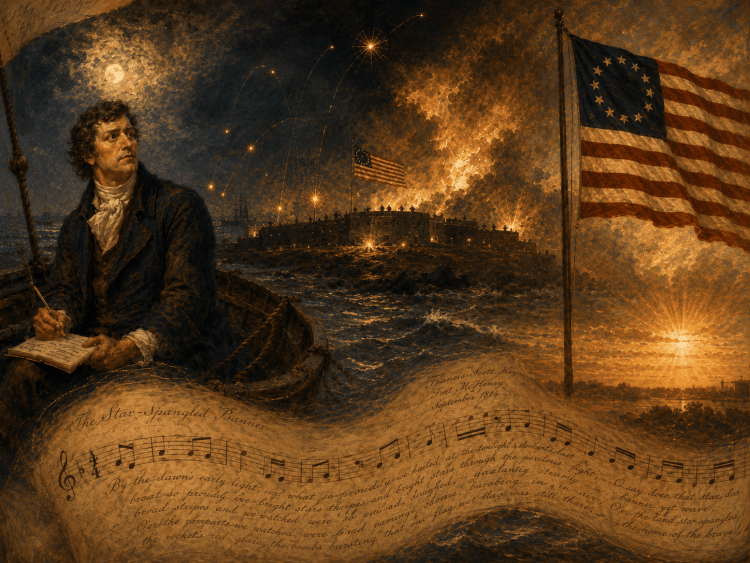
Clague began by dismantling a common myth: the idea that the anthem dates back to the country’s founding in 1776. Instead, it was born during the Second War of National Independence, the War of 1812. He described how Francis Scott Key, a lawyer from Georgetown, found himself on a boat in Chesapeake Bay, appointed by President James Madison to negotiate a prisoner release following the assault on Washington, D.C. Key watched the bombardment of Fort McHenry for over twenty-five hours, convinced that a British victory was imminent after the recent burning of federal buildings in D.C. When the smoke cleared on the morning of September 14, 1814, and the flag still flew, Key did not just write a poem; he composed a celebratory song intended to be sung to a popular melody he already knew.
That melody, “To Anacreon in Heaven,” had been the theme song of the Anacreontic Society, an amateur musicians’ club in London. While often dismissed today as a simple drinking song, Clague explained that for members of the club, named after the Greek poet Anacreon, the tune was a celebration of fellowship and musical skill. Key had actually used the same tune nine years earlier to honor Stephen Decatur Jr. and Charles Stewart, heroes of the First Barbary War who had famously burned the captured frigate USS Philadelphia to keep it out of enemy hands. Key’s decision to reuse the melody was a practical one, as the tune’s unique nine-rhyme, eight-line format was a rare and recognizable structure in the era of broadside ballads.
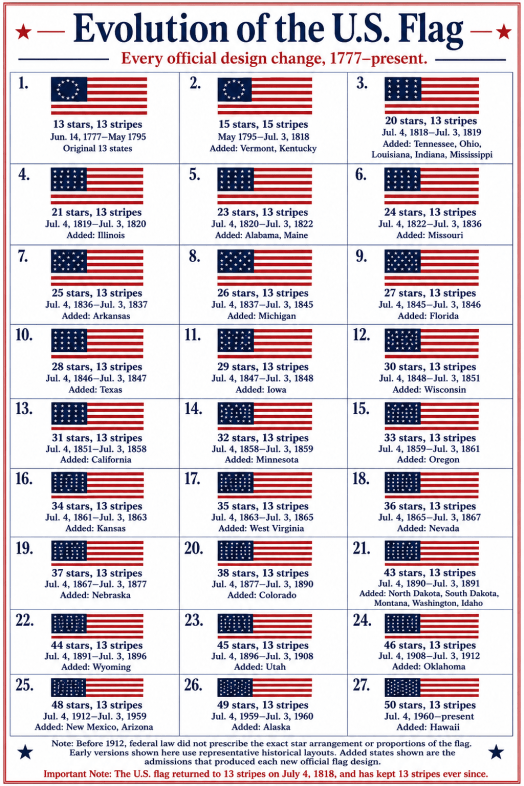
The presentation moved through time to 1861, a moment Clague identified as the point when the song truly became sacred in American culture. As the U.S. Civil War began, President Abraham Lincoln made the symbolic choice not to remove stars from the f lag to represent the seceding Confederate states. Consequently, both the flag and its song became potent symbols of the Union. It was during this era that the tempo slowed, transforming the once-jaunty celebratory tune into something resembling a church hymn or a recruitment song to honor the rising toll of the dead. Clague noted the anthem’s inclusivity even then, citing an 1851 German translation created in New Braunfels, Texas, which was used to recruit abolitionist immigrants for the Union Army.
By 1917, the entry of the United States into World War I moved the anthem into the realm of community ritual. Clague explained that before this, the song was usually a dialogue between a soloist and an echoing crowd, but the pressures of global conflict led to the Service Version, a standardized arrangement used by the military services. This was the era when the anthem became a staple of public life, aided by the invention of public address systems that eventually brought the ritual into every professional sports stadium by 1940.
The narrative of the anthem has also been punctuated by voices of protest and individual expression. Clague pointed to Jimi Hendrix’s legendary performance at Woodstock in 1969. While some saw it as a desecration, Clague argued it was a deeply personal reflection by a man who had served in the 101st Airborne Division. Hendrix’s use of distortion and the melody of Taps was a musical illustration of the rockets’ red glare and a tribute to the military dead during the Vietnam War. Similarly, Clague discussed José Feliciano, the Puerto Rican-born singer whose soulful 1968 World Series performance was intended as a gift to make the anthem accessible to a younger generation.
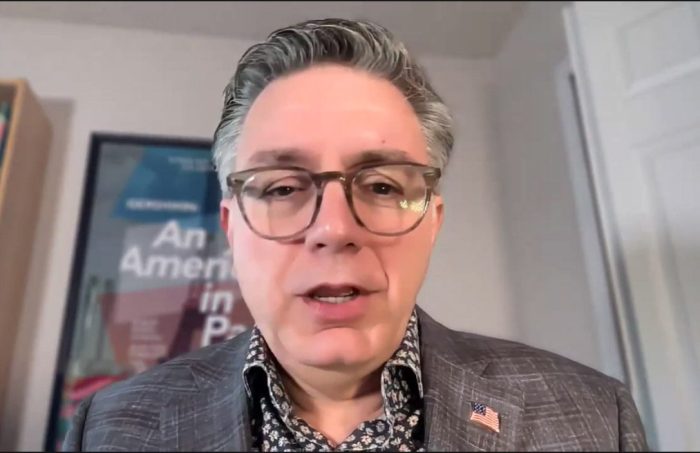
In closing his presentation, Clague returned to the present day, noting that the first verse of the anthem ends not with an exclamation point, but with a question. He argued that the word “you” in “O say can you see” is an invitation for every American to enter the story of the nation’s future. To Clague, the anthem is a verb, an active commitment to the ideals of freedom and bravery that must be earned anew by each generation..
The talk can be viewed by going to the RMA website at https://greenwichrma.org, clicking on “Speakers,” then “Past Speakers,” and then “RMA Vimeo Library.”
The RMA’s next presentation, “The Next Generation of Long Island Sound Research: Understanding our Coast Through an Interdisciplinary Approach” by Robert Nazarian, PhD., is scheduled for 11 AM on Wednesday, May 20, 2026. RMA presentations are held at Christ Church Greenwich, Parish Hall, 254 E. Putnam Avenue, Greenwich, CT 06830.
Last year, Fairfield University launched the new Center for Climate, Coastal, and Marine Studies, designed to support research through inter- and trans-disciplinary scholarship. This project, which represents Fairfield’s first center singularly dedicated to research, supports interdisciplinary research initiatives across Fairfield’s professional schools and College of Arts and Sciences, in disciplines including anthropology, applied ethics, biology, chemistry, computer science, counselor education, economics, education studies, English, finance, management, mechanical engineering, physics, politics, sociology, visual and performing arts, and more. In addition to advancing knowledge and developing answers to some of the most pressing questions in the field, the Center promotes the engagement of faculty and students with the community through outreach events, such as this event with the Greenwich RMA.
Prof. Robert Nazarian is an Associate Professor in the Physics Department at Fairfield University and Special Assistant to the Associate Vice Provost for Research. He received his PhD in Atmospheric and Oceanic Sciences at Princeton University and his BA in Physics and Mathematics, magna cum laude, from The College of the Holy Cross. His primary area of research is the physics governing the ocean, atmosphere, and climate, using computational models to answer exciting questions about the dynamics of the ocean, atmosphere, and climate systems, including past and future climates. Rob and his students have been the recipients of several awards including a 2022 Goldwater Fellowship, campus-wide fellowships, and several NASA Space Grants to support undergraduate research.
To stream the presentation by Robert Nazarian at 11 AM on Wednesday, May 20, click on https://bit.ly/30IBj21. This presentation will also be available on local public access TV channels, Verizon FIOS channel 24 and Optimum channel 79.
Note: The views expressed in these presentations are those of the speakers. They are not intended to represent the views of the RMA or its members.
RMA speaker presentations are presented as a community service at no cost to in-person or Zoom attendees, regardless of gender. Any member of the public who would like to receive a weekly email announcement of future speakers should send a request to members@greenwichrma.org. The RMA urges all eligible individuals to consider becoming a member of our great organization, and thereby enjoy all the available fellowship, volunteer, and community service opportunities which the RMA offers to its members. For further information, go to https://greenwichrma.org/, or contact info@greenwichrma.org.