By Elizabeth Barhydt
Josh Kivijarv’s work at NASA begins with one of spaceflight’s most practical questions: What do astronauts need to do inside a spacecraft to stay alive, keep working, and bring the mission home?
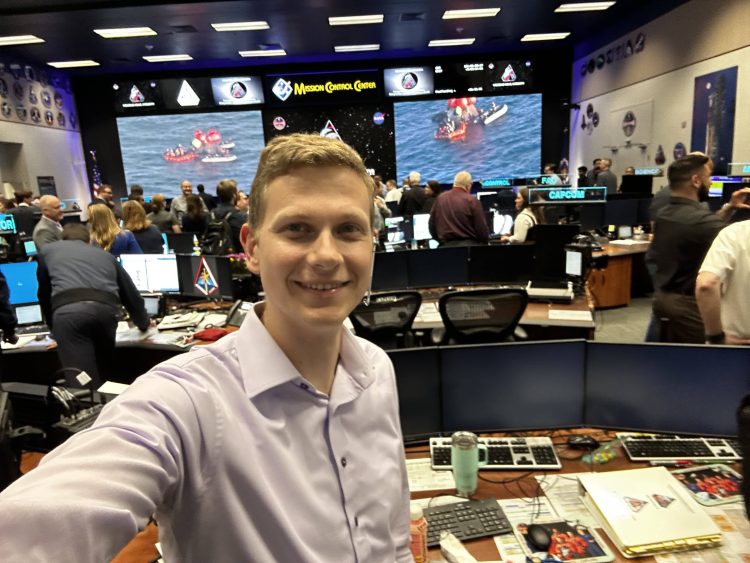
Kivijarv, 32, grew up in Greenwich, attended public schools here, and now lives in Houston, where he works in NASA’s human spaceflight operations. His branch focuses on intravehicular activity, or IVA — the astronaut work that happens inside the spacecraft, from maintenance to daily living.
“So any sort of maintenance they have to do on the spacecraft–all aspects of how they live there,” Kivijarv said. “How they eat, sleep, drink, go to the bathroom, all that kind of human centric stuff is what my group does.”
His work places a Greenwich native inside the larger machinery of Artemis, NASA’s campaign to return humans to the Moon, test new spacecraft and lander systems, and prepare for later missions to Mars. NASA says Artemis II was the first crewed Artemis flight and “a key step toward long-term return to the Moon and future missions to Mars.”
A GREENWICH PUBLIC SCHOOLS BEGINNING
Kivijarv traces the beginning of his scientific interest to Greenwich classrooms.
He attended Cos Cob School, Central Middle School and Greenwich High School, institutions he still describes with affection. “Each one of them is near and dear to my heart,” he said. “I think our public school system is fantastic.”
Science appealed to him early. Physics, in particular, became the class he waited for at Greenwich High School. He credited Ms. Zeegan, his physics teacher, as one of the educators who helped shape his direction.
“I’ve been interested in science from as early as I can remember,” Kivijarv said.
That early curiosity eventually became a career inside one of the most consequential public science programs in the world. NASA’s Artemis campaign is not merely a sequence of rockets and test flights. It is an attempt to revive a national habit of looking beyond Earth with discipline, patience, and technical seriousness.
For Kivijarv, the connection between Greenwich classrooms and lunar missions is part of the same chain. A student waits years to take physics. A teacher sharpens an interest. A young engineer keeps applying, keeps asking, keeps looking for a way into aerospace. Years later, he is working on the routines that make human life possible inside a spacecraft bound for space.
FROM TESLA TO HOUSTON
While attending college at Manhattan College, now Manhattan University, he worked part time and completed internships at Tesla, traveling to California several times. During semesters, when he could not be in California, he sold Tesla vehicles in New York and Connecticut.
Spaceflight remained the goal. Kivijarv said he first tried to move from Tesla toward SpaceX. He applied repeatedly.
“I counted one time,” he said. “I applied to 27 different roles and never got anything.”
The rejection did not end the pursuit. Kivijarv asked a Manhattan College professor if he knew anyone who could help. That led him to a Manhattan alumnus working at NASA, which led to Houston. Kivijarv said he is still in touch with that alumnus.
The story has the shape of many careers: not a straight ascent, but a set of attempts, rejections, contacts, revisions and more attempts. Kivijarv once thought of NASA as the fallback plan. The irony is not lost on him. The institution that, at the time, had seemed like the alternate route became the place where he found himself working on America’s return to the Moon.
THE WORK BEHIND HUMAN SPACEFLIGHT
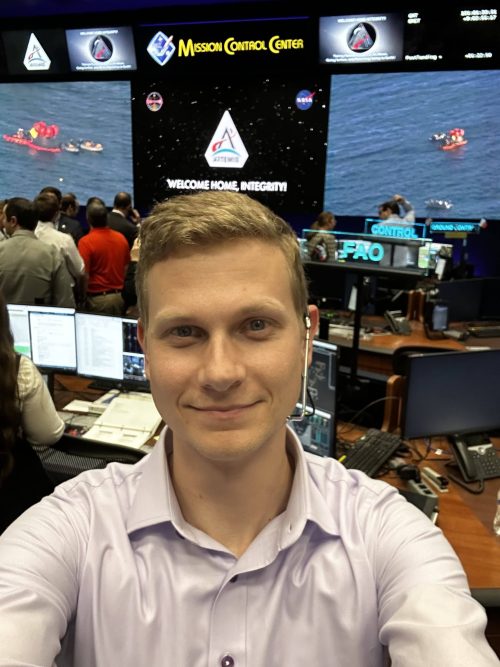
Kivijarv now works in NASA’s Flight Operations Directorate, or FOD, at Johnson Space Center in Houston. The directorate “touches every program and part of sending humans to space,” including astronaut training in spacecraft mockups, underwater training in the Neutral Buoyancy Laboratory and T-38 aircraft training, according to NASA. FOD is responsible for planning, directing, managing and implementing mission operations for NASA human spaceflight programs.
Kivijarv described the directorate in more direct terms.
“You can think of them as mission control,” he said. “What we do is we plan, train, and fly space flight missions.”
Kivijarv first worked on the International Space Station program, gaining flight controller and instructor certifications. The station gave him a structured entry into human spaceflight operations before he moved into Artemis.
“I got trained through the International Space Station program,” he said. “I got my first flight controller certification, my first instructor certification and started teaching crews all starting out of ISS.”
His description of the work strips spaceflight of abstraction. Astronauts do not simply “go to space.” They follow checklists, maintain systems, sleep in confined quarters, eat planned meals, manage limited resources and live inside a vehicle where small things matter. Human spaceflight depends on these things.
ARTEMIS AS A CAMPAIGN
Kivijarv emphasizes that Artemis is not a single mission. It is a campaign.
“The first thing to know about Artemis is it’s a campaign,” he said.
NASA’s public Artemis plan reflects that step-by-step structure. Artemis I launched in 2022 as an uncrewed test flight. Artemis II was the first crewed Artemis flight. Artemis III is scheduled for 2027 as a low Earth orbit demonstration mission to test one or both commercial landers from SpaceX and Blue Origin. Artemis IV is targeted for early 2028 as the first Artemis lunar landing, with a crew transferring from Orion to a commercial lunar lander after reaching lunar orbit, according to NASA.
Kivijarv’s Artemis work began with longer-range planning, including questions about what later missions would require. He said his assignment eventually moved backward from future missions to Artemis II.
“The difficult thing is not figuring out what you want to do on Artemis five or six or seven,” he said. “The difficult thing is actually going from where we are today to that future and figuring out what small steps you have to take each time to get there.”
That sentence contains much of the logic of Artemis. The dream is large: a permanent human presence on the Moon, new science, new systems, and eventually Mars. The work is incremental: one test, one plan, one procedure, one launch window, one trained crew, one corrected assumption at a time.
Kivijarv’s pride in the program comes through not as triumphalism, but as purpose. He described NASA after Artemis II as a place where momentum feels tangible.
“Things are really, really happening,” he said. “It feels like a much stronger sense of direction and purpose and action these days, especially in the wake of Artemis two.”
THE RETURN OF A PUBLIC DREAM
For many Americans, the Moon has long carried two meanings. It is a physical place and also a measure of national aspiration. Apollo made the Moon part of the American civic imagination. Artemis asks whether a new generation can look up and see not only history, but unfinished work.
Kivijarv said Artemis II reached people in a way he had not seen for some time.
“I think Artemis two captivated the world in a way that I don’t think we’ve seen in a while for something positive,” he said. “It’s nice to have something positive captivating people, bringing everyone together.”
That response is important to him because the technical mission and the public mission are connected. Spaceflight is funded, explained, defended and renewed across generations. A child watching a Moon mission today may become the engineer, flight controller, physician, geologist, software developer, artist or journalist who helps carry the program forward.
NASA frames Artemis as preparation for Mars and as a way to establish sustained lunar exploration while building the knowledge needed for deeper human spaceflight. Kivijarv spoke about that future in generational terms.
“The things that we’re trying to do are long, long term endeavors,” he said. “The goal is a permanent presence on the moon and that will take the work of generations.”
NUTELLA, SRIRACHA, AND THE ORDINARY DETAILS OF SPACE
For many viewers, one of the most memorable Artemis II moments was not a rocket engine or lunar trajectory. It was an everyday object floating in microgravity: Nutella.
Kivijarv said the public reaction made sense. To flight teams, loose objects drifting through spacecraft are normal. To viewers at home, the sight made spaceflight seem less remote.
“To us that’s just stuff f loating around inside the space craft, that’s what stuff does,” he said. “The crew’s going to f ind it and put it back to where it belongs and Velcro it to the wall.”
He said many space items begin as commercial products, though NASA must know what is inside them and whether they are compatible with spacecraft systems. Astronauts may lose some sense of taste in microgravity, he said, which is why spicy condiments often end up in space.
“Sriracha is actually a very common astronaut food because they lose some taste over time in zero gravity and so they’ll just start layering sriracha on everything because it helps them get the flavor,” Kivijarv said.
The detail illustrates the work of IVA: spaceflight depends on rockets, guidance systems and spacecraft design, but it also depends on human routines. A floating jar of Nutella can do what a technical diagram cannot always do. It can remind the public that astronauts are not abstractions inside a capsule. They are people trying to live and work in a place where nothing behaves as it does at home.
Kivijarv credited the Artemis crew with bringing that human dimension forward.
“This crew did a great job overall of really adding a human touch to the mission,” he said.
THE NEXT GENERATION
Kivijarv said the long-term work of Artemis will extend beyond the present generation of NASA engineers and astronauts.
He sees today’s children as the people who may someday build lunar cities or take first steps on Mars. That possibility gives Artemis much of its emotional force. The program is not only about the astronauts assigned to the next mission. It is also about the students now sitting in classrooms, some of them in Greenwich, who may not yet know what role they could play.
Kivijarv said the future of space exploration will require more than scientists and engineers. It will require business specialists, artists, public affairs professionals, journalists, people who work with elected officials and others who can make a long national project understandable, fundable, and durable.
“What we’re looking to do in the future requires all kinds of people,” Kivijarv said. “Math and science is important, but I think the best guideline is find and do what you’re passionate about and as long as you are doing something that really interests you, you can find a way to be a part of NASA.”
For Greenwich readers, his story carries a local point inside a national one. The road to lunar space can begin in a public school classroom, with a physics teacher, a persistent student and an ambition that survives a stack of unanswered job applications. Artemis may be aimed at the Moon and Mars, but it is built by people whose first steps often begin much closer to home.