By John Reese
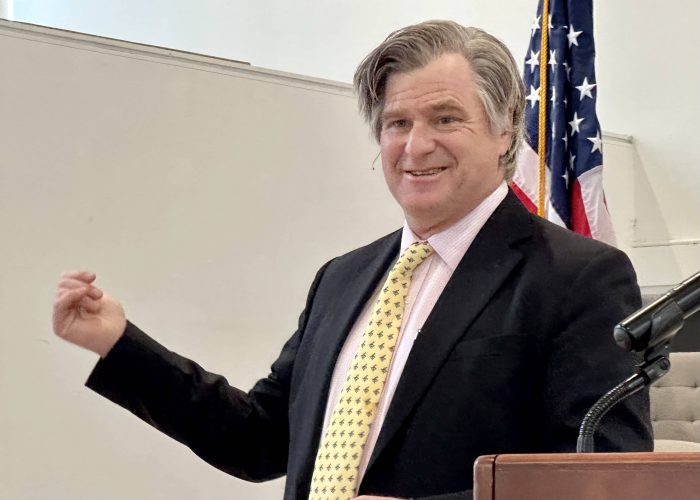
The men and women who sailed the merchant ships, manned the U-boats, and washed ashore on the beaches of New England during two world wars were not abstractions. They were teenagers in winter coats, captains reaching for cigarettes, and fathers whose reputations were destroyed by a misunderstanding about torpedoes. At the March 25th meeting of the Retired Men’s Association, maritime historian Eric Wiberg spent an hour restoring their names, their decisions, and their humanity.
Mr. Wiberg, a sea captain, maritime lawyer, and the author of more than 45 nonfiction books on World War II naval history, was introduced by Troy Johnson, the RMA’s publicity chair. Johnson has known the speaker for 25 years, since Wiberg was pursuing his degree in maritime law, having already held a commercial captain’s license and operated cargo ships out of Singapore. A former Greenwich resident who now lives and writes in Boston, Wiberg does not deliver lectures so much as unspool yarns — densely factual, wryly told, and anchored in the kind of firsthand research that sometimes involves getting bitten by a German shepherd.
That incident occurred in the Bahamas, where Wiberg grew up, during an interview with Prince Niccolò of Piedmont, an Italian nobleman who had served on a submarine during the war. As Wiberg leaned in to show a list of vessels, the prince’s guard dog lunged and tore his shirt and shoulder. “I continued the interview with a ripped shirt and a bleeding arm,” he told the audience. “It was a very good interview.”
The presentation, titled “Shipwrecks and U-Boats: Amazing New England Coastal Sea Stories,” ranged across a century of maritime history, guided by the philosophy of Wiberg’s intellectual hero, Rear Admiral Samuel Eliot Morison, the Harvard historian whose famous advice is inscribed on his Boston statue: “Dream dreams and write them, aye, but live them first.”
He opened with a SpanishAmerican War artifact: a gun from the Infanta María Teresa, flagship of Admiral Cervera’s fleet at the 1898 Battle of Santiago de Cuba. The cruiser led a suicidal charge against the American blockade, was sunk, and later salvaged, only to be lost again when a hurricane severed its tow line near the Bahamas. Her guns were scattered across America, including one at Fort Griswold in Groton, Connecticut. From there he turned to the Deutschland, a privately financed German cargo submarine that during World War I traded with the still-neutral United States, the only submarine in history to complete a commercial mission during wartime. But as the Deutschland departed New London, it collided with the tug T.A. Scott, killing all five American crewmen. The lone survivor pulled from the water was a German businessman — a fact, Wiberg noted, that “didn’t look good.”
The heart of the presentation belonged to the final weeks of World War II. Wiberg told the story of the SS Black Point, the last American merchant vessel sunk in the Atlantic, torpedoed off Point Judith, Rhode Island, on May 5, 1945, the same day all U-boats were ordered to cease hostilities. Whether the 24-year-old commander of U-853, Oberleutnant Helmut Frömsdorf, never received the order or chose to ignore it remains unknown. Lewis Iselin, a Harvard-educated sculptor from Camden, Maine, then commanding the destroyer escort USS Atherton, led the attack that destroyed the submarine with all 55 hands.
What captivated the audience was a mystery Wiberg solved in 2018. Accounts of a sinking near Rhode Island mentioned a tug and barge near an explosion that was never identified. Then a call came from a man whose elderly father-in-law — a lifelong Boston waterman in his nineties — wanted to tell his story. He insisted on confirming Wiberg’s merchant marine credentials before speaking. Satisfied, he described how his tug had been near Point Judith when the ship beside them exploded. The teenagers aboard looked at one another and fled. Wiberg traced the tug, the Ocean King, to Boston and then to the Bahamas. Just a month before the presentation, a colleague sent a photograph from an uninhabited atoll confirming the vessel’s final resting place.
He also recounted the harrowing voyage of the Liberty ship SS Benjamin Contee, torpedoed while transporting 1,800 Italian prisoners of war from North Africa in 1943. The captain sealed the flooded hold, containing both the living and the dead, to save the ship, which limped to Gibraltar and across the Atlantic. In Brooklyn, military police escorted the remains of at least 19 prisoners to ambulances. The damaged Benjamin Contee was later scuttled off Utah Beach on D-Day, becoming part of a Mulberry artificial harbor across which tanks rolled to liberate Europe. Wiberg said the Italian consulate contacted him just weeks ago to say the case remains a matter of great interest to the Italian government.
The story Wiberg saved for his close was the most moving. At a dinner in Stockholm, he had invited an elderly Swede, Mr. Johansen, who had helped with his research. When asked why he had come, the old man broke into tears. His father, captain of a neutral vessel near Bermuda, had ordered his crew into lifeboats after spotting torpedoes. The ship was not sunk. In New York, the captain was ridiculed as a coward. The stigma haunted the family for decades, until Wiberg found the German commander’s log confirming he had fired two torpedoes and was baffled that they missed. The explanation was simple: sailing in fair weather with no cargo to load as ballast, the captain had left his ship riding high. The torpedoes passed underneath. “This old man was crying because I’d saved his reputation,” Wiberg told the hushed room. “I was the only person who said, ‘your dad was right’.”
The RMA’s next presentation, “Saving Nature’s Strongholds” by Stephen Ham, is scheduled for 11 AM on Wednesday, April 8, 2026. RMA presentations are held at Christ Church Greenwich, Parish Hall, 254 E. Putnam Avenue, Greenwich, CT 06830.
The Wildlife Conservation Society is protecting wildlife and wild places across the planet. Stephen Ham, Senior Vice President and Chief Development Officer, will be discussing how WCS, the largest, field-based conservation organization in the world, approaches conservation and why WCS knows that zoos, particularly its headquarters at the Bronx Zoo, are essential to inspiring people to take action for conservation. WCS manages four New York City wildlife parks in addition to the Bronx Zoo, and does conservation work in more than 50 countries to achieve its mission to save wildlife and wild places.
Stephen has spent his life dedicated to the field of global conservation. Whether trekking mountain gorillas in Rwanda or whale watching in Antarctica, he is a passionate advocate for wildlife and the wild places they inhabit, particularly for Africa. He received a degree in anthropology and environmental studies from the University of North Carolina at Chapel Hill. He is a returned volunteer with the United States Peace Corps where he served in Ghana, West Africa. Before WCS, he was Senior Director with the African Wildlife Foundation and he also spent years as a special assistant to Dr. Jane Goodall. When not looking for animals Stephen lives in New York with his wife and two daughters.
To stream the presentation by Stephen Ham at 11 AM on Wednesday, April 8, click on https://bit.ly/30IBj21. This presentation will also be available on local public access TV channels, Verizon FIOS channel 24 and Optimum channel 79.
Note: The views expressed in these presentations are those of the speakers. They are not intended to represent the views of the RMA or its members.
RMA speaker presentations are presented as a community service at no cost to in-person or Zoom attendees, regardless of gender. Any member of the public who would like to receive a weekly email announcement of future speakers should send a request to members@greenwichrma.org. The RMA urges all eligible individuals to consider becoming a member of our great organization, and thereby enjoy all the available fellowship, volunteer, and community service opportunities which the RMA offers to its members. For further information, go to https://greenwichrma.org/, or contact info@greenwichrma.org.