By Frank Scarpa
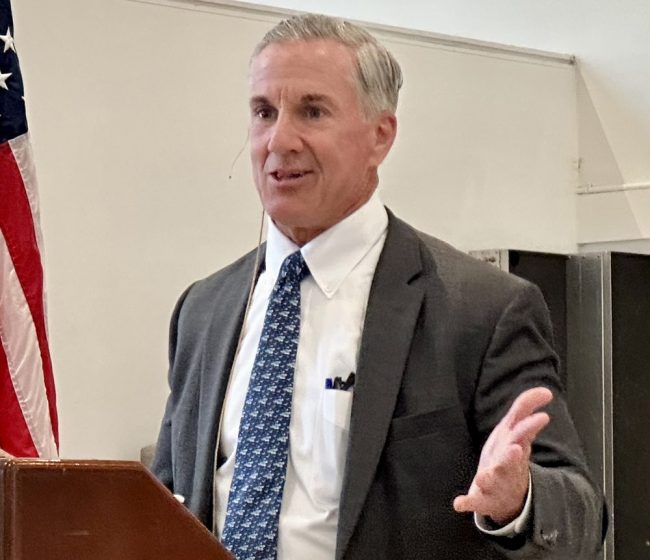
At the March 18 meeting of the Retired Men’s Association Troy Johnson introduced the Honorable David Hopper, probate Judge for the District of Greenwich. His presentation was titled “Probate Law in Connecticut.”
Judge Hopper has served the Town of Greenwich in this role since 2002, continuing the legacy of his father, the Honorable Cameron F. Hopper, who held the same office from 1967 to 1990. Judge Hopper is a graduate of the University of Richmond and Quinnipiac University School of Law. He and his wife, Susan, reside in Riverside and are the parents of three adult children. David Hopper stood before his audience in Greenwich ready to demystify a corner of the judiciary that many often confuse with the criminal justice system. The judge did not arrive with the stern formality one might expect of the bench. Instead, he brought stories of frozen heads, colonial rebels, and the simple power of a gavel-shaped pencil.
The judge began by reflecting on the inherent mystery of his role. To many, a probate judge is a figure associated with the grim paperwork of death or the administrative haze of trusts. Hopper recalled a day twenty years ago when he was invited to speak to approximately one hundred third graders at Riverside School. Flanked by a police officer and a firefighter, Hopper worried that his presentation on estate administration would pale in comparison to stories of sirens and rescues. He decided to lean into history, bringing colonial hats and kingly costumes to explain why he was elected rather than appointed. He shared that the children ultimately voted him the best speaker of the day, though his daughter later clarified the victory: they simply liked the gavel shaped pencils he had handed out as souvenirs.
Hopper explained that the lack of judicial robes in his courtroom is not a matter of casual style, but a direct link to the Connecticut Royal Charter of 1662. He spoke of how the early colonists were wary of the “king’s justice” and the robed officials sent from England. He recounted the legend of the Charter Oak, where Captain Joseph Wadsworth allegedly hid the colony’s founding document in a hollow tree during a 1687 standoff with Sir Edmund Andros. Andros, the governor of the Dominion of New England, had arrived in Hartford to seize the charter under the orders of James II, but the defiance of leaders like Robert Treat ensured that Connecticut retained its right to self-government. This tradition of local, elected judges remains the backbone of the probate system today.
The conversation turned toward the human dramas that play out in Greenwich Town Hall, where Hopper’s office is located. He projected a photo of the courtroom, designed like a conference room to lower the emotional temperature of proceedings that are often fraught with grief and resentment. He shared an account of the 2005 disappearance of George Smith IV, a Greenwich man who vanished from a Royal Caribbean cruise ship during his honeymoon in the Mediterranean. Hopper was tasked with approving a settlement between the cruise line and the widow, Jennifer Hagel-Smith. The case was a labyrinth of international maritime law and family heartbreak, as Smith’s parents fought the settlement in a quest for answers that they felt the money could not provide.
Hopper also touched upon the complexities of modern family structures and the lengths to which people go to secure an inheritance. He described a case involving a Greenwich man with a multi-million-dollar trust for his grandchildren. One of his daughters, living in a committed relationship with another woman in the 1990s, sought to bypass inheritance restrictions by adopting her partner as a “grandchild.” Because Connecticut law prohibited adopting someone older than oneself, the couple traveled to Maine to complete the process. Following the death of the patriarch, the partner claimed her share of the estate. Hopper ultimately ruled against her, citing the father’s intent and the disruption of the estate plan, though the case eventually reached a settlement after an appeal.
The judge did not shy away from the more eccentric or tragic duties of his office, from name and gender changes to the involuntary commitment of those suffering from mental illness. He recalled a particularly surreal moment when a man attempted to record a deed at Town Hall claiming that God had transferred the entire town of Greenwich to him, with the document supposedly witnessed by the Holy Ghost. More somberly, he shared the story of a man in his nineties whose living will included a directive that, upon his death, his son should have his head removed and frozen in the hope of future resuscitation. Despite the family’s objections, Hopper ruled that the son was legally obligated to follow the specific, if unusual, wishes of his father.
Longevity and community were recurring themes in Hopper’s talk. He paid tribute to Martha Weir, a legendary clerk who began her career at the Greenwich Probate Court in 1915 under Woodrow Wilson and did not retire until 1989. This sense of continuity is personal for Hopper. By placing photos of his predecessors on the walls of his office, Hopper signaled that while the cases may change from the colonial era to the age of cryonics, the mission of providing compassionate, accessible justice remains the same.
For the RMA’s next presentation, Governor Ned Lamont is scheduled to speak at 11 AM on Wednesday, April 1, 2026. RMA presentations are held at Christ Church Greenwich, Parish Hall, 254 E. Putnam Avenue, Greenwich, CT 06830.
In this meeting, the governor will answer questions that have been submitted in advance. Questions should be submitted to RMA President, David Michonski, at David@Quigler.com. Questions submitted in advance will be addressed first and then, if time permits, questions will be taken from the floor.
The public is invited to attend. Attendees are urged to arrive no later than 10:45 am. Parking will be limited, but ample parking can be found next to Christ Church at the Tomes Higgins House. Also, across the street the Christian Science Church on Park Avenue will allow for RMA overflow parking. Coffee will be served by the RMA to attendees starting at 10:30 am.
Elected governor in 2018, and reelected to a second term in 2022, Ned Lamont is the state’s first chief executive with a business background in 80 years. After college, he entered the cable television industry, managing the startup operation in Fairfield County, CT, for Cablevision. In 1984, he founded Campus Televideo, a company that provides cable and satellite services to college campuses and grew to serve over 400 of America’s largest colleges and one million college students across the nation.
Lamont also got involved in public service shortly after college, founding a weekly newspaper in a town hit by the loss of its largest employer. Later, as a member of both the Greenwich Board of Selectmen and the Board of Estimate and Taxation, he worked in a bipartisan effort to safeguard a multimillion-dollar budget and deliver results for constituents. For four years, he also served as Chairman of the State Investment Advisory Council, overseeing a multibillion-dollar state pension fund.
To stream the presentation by Governor Lamont at 11 AM on Wednesday, April 1, click on https://bit.ly/30IBj21. This presentation will also be available on local public access TV channels, Verizon FIOS channel 24 and Optimum channel 79.
Note: The views expressed in these presentations are those of the speakers. They are not intended to represent the views of the RMA or its members.
RMA speaker presentations are presented as a community service at no cost to in-person or Zoom attendees, regardless of gender. Any member of the public who would like to receive a weekly email announcement of future speakers should send a request to members@greenwichrma.org. The RMA urges all eligible individuals to consider becoming a member of our great organization, and thereby enjoy all the available fellowship, volunteer, and community service opportunities which the RMA offers to its members. For further information, go to https://greenwichrma.org/, or contact info@greenwichrma.org.