By Anne W. Semmes
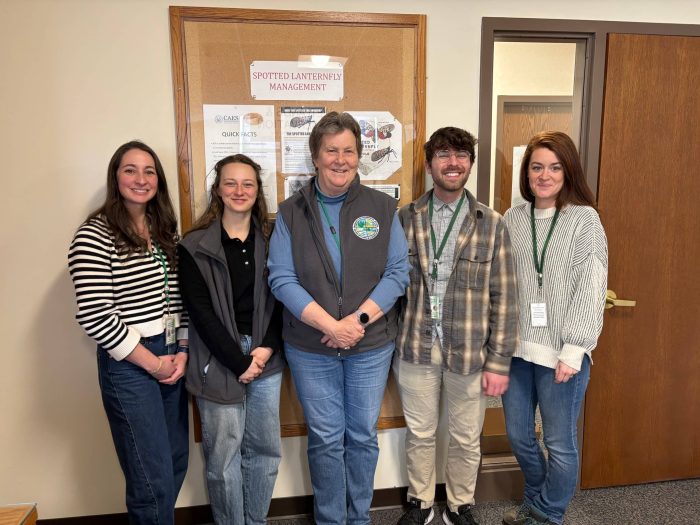
There is a small group of people dedicated to the health of the landscape of Greenwich. They are located in Town Hall serving in the Environmental Affairs department under their director Beth Evans, who oversees the Conservation and Inland Wetlands and Watercourses Departments beneath the umbrella of Environmental Affairs.
Those four staffers were aware of a part of the town needing help, seeing Byram as an “environmentally sensitive area.” More trees were needed there “to reduce heat and flood risk, improve air quality, and strengthen neighborhood resilience.”
Evans explains further. “These challenges leave many residents, particularly low -to moderate -income households, less protected from climate-related impacts.” And so, some timely spotting by Evans’ staff on the Connecticut DEEP website – with a new initiative found, “Trees for Communities” – “to get more native trees planted in urban areas,” shared Evans, “for resilience and adaptation for climate change.” Two-year grants were being offered for this initiative by CT DEEP.
Evans’ staff application of “Byram Branches” was a winner. “They got all the money they asked for, $49,536,” said Evans, who had not expected such a result. “We’re Greenwich after all,” she noted. “We’re really very excited about it… Other municipalities had budgets that were much higher, and some got partial funding. So, I’m very proud of my staff for being careful and doing a lot of the background legwork with the nurseries and the Greenwich Tree Conservancy to make sure that we could deliver on what we were asking for. “
Just how many trees are to be added to Byram? “A hundred is the goal,” said Evans, “But with the Tree Conservancy and others, we may end up getting more. We’re hopeful that we get at least 100 so that we can not only plant them on private property, but also in public spaces like the library, or the schools, or any of the parks.”
“It’s a collaborative program,” Evans noted, “sponsored primarily by the Conservation Commission, but we’re going to be working with partner organizations. The Greenwich Tree Conservancy has signed on to help, and the Byram Neighborhood Association is also involved. We will be doing outreach in education programs to help people know how to take care of these plants – the new trees that are to be planted. And how trees can help lessen some of the impacts from extreme temperatures in summer, and flooding, and just general aesthetics.”
What might be some of those native trees to be planted? “We have reached out to some nurseries in Connecticut – Sam Bridge, and Planters Choice. We have gotten their assistance in finding trees that are appropriate in terms of size and species. And the Greenwich Tree Conservancy will also be helping us and potentially donating some trees.”
Evans noted the Byram Branches as “a community outreach effort” for her staff and the Conservation Commission. “We had an introductory talk to the Byram Neighborhood Association back in the fall to let them know that we had applied for this grant and it is funded. And that we would be reaching out to them to ask for suggestions and an input from the community on where the trees should go and the long-term stewardship of who’s going to take care of them.”
It is Evans’ hope that “many of the trees will end up going onto private property… and if a homeowner is part of the program, they will sign a simple pledge that says they will water and care for their trees, so that we don’t have to worry about the town going back and watering them.”
So, for now said Evans, “It’s really the boots on the ground – the town staff are meeting up in April to kick it off. The people on the town side are going to be working on the education and the outreach and contact with the nurseries.”
Speaking for that winning group of staffers was Evans’ assistant director Sarah Coccaro. “We are beyond excited about the Byram Branches project and receiving the grant from CT DEEP. Byram Branches builds on the success of past tree plantings in Byram, through collaboration between the Town and Greenwich Tree Conservancy, which focused on public street trees. This grant allows us to take the next step by extending the urban canopy to private and high-use public areas where the benefits will be expanded and even more enduring.”