By Elizabeth Barhydt
 Anne W. Semmes stood before roughly one hundred people at Christ Church and spoke with the authority of long acquaintance. Many in the room knew her. Some were in her book. All were part of the town she has spent decades observing, recording, and, in her way, preserving.
“Thank you Marek!” she began, thanking Christ Church Rector Marek Zabriskie for his introduction. “What a privilege to stand on this podium where so many giants have spoken in the years you have been here.”
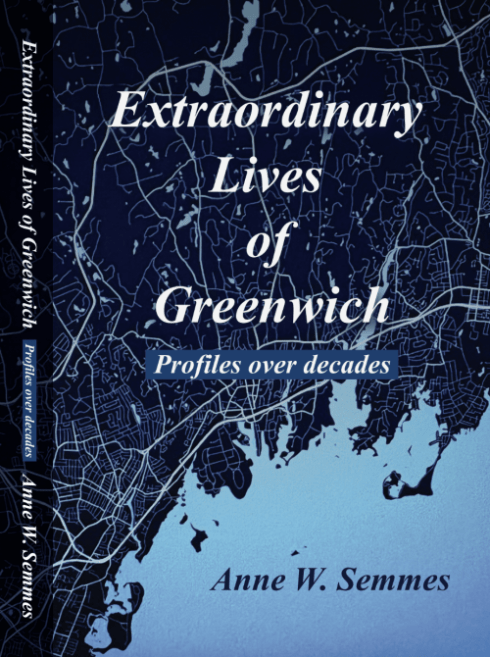
Semmes has written about Greenwich for more than 40 years. Her work has appeared in the Greenwich Sentinel, Greenwich Magazine, Greenwich Time, and Greenwich Review among others. Her new book gathers that work into a single volume: 100 profiles drawn from a list of 400 individuals she has encountered and written about over time.
“My journalistic life of meeting up with the extraordinary people of Greenwich in my book began some 40 plus years ago,” she said, recalling her return to Sarah Lawrence College after raising her children. “I learned there I could write that I was nostalgic — and curious.”
That curiosity became method. It carried her outward, on assignment and on instinct. Early reporting took her to Europe aboard the Orient Express. She began in Venice, profiling “Harry of Harry’s Bar,” then traveled to England to cover the Wordsworth Summer Conference in the Lake District.
A stop in Paris became part of the story. Arriving without local currency, she turned to the American Embassy. Ambassador Evan “Van” Galbraith, a Greenwich resident, appeared. “Who should arrive for my rescue in his shorts but Van Galbraith inviting me for a few days’ stopover at the Embassy,” she said. There, she joined journalists covering “a challenging U.S. effort to stop a Soviet plan for a gas pipeline from Siberia to France and Germany.”
Other assignments followed. AmeriCares founder Bob Macauley
brought her to Sudan. “He airlifted me to drought-stricken Sudan with two CARE foresters to write up a plan to plant a million trees,” she said. They flew over “deforested Darfur in a single-engine plane.” The plan changed course. “Politics sadly caused those trees to be planted in Kenya.”
War, invention, and memory appear throughout her work. She wrote about Lee Davenport, a physicist whose radar system aided Allied forces. She followed his path to St. Lô, France. “Uncanny was learning later Lee had discovered at MIT what would become a microwave oven,” she said.
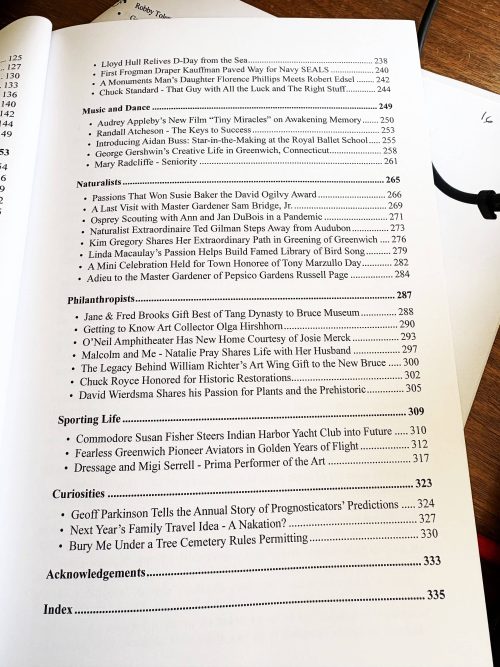
Yet the center of her work remains Greenwich. The book reflects that focus. It is arranged in 12 categories, “from Art to Sporting Life,” with a final section titled “Curiosity.” The people in it are drawn from lived encounters, conversations, and years of reporting.
“In my book you will find these 100 fascinating people — chosen from a list of 400,” she said.
Her approach is particular. She does not summarize lives. She enters them through moments—meetings, stories, places—and lets them stand. Through Sam Pryor III, she learned of wartime aviation routes organized with Pan Am founder Juan Trippe. Through the Pryor family, she traced the moment Gene Tunney met Polly Lauder in Greenwich and later developed housing for returning veterans.
Her work also records the town’s artistic and intellectual life. Maryan Ainsworth’s four decades at the Metropolitan Museum of Art appear in the book, as does her early work examining paintings “through a high-powered microscope.” Artist Peter Arguimbau is recalled for painting a Michelangelo figure on a Fifth Avenue sidewalk “to protest the over-cleaning of the Sistine Chapel.” Bing Bingham enters the narrative through a local story—a turkey on Dearfield Lane— and remains for her landscapes of southern France, “with sometimes a hidden horse.”
The talk at Christ Church moved between these lives with ease. Photographs accompanied the stories. Faces in the audience corresponded to faces on the screen. The distance between subject and listener narrowed. This was not a distant chronicle. It was a local record, assembled over time.
Semmes’s work reflects a sustained act of attention. It is built on decades of reporting, but also on presence—being in the room, asking the question, following the thread. The result is a collection that reads as both documentation and remembrance.
The book stands as a record of a town told through its people. The talk made clear that the work was the product of years, of discipline, and of a particular kind of regard—for individuals, for memory, and for this place.
Anne is a treasure, as is her book which can be found at Diane’s Books off the Avenue on Grigg Street and Dogwood Books on the Christ Church campus.