By Anne W. Semmes
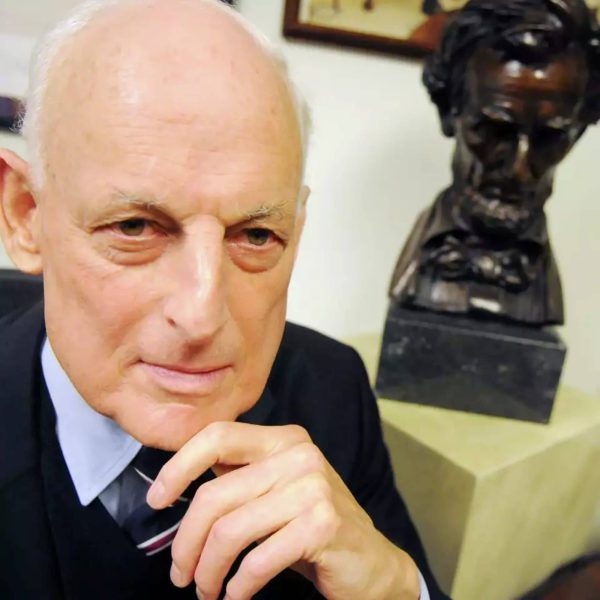
The town of Greenwich has lost a most estimable historian Lewis “Lew” Lehrman. As of Wednesday week Lew, who I knew, died at home at age 87, sadly, after years of suffering from Parkinson’s disease. Of this I did not see in July of 2014 when I last questioned him in his downtown Greenwich office on how he looked upon the Fourth of July. His memorable answers included addressing the influence of President Abraham Lincoln.
“The founders of America, led by General Washington, made the Union, the United States of America. In order to get the Union, they had to accept slavery in the states where it existed. President Lincoln recognized this flaw and inconsistency with the founding document, namely the Declaration of Independence, and then campaigned to put slavery in the course of ultimate extinction.”
Lew, an investment banker, had a passion for President Lincoln that would result in the “largest collection of rare American manuscripts in private hands in the country” via the Gilder Lehrman Collection, cofounded with “wealthy businessman” Richard Gilder.
In 2015, the Morgan Library would exhibit “Amid Swords of Civil War, a President with a Pen” with “more than 80 pieces of letters, notes, speeches and such by Lincoln himself.” Organized by the Gilder Lehrman Collection, the exhibit included 55 items from its collection.
“For Lincoln admirers,” read The New York Times exhibit review, “simply being in the same room with so many artifacts he touched will be a delight.” And I recall that formidable bust of Lincoln in Lew’s office.
And there’s more, in 1990 Lew and Gilder would create the Lincoln Prize for $50,000, “to elevate the whole field of Abraham Lincoln and Civil War studies.” In 1994, the two would partner with Gettysburg College to create the Gilder Lehrman Institute of American History “to conduct their first teacher seminar, on the Transatlantic Slave Trade…at Yale.” And “over the next 30 years, the Institute would grow and diversify to a point where Lew regarded it as his most important legacy, after his own family.”
That Lehrman family includes his widow Louise, five children, 15 grandchildren, and two great grandchildren. He addresses that family in his 2023 autobiography, “The Sum of It All.” He addressed his 60-year marriage with, “My life – so much of what I cherish – is all about Louise. She made my life worth living.”
I had the privilege of earlier interviewing Lew in 2008 about his book, “Lincoln at Peoria” that focused on a 17,300-word speech that took Lincoln over three hours to deliver on Oct. 16, 1854, six years before he won the presidency. For Lew, the speech was a “rhetorical and literary masterpiece” and marked “the turning point,” as the book is subtitled, in Lincoln’s early career “when Lincoln became the historic Lincoln we know. It includes most of his policies and programs and essential philosophy that we recognize as the great decade of Lincoln dominance of American politics.”
And it was in that speech noted Lew, “wherein Lincoln first spelled out his antislavery views, that the Declaration of Independence spoke also for black Americans.”
He cited the candidacy of Barack Obama, “a legislator from Illinois like Lincoln, along with the ascendancy of Dr. Martin Luther King would be unthinkable without the triumph of President Lincoln with the issuance of the Thirteenth Amendment, of saving the union and abolishing slavery.”
Lehrman came upon that speech in his 20’s in a 1953 book “Collected Works of Abraham Lincoln.” As I wrote back in 2008, “The speech left an indelible mark on his memory. But it took a few years before he could address the speech in a book. There was marriage, five children, grandchildren… a brief American history teaching career at Yale and Harvard, an investment career, an unsuccessful run for governor of New York on the Republican ticket (Lincoln’s party) and a lifetime of seeking, shoring up, and promoting the primary sources of American history of the 18th and 19th Century, while lecturing and writing articles about Lincoln’s legacy.”
In 2005, he was presented the National Humanities Medal at the White House for his advocacy of American history. As of 2006, his historic gathering in the Gilder Lehrman Collection equaled over 60,000 documents and other historical items now available for public use at the New York Historical Society.
But back to that 2008 interview on Lew’s book, “Lincoln in Peoria.,” as what he shared with me that day was an unforgettable profile of Lincoln.
“Mr. Lincoln – as the 16th president liked to be called – summed up the entire American experience. He represents the best of all of our historical traditions. He was human. He made mistakes but he had a well-developed political philosophy. Mary Lincoln said he was honest to a fault… He was very strong physically – he was big. He was never a bully. He was self-taught. He had fewer than 12 months of education. He was very sophisticated in economic theory and policy and interpretation. He had mastered on his own much of Shakespeare…He was a genius, but he also had the character most geniuses don’t have.”
In my last 2014 interview with Lew, I asked what project he was working on. His answer was his [to be published in 2017] book, “Churchill, Roosevelt & Company – Studies in Character and Statecraft.” “I believe,” he shared, “the facts suggest that President Lincoln was the greatest English-speaking statesmen of the 19th century, and that Prime Minister Churchill the greatest English-speaking statesmen of the 20th century. Lincoln saved the Union and abolished slavery. Churchill saved England from the slavery of Nazism, and with his allies, preserved the possibility of liberty in countries around the world.”
At this fractious, war-torn time it appears a timely read. Its flyleaf states how the book addresses the “special relationship of these two famous men,” and that Lew’s research “reveals the personal diplomacy and war policies at the core of the leadership of the Anglo-American alliance.”
Post note: My 2014 interview, “Lewis ‘Lew’ Lehrman: On Life, Liberty and Lincoln” is one of 100 profiles found in my newly published book, “Extraordinary Lives of Greenwich.”