The RMA Presents “Bridging Generations: Parenting Adult Children and Grandchildren in a Changing Cultural Environment”
By Michael LaGamma
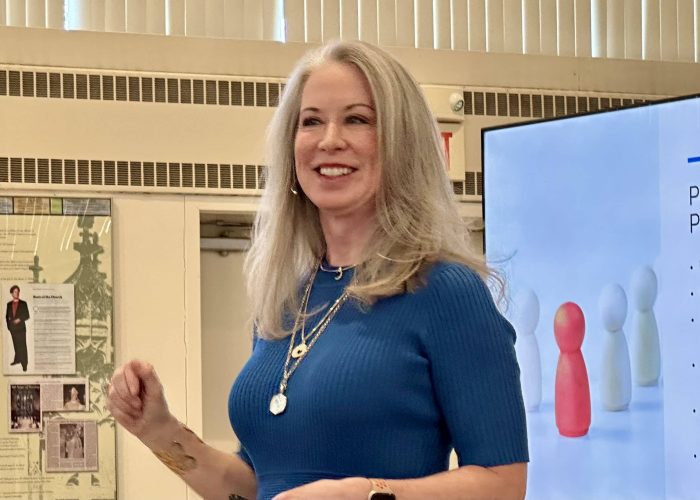
The speaker at the March 4 meeting of the Retired Men’s Association, introduced by Bob Rimmer, was Trevor Crow, a Certified Executive Coach, Licensed Marriage & Family Therapist, Certified Emotionally Focused Therapist and Supervisor, author and talk show host. Her unique expertise of relationship expert and executive coach positions her to advise family, business executives and companies on solutions for leadership and team building with an eye toward creating more diversity at the senior level. Her latest book “Blending Families: Merging Households with Kids 8-18,” co-authored with Maryann Karinch, addresses the trickiest aspects of creating step families.
Trevor began by addressing a startling reality that is increasingly documented by sociologists like Karl Pillemer. She noted that nearly 27 to 29 percent of American adults are currently estranged from a parent, a figure representing some 67 million people. To illustrate how the cultural landscape has shifted, she invoked the memory of her own grandmother, Katherine, known affectionately as KK. To her family, KK was a figure of unquestioned reverence who had survived the Great Depression and viewed food and work as the primary measures of a successful life. In that era, Trevor explained, mental health was a luxury no one could afford to discuss.
However, the modern world has undergone what she described as a massive shift toward therapy and self-care. Today’s younger generations are far more likely to set boundaries or initiate cut-offs if they perceive a relationship as toxic or damaging to their mental well-being. This shift often leaves older generations, particularly the baby boomers, feeling bewildered and blamed. Trevor shared that her own stepfather, the esteemed Harvard Business School professor Howard Stevenson, had jokingly warned her she might need a bulletproof vest to discuss these themes with a group of retired men.
The heart of her presentation delved into the biological and psychological reasons for family friction. She introduced the audience to the work of Stephen Porges and his Polyvagal Theory, which explains how our nervous systems respond to perceived threats. Using a hand model of the brain, she showed how the amygdala and hippocampus—the lizard brain—can take over during an argument, leading to a state of fight, flight, or freeze. For many of the men in the room, who had spent decades in high-pressure industries like finance, pushing down emotions was once a survival mechanism for professional success. Trevor pointed out that when this emotional shutdown is brought home, it creates a profound disconnect with children and grandchildren who crave emotional depth.
The discussion turned particularly poignant when she addressed the gender dynamics of estrangement. Statistics show that daughters are significantly more likely to become estranged from their fathers than from their mothers. She explained that while fathers often provide instrumental support, like asking about school or sports, daughters frequently seek a deeper emotional resonance that many men were never taught to provide. This gap often widens during a daughter’s adolescence, leading to what she termed an attachment wound—a sense of perceived abandonment that can linger for decades.
During the interactive portion of the morning, the vulnerabilities Trevor had described began to manifest in the audience’s questions. One member discussed the difficulty of staying connected to one’s emotions in a high-stress career. Another member, a former international real estate consultant, spoke candidly about the sacrifices he made for his family, traveling for weeks at a time only to realize in hindsight that gifts and phone calls were not a substitute for his presence. He asked what more he could have done, a question that seemed to hang heavy in the air.
Trevor offered a path toward reconciliation rooted in the concept of neuroplasticity. She argued that the human brain remains capable of change at any age through a process she called firing together and wiring together. The key to repair, she told them, is not in defending one’s past actions or offering unsolicited advice, but in active listening and validation. She encouraged the men to use the power differential inherent in their roles as patriarchs to initiate the first move toward healing. By apologizing for past hurts without getting defensive, they could begin to build new neurological pathways with their children.
As the session drew to a close, she touched upon the spiritual setting of their meeting, referencing the Lord’s Prayer and its ancient focus on forgiveness and trespasses. She reminded the men that the goal of parenting was never perfection, but the ability to repair a rupture when it occurs. Her final message to the group was one of mindful appreciation: to amplify the positive moments and to tell their families, even their sixty-year-old children, that they are proud of them. By doing so, they might transform a legacy of silence into one of connection.
The RMA’s next presentation, “Probate Law in Connecticut” by Judge David Hopper, is scheduled for 11 AM on Wednesday, March 18, 2026. RMA presentations are held at Christ Church Greenwich, Parish Hall, 254 E. Putnam Avenue, Greenwich, CT 06830.
Hon. David Hopper, Probate Judge for the Greenwich Probate District, will share Greenwich probate history, explain the critical role of wills and trust, and discuss notable Greenwich cases. The presentation offers residents practical insights into probate processes, estate planning, and avoiding common pitfalls.
Elected in 2002, Judge Hopper continues his family’s legacy—his father, Hon. Cameron F. Hopper, served 23 years from 1967-1990. With expertise in real estate, probate, wills, and trusts (University of Richmond ’87; Quinnipiac Law ’90), he oversees estate administrations, guardianships, conservatorships, and trusts for Greenwich. Judge Hopper has also served on various boards including First County Bank, Board of Health, and Transportation Association of Greenwich, and on the Republican Town Committee.
Established by the Connecticut General Assembly on July 4, 1853, the Greenwich Probate Court has exclusively served the town for over 170 years—handling probates, trusts, guardianships, and property titles. Before 1853, matters fell under the Stamford District. Today, under Judge Hopper, the court efficiently settles debts, taxes, and expenses before asset distribution, while resolving will contests.
Judge Hopper stresses proactive planning: A will directs assets, names executors and guardians, and overrides intestacy laws that can spark disputes. Trusts—living or testamentary—bypass probate, cut taxes, ensure privacy, and speed transfers, especially for complex estates or real property. “Everyone needs at least a will,” he says. “Proper planning makes probate swift; poor preparation breeds delays, costs, and family strife. Wills and trusts honor your wishes and protect loved ones.”
To stream the presentation by Judge David Hopper at 11 AM on Wednesday, March 18, click on https://bit.ly/30IBj21. This presentation will also be available on local public access TV channels, Verizon FIOS channel 24 and Optimum channel 79.
Note: The views expressed in these presentations are those of the speakers. They are not intended to represent the views of the RMA or its members.
RMA speaker presentations are presented as a community service at no cost to in-person or Zoom attendees, regardless of gender. Any member of the public who would like to receive a weekly email announcement of future speakers should send a request to members@greenwichrma.org. The RMA urges all eligible individuals to consider becoming a member of our great organization, and thereby enjoy all the available fellowship, volunteer, and community service opportunities which the RMA offers to its members. For further information, go to https://greenwichrma.org/, or contact info@greenwichrma.org.