By Anne W. Semmes
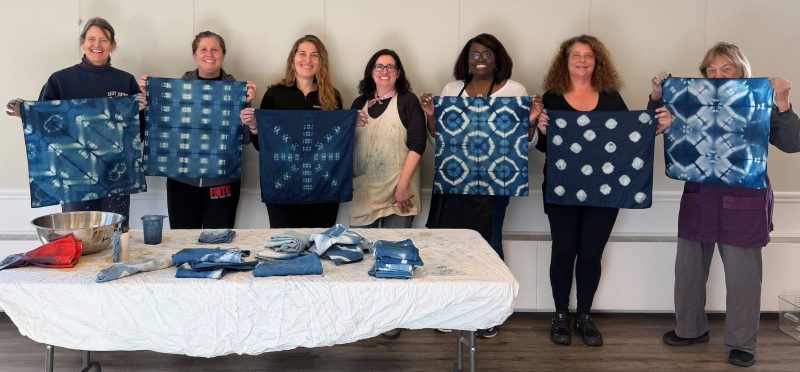
Last Saturday afternoon Laura Berkowitz Gilbert held up in her hand a small plant sporting a small green leaf, with seeds, before six curious women signed onto a workshop at the Greenwich Botanical Center entitled, “Playing with the Blues: Indigo Dye & Shibori Workshop.” Two hours later from their “playing” with the indigo dye coming from that flowering green leaf species, Persicaria tinctoria, they would each produce a thing of beauty, a bandana of their own design.
Gilbert, based in Guilford with her Tocco Studio – “creating naturally dyed fiber art and home goods,” brought her enthusiasm with her. Tocco means in Italian ‘to touch’ as her goods are “very tactile.” She grows that indigo blue plant known also as Japanese indigo and she’s been to that Japanese island of Shikoku, “where all of the indigo is grown.” “They create a kind of fermented leaf… like a compost, and it takes them four months to process the indigo… they’re turning the leaves and have these enormous batches of leaves. It’s quite labor intensive… they’re pounding it, they pulverize the leaves, then roll these little balls and bake them.” All of that to get that indigo powder.
Having learned the Japanese art of shibori Gilbert would introduce to the six women, a “resist-dyeing” technique of how to imprint dazzling designs into that indigo dyed cloth.
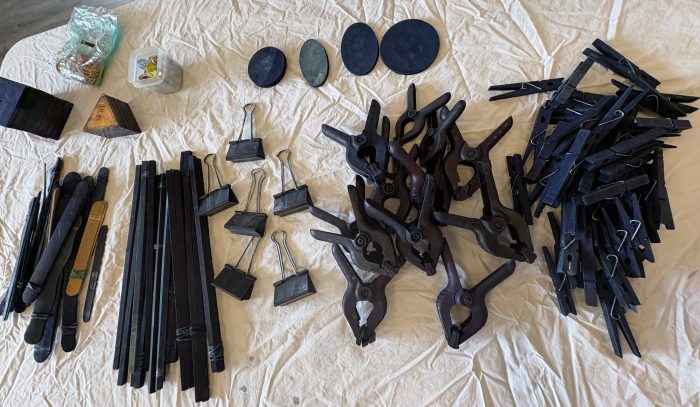
Spread across a table before her was an array of wooden tools of popsicle sticks, clothes pins, and metal clamps to employ upon a cloth to bring forth those designs. On another table sat a number of large, indigo-infused vats where those pinioned cloths, those bandanas would be dipped.
“So, shibori means to ring or press together,” she told, “We’re creating a resist – wherever there’s a tight bound area that’s going to impede the dye to coming into the fiber. That’s where you get that play of the contrast of the color of the cloth… So, there’s different ways of creating resist… you’re folding the cloth … you get more channels to allow the dye to penetrate…You’re going to hold the folds with a clip,” or secure those popsicle sticks with rubber bands. “You don’t have to think too much about it, you will get something really beautiful.”
But while everyone was busily folding this and that way and compressing their cloths with wooden tools, they were hearing Gilbert expound on the deep history of indigo across the world, tracing to ancient times. “Since textiles and dyes are pretty perishable,” she said, “there aren’t a lot of artifacts for the history of indigo.” For decades, Egyptians were thought to be the originators, “because burial cloth with indigo was found in the tombs, in the pyramids… about 4,000 years ago… But very recently they found some crudely woven pieces in a cave in Peru around 12,000 BC.” Then came the finding “a few months ago in a cave in the country of Georgia “these pebbles that revealed the production of indican, which is the precursor of indigo, dating 32,000 years ago… It might’ve been used for textiles or for paint. But what it shows is that they knew the process of taking this plant and extracting the pigment from it – that technology was known all this time. Very exciting.”
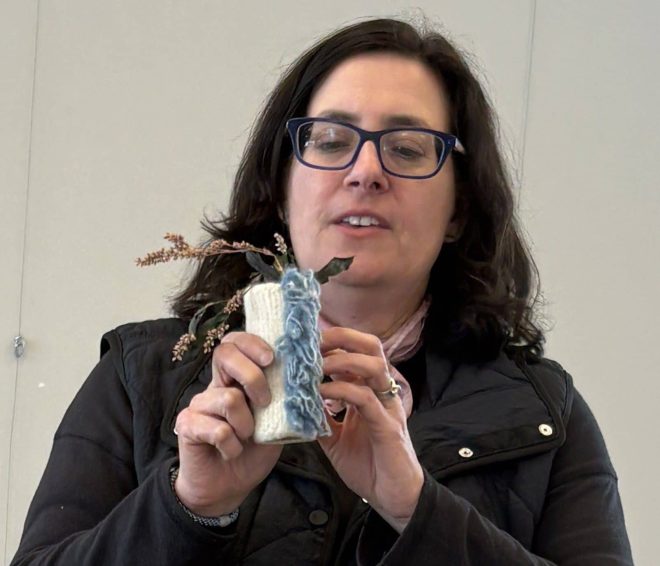
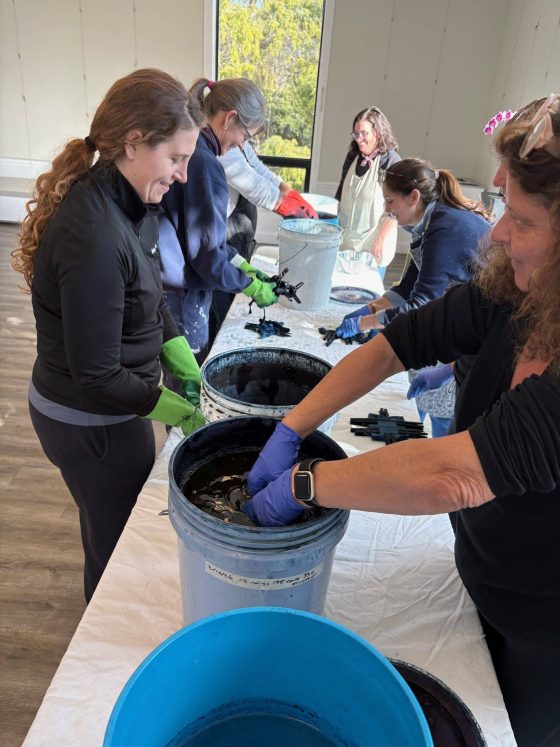
And then it was indigo dying time. “So, this is the indigo vat and this is the drip bucket… So, each time you’re putting something in and swirling it around, you’re introducing some oxygen… and when you’re dripping it [over the drip bucket], that would be introducing oxygen. Are you squeezing it?… What I learned from one of the Japanese master dyers, it’s all about the squeezing… So, if you’re using the wooden tools, it’s harder to squeeze everything, but you just do the best.” So, after the squeezing, you place your cloth bundle atop the table and its “already looking blue. So, you just kind of want to open [those folds] to expose as much as possible to the atmospheric oxygen.”
That dying process would include three dunking’s, and “to get that really dark color…You don’t want to bring it up. If it was above the surface, it would start oxidizing… I’ll just bring it up so you can see. It’s like a yellowish green.” Then you leave it there [atop the table] for 10 minutes until you don’t see any more green.”
“To be a master dyer,” she told, “you have to consistently get these gradations of color. It’s very difficult to get. In Mali, there’s a whole kind of cosmology and mythology around it. It’s a very spiritual practice… they have 12 shades… And each color has its own beautiful name. So, the first, the palest of blue is called ‘The Blue of Nothingness.’ And the darkest, that’s practically black is ‘The Glued Midnight.’ It’s just so beautiful.”
Closer to home, Gilbert told another tale of those pre-revolutionary days when the production of indigo, especially in South Carolina, was their number two export “that made fortunes for a few families. It was very profitable to export because it was so light, when you create the powder or the cakes from it, you could put a lot of it on the ships, because their main customer was the British industrial industry. It became very coveted – and everyone loves blue. But it was so labor intensive, when the revolution came, they lost their main customer, the British Empire.” And then “as more slaves were imported, cotton became replaced as one of the main exports.” The British Empire would turn to other parts of their empire, to India, “where indigo grows like a weed, and they forced a lot of the farmers there to stop growing rice to grow more indigo, so it led to a lot of famines because there wasn’t enough food for them.”
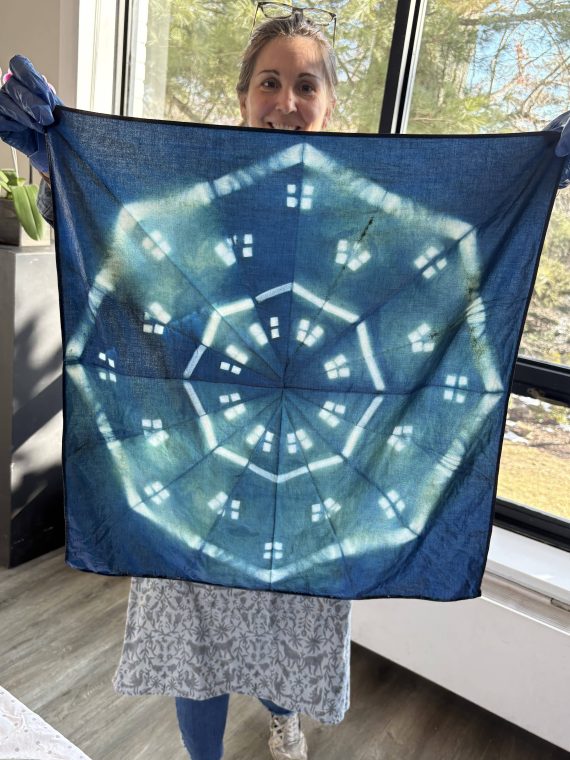
By 3:15 Gilbert’s indigo dye workshop was coming to a close, as each participant began to unfold their indigo designed bandanas. There were spider web designs, triangles, squares, snowflakes, and lots of dots. “I love it, I love it!” shouted one of the six indigo dye first time designers, holding her creation up for all to see.
For more information about Laura Berkowitz Gilbert, visit her website at toccostudio.com