By Mary A. Jacobson
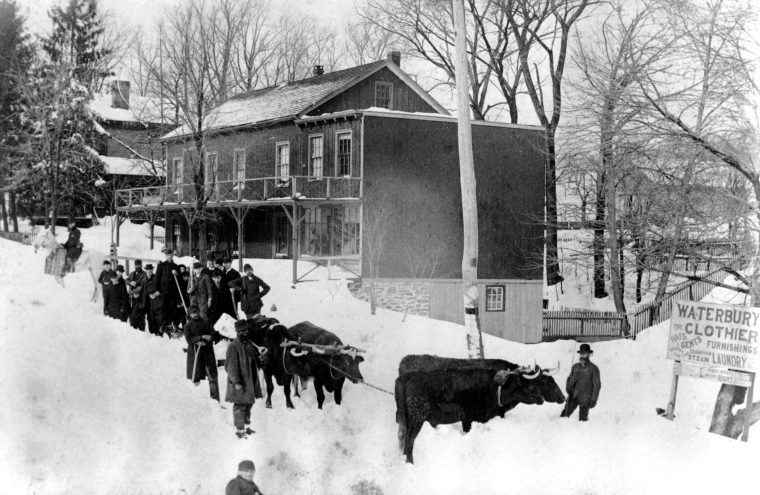
The winter of 20252026 is one of the harshest ones remembered by many Greenwich residents in a very long time. With thermometers reading zero degrees and wind chill temperatures in the negative double-digits, with ice and over a foot of snow lingering seemingly endlessly, it is a winter.” With that in mind, it seems fitting to resurrect the remembrances of numerous past Oral History Project narrators who can recount their winter recollections and perhaps give ours a different perspective.
Horace Bassett, a Greenwich dentist born in 1905, was interviewed in 1976 by OHP volunteer Richard W. Howell. He reminisced about the winter of 1918, one of the harshest in his memory. At that time, coal to heat homes “was delivered to Greenwich by barges, not by railroad… Greenwich harbor was completely frozen, so the barges couldn’t get in (to Steamboat Road). The schools were closed because they ran out of fuel… It froze all the way out to the Captain’s Islands.” Horses pulling sleighs traveled on the ice to the stranded barges to transport coal to Maher Brothers, a coal importer on Steamboat Road.
Being young and carefree, Horace and some friends walked over the ice that year to Island Beach to visit its caretaker there, Fred Metzger. Metzger asked the boys to return the next day with his mail from the Post Office and the teens readily agreed. The next day “it must have been towards the end of the cold spell, because the ice was rather weak. My dad happened to be down around Indian Harbor. He saw us out there, met us halfway, and just reprimanded us very severely… Even today I think of what might have been if that ice had caved in.”
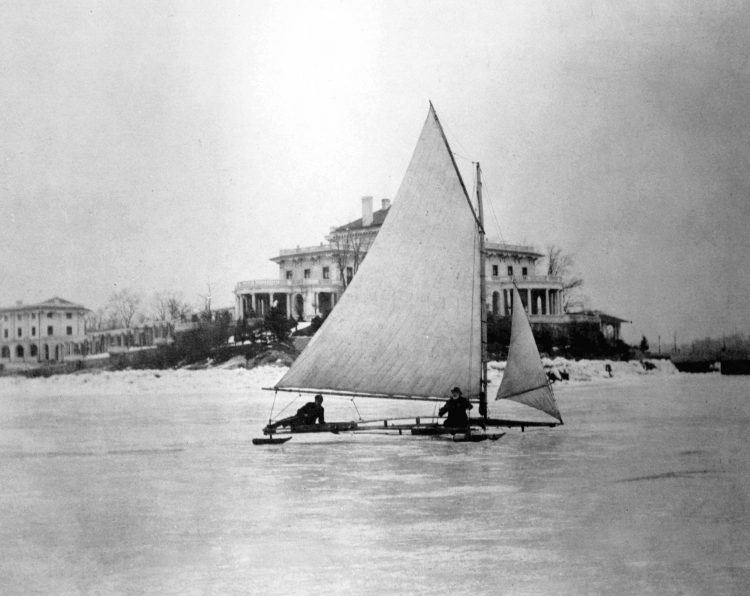
Another remarkable year was 1934. William Erdmann, captain of the Island Beach ferry for thirty years, was interviewed in 1975 by OHP volunteer Marge Curtis. As a young man of 24, he recalled that “in 1934 we had a particularly severe winter. It was a combination of real cold weather and no wind, so the Sound was frozen over.” The ice “got real thick at that time. I skated out to the island Ice boating in Greenwich Harbor. Courtesy of Greenwich Library. (Island Beach) to visit the Metzger family who were very low on food supplies. I thought to myself, ‘Boy, I’m a dope for ever being out here on skates all alone.’”
The next time he went to Island Beach, in order to deliver food to the Metzgers, Erdmann put his rowboat on a sled. “I’d pull the boat up on the ice and put the sled underneath it, and I’d walk the rest of the way back in, towing the boat.”
Erdmann had a theory to explain that “awful, heavy ice… That was Depression days, and they just didn’t have much boat traffic, either. So, as long as there was no boat traffic to keep the ice broken up, the ice just got stronger and thicker and thicker and stronger.”
Hugh Dougherty served as dockmaster at Tod’s Point for many years. He was interviewed by Esther H. Smith in 1975 at the age of 72. “We seemed to have much more bitter winters in those days than what you have today, and the Sound would freeze up almost every winter.” He described how, at high tide, along the shore, the ice would “break into cakes and you had what we called ‘cakey.’ Then to get back and forth you had to walk the cakes. I do remember my father being on one and the cake turned over and dumped him in the water… Luckily, we had very few drownings… Old Captain Gardner, who was a very cautious man, warned us if we ever went out to the lighthouse, be sure and take a long sled with us so that if the ice started to get weak at all, you could get on the sled and spread your weight out over a greater area. Then you’d push it along until you got back onto hard ice again.” One of Dougherty’s favorite pastimes was on an iceboat with “a very light frame, with runners on it and a goodsized sail. It did go very fast and it was bitter cold riding on it.”
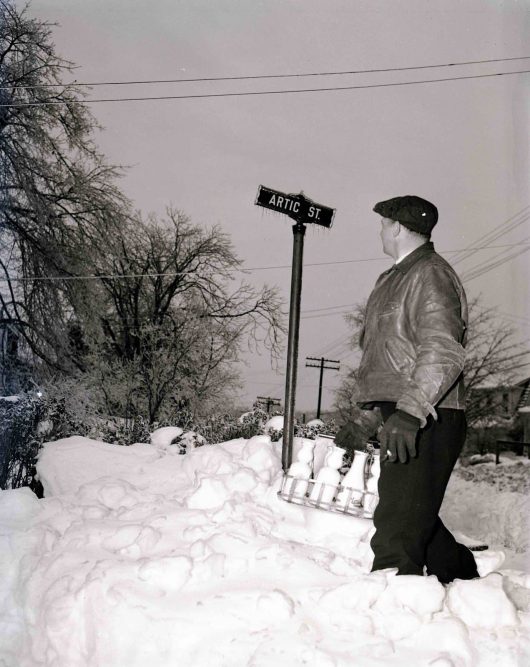
Cherry Grafton Taylor had somewhat less dramatic, but no less memorable times skating on icy ponds, which she related to OHP volunteer Marjorie Schwier in 1989. “It seemed to me that we had many, many weeks of ice skating and we would take lanterns and skate at night in the moonlight. There’s a pond we used to call Shop Pond where there was an old mill. That was a beautiful place to skate at night when the moon was full and the ice was very thick and black. “Sometimes we would make sails out of an old bedsheet and let the wind take us from one end of the pond to the other.” She, too, had memories of the Blizzard of 1934 “skiing down to Glenville to get milk and eggs.” There was purportedly more than three feet of snow that year in Greenwich and the snowplows couldn’t maneuver. “It was quite a horrendous blizzard.”
Space does not allow us to include the classic nor’easter of 1888 with snowdrifts of twenty feet, or the storm fiftynine years later in 1947, which dumped 25 inches of snow, again stranding residents with dwindling fuel and food. Yet, with these harsh winters and others to follow, the sense of community and the kindness of Greenwich neighbors to one another have remained notable, steadfast, and true.
The Oral History Project is proud to present blogs derived from its collection of recorded interviews as part of the Project’s celebration of “America’s 250th | Greenwich – Greenwich History is American History.” The OHP is sponsored by Friends of Greenwich Library. Visit the website at glohistory.org. Interviews may also be read in their entirety or checked out at the main library. They are also available for purchase by contacting the OHP office. Our narrators’ recollections are personal and have not been subjected to factual scrutiny. Mary Jacobson serves as blog editor.