By Mark Pruner
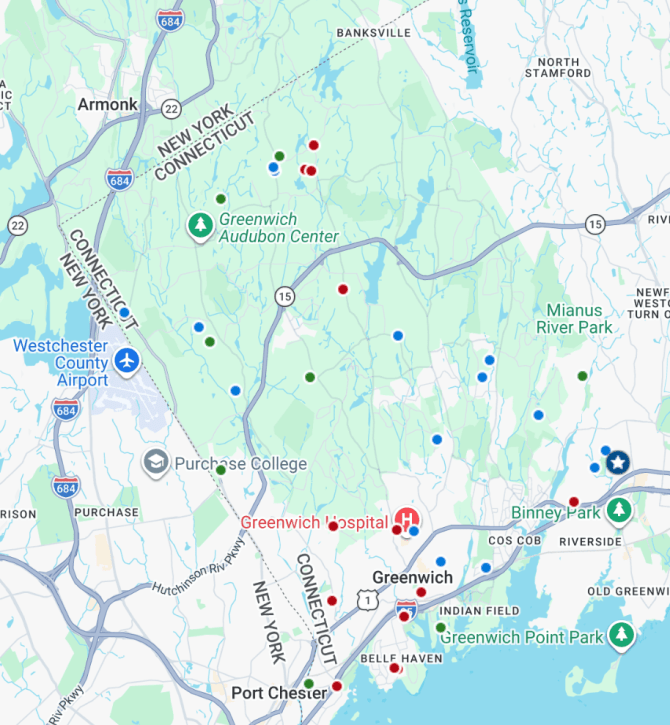
If you want to build a house, you need a piece of land to build it on. This week you have 8 options and half of them are in the northern section of town. We have 4 listings in backcountry. We have one listing each in mid-country, Byram, Belle Haven, Riverside and in Old Greenwich.
Most of those “land” listings aren’t really land listings. Only 4 of the 8 are actually raw land listings. The other 4 properties have a house on them; These properties have just been dually listed as both residential and land listings, since the agent thinks that the house is likely a teardown.
On the sales side we have had 18 “land” sales in 2025 this down from 32 land sales in 2024. These land sales are where the land listings are with 6 of the 18 land sales being in backcountry and mid-country. We have also had 2 sales in central Greenwich and two in Old Greenwich. The other sections of town only had 1 sale each.
Curiously, in a market this hot with such limited inventory, we have had 14 land listings expire. Of those, 6 were South of the Post Road and 3 were in backcountry. We also had 2 land listings expire in Glenville. Price didn’t seem to be a factor in whether a land listing expires. Under $1 million 2 listings expire, between $1 million and $2 million, 5 expired between $2 – 5 million price and 5 expired over $5 million.
Less than 1% is available for sale as land
As you can see there is not much land for sale in Greenwich, which is interesting given that Greenwich is the second largest town in Fairfield County after Newtown. Curiously, it’s hard to put an exact number on just how much land we have. Lots of websites use 47.83 square miles as the area of Greenwich, but a town annual report says 50.6 square miles. Wikipedia says 67.2 miles, but this includes the water.
Luckily, the Realtors in town don’t sell much water, though for the lowest priced listings in Greenwich are boat slips on the Mianus estuary. You can also buy offshore clam beds.
If we take the 47.83 square miles number and multiply it by 640 acres per square mile, we come up with 30,611 acres which is quite a bit of land. Divide that by the 96.4 acres that we have sale and only 0.31% of our total acreage in Greenwich is listed for sale as land.
The average price for a land listing is high at $9.2 million versus our average single family home listing of $6.8 million. (Now if you’re like me, you probably asked yourself, how could our average list price be so high. It’s because we have so little to sell at the low end. Our median/midpoint list price for a house is $6.9 million. This means that half of our house listings are above that with many way above that price, pulling the average house list price up.)
Never developed land in Greenwich is a particularly rare commodity. In the last 386 years since Greenwich’s founding, just about every lot worth building on has been built on. We get most of our raw land listings from subdivisions of oversized lots where the house is on one lot and the formerly empty extra acreage becomes another lot or lots.
Fire, unfortunately, is also another source of “raw” land as it doesn’t take much of a fire to condemn a whole house. The smoke damage, and the water damage from putting out the fire, often mean that the total cost to clean up the house, eliminate the smoke smell from carpets, walls and ceilings as well as to reconstruct the actual fire and water damaged areas can quickly exceed the costs of building a new house.
Land sales appear artificially low
So how do land sales compare to house sales? If you look at the raw numbers, the answer would be not well. In 2025, we only had 18 sales that totaled 27.1 acres of land and averaged 1.5 acres on average. On the single-family home sales side, we have had 519 sales that totaled 832 acres or an average of 1.6 acres per sale.
The poorer sales for land are partially an artifact of the way that sales are reported on the Greenwich MLS. As mentioned, most land listings actually have a house on the land and are usually co-listed as a residential listing. When the property sells, the agent has to change the status on one listing to “sold” and the other listing to “cancelled”. Most agents pick the residential listing to be the sold listing and cancel the land listing. The result is that sales of listings for land are significantly under-reported. In 2025, we had 15 cancelled land listings compared to 18 land sales.
Tips on working with developers on land sales
I’m part of the Greenwich Streets Team at Compass and we deal with a lot of builders and developers. To their credit, none of the builders that I know of don’t want to be known for building cheap houses. Cheap construction doesn’t sell in Greenwich. (PreCovid, an out-of-town builder tried to do that in Pemberwick using lots of plastic, on the front porch, on the siding and in the windows. It was a tough sale. The house hung around for a long time and sold well below its original list price.)
Builders are interested in getting the land for as cheap as possible as every dollar they save is an extra dollar of profit. Agents who work with developers know what they are looking for and will often contact owners of developable land directly, often by letter, to see if they might want to sell. (Owners should be a little cautious as a few agents have been known to exaggerate just how active the buyer is to get a listing.)
A developer/buyer needs a low price if they are to make a profit with the rise in the cost of materials and labor in the last few years. The oft-repeated rule is a third, a third, a third, i.e. one-third for land purchase cost, one-third for construction costs and one-third for profit. I looked into that preCovid, and the ratio was more like 40:40:20. Most developers would be ecstatic to get a 33% profit.
When we represent developers, we have several nonmonetary incentives that can make a developer’s lower price more appealing to a buyer. For example, the closing date can be flexible. Some buyers want a quick close and no mortgage contingency and our more well-financed sellers can do that.
Another non-monetary benefit is epitomized by a seller I had in Riverside. She was older, disabled widow who was moving to a senior care facility. She needed a longer closing time to arrange for her children to take the furniture they wanted, arrange a tag sale and sign a contract with the place where she was moving. In that case I asked that the seller be allowed to leave whatever she wanted in the house that is being torn down. This not only saved the seller money, but it was also a major time saver and stress reliever. A lower price from a developer does not necessarily mean a lower value to the seller.
Custom building your own home
Land listings are unique and need to be looked at carefully. If you plan on building a custom house in a new development, it really helps to know what the neighbors are going to build. If you have two large, beautiful, newly built houses on each side of the land you are
If you want to build a house, you need an agent and architect who are familiar with the requirements at planning and zoning, wetlands, f loor area ratios, setbacks, green areas, wells or town water, and septic or sewers. When you are building your dream house, you have lots of options, but also lots of rules to follow, but in the end, you will have a house built just the way you want.
If you will only be in the house for a few years, you may want to be careful how many “custom” features that you put in just for you. I have seen worldclass, custom rooms for fly-tying f ishing lures, museum shelving for both baseballs and Star Trek memorabilia, present wrapping rooms and sewing rooms.
Having money gives many Greenwich homeowners options, just realize that the next buyer is unlikely to have the same avocation as you do. These new buyers may actually see these custom rooms as having negative value as all that hard work has to be removed and the room redone.
Land is precious and hard to find and raw land even more so.
Mark Pruner is a realtor with Compass Connecticut. He can be reached at 203-817-2871 or mark.pruner@compass.com.