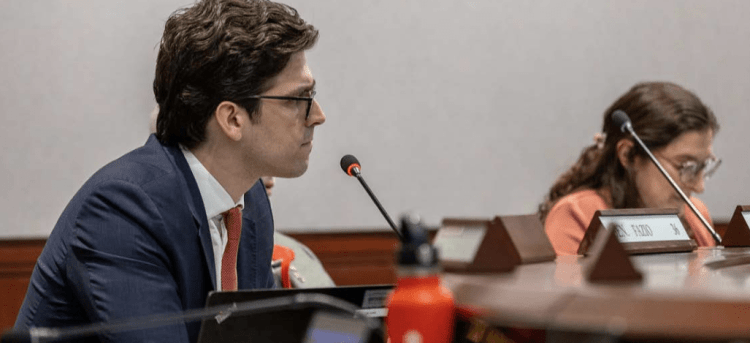
State Sen. Ryan Fazio testified Feb. 17 before the General Assembly’s Housing Committee in opposition to S.B. 151, arguing the proposal would further erode local zoning authority and fail to address the underlying drivers of housing costs.
S.B. 151 would impose statewide zoning standards, including capping residential lot sizes at 5,000 square feet — approximately one-tenth of an acre — limiting setbacks to as little as five feet, and prohibiting municipalities from enforcing certain local size and height restrictions. Fazio said the measure would “effectively outlaw light-density neighborhoods” and transfer zoning authority from towns to the state.
“The ink is barely dry on a sweeping housing law passed in November that fundamentally altered the relationship between the state and our municipalities,” Fazio told lawmakers. “That law imposed more than 50 new mandates on towns and was released just an hour before debate, without a public hearing. Towns are still trying to understand their obligations — and now we are being asked to go even further.”
Fazio has opposed prior housing measures that expanded state oversight of local land-use decisions, including H.B. 5001 and H.B. 8002. He characterized those bills as broad mandates that limited municipal discretion.
“Why even pretend to negotiate with towns through prior legislation if we are simply going to override them again?” Fazio said. “Communities deserve transparency and respect, not a moving target.”
The senator framed his opposition as a defense of Connecticut’s long-standing home rule tradition, under which municipalities retain primary authority over zoning and land-use planning. He warned that centralizing decisions in Hartford would disrupt community planning efforts and undermine local accountability.
While criticizing S.B. 151, Fazio said he supports housing expansion when pursued through what he described as targeted, locally responsive policies.
“We need more housing and greater affordability. Zoning is not sacrosanct,” he said. “I support accessory dwelling units, mixed-use residential development, and sensible workforce housing. But centralizing power in Hartford is not the solution.”
Fazio argued that housing affordability cannot be addressed solely through zoning changes. He pointed to broader cost drivers, including state mandates imposed on municipalities, labor regulations affecting skilled trades, and energy prices.
“If we are serious about affordability, we must eliminate costly mandates, reduce artificial barriers for workers and apprentices, and bring down energy costs,” he said.
Supporters of statewide zoning reforms have argued such measures are necessary to increase housing supply and reduce barriers that limit development in high-cost communities. Fazio contended that S.B. 151 would override local planning processes without resolving systemic cost pressures.
He concluded his testimony by urging the committee to reject the proposal.
“The government that governs closest to the people governs best,” Fazio said. “We can create a more affordable Connecticut while defending local democracy, but this bill is not the way forward.”
The Housing Committee has not yet voted on S.B. 151.