The Greenwich Tree Conservancy is dedicated to advocating for and planting trees, but what exactly is a tree? The answer may seem obvious, yet it turns out to be more complicated than most people expect.
Scientists generally describe a tree as a tall plant, at least 10 to 15 feet high, with a long, woody trunk that supports branches and leaves. By contrast, shrubs are usually defined as woody plants under 10 feet tall that often have multiple stems rather than a single trunk.
It seems simple enough, except that these definitions can be surprisingly slippery. The very same plant species may grow in a shrub-like form under one set of conditions and take on a tree-like form under another. Height and structure alone don’t always tell the whole story.
Adding to the confusion are plants that look like trees but don’t quite fit the definition. Banana “trees” can grow tall and leafy, but their trunks aren’t made of wood at all. Instead, they consist of tightly layered leaf stalks. Bamboo can reach impressive heights and produces hard, woody tissue, but it has hollow stems instead of a dense trunk, and is structurally unlike other plants we think of as trees.
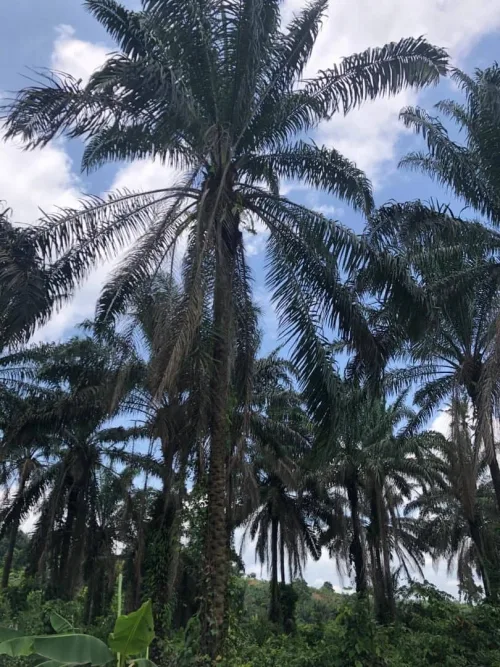
Palm “trees” raise even more questions. Some palms soar over 100 feet tall and are commonly referred to as trees, but biologically they are quite different. Palms lack true bark and instead have layers of fibrous tissue left behind by previous leaves. Their vascular systems are arranged in bundles throughout the trunk rather than in a continuous ring beneath the bark, as in most trees.
If this seems complicated, taxonomy only deepens the puzzle. In biological classification, organisms are grouped by shared evolutionary ancestry. Cats, for example, belong to the family Felidae, a group descended from a common ancestor. Trees, however, have no equivalent taxonomic category.
Trees are scattered across many different evolutionary lineages. Fossil evidence suggests that woody plants have evolved from herbaceous plants, and herbaceous plants from woody ones, many times throughout Earth’s history. Peaches, plums, and almonds are trees in the rose family, making them more closely related to roses than to oaks or maples. Acacias and black locusts belong to the legume family and are more closely related to chickpeas and soybeans than to most other trees.
In other words, “tree” is not a category defined by shared ancestry, but by appearance and anatomy.
This evolutionary pattern becomes even clearer on islands. A recent study of plants in the Canary Islands found that woody, tree-like forms evolved independently as many as 38 separate times. Why does this happen so often? Fossil evidence suggests that some of the earliest land plants with vascular tissue could produce woody stems. Even today, many herbaceous plants form small amounts of wood-like tissue, and every towering tree begins life as a small, non-woody seedling. From an evolutionary perspective, herbaceous plants already contain all the biological building blocks needed to become trees and only a few evolutionary changes are required for them to develop a woody form.
So what is a tree? Scientifically, the answer is complex. But for the Greenwich Tree Conservancy, it’s refreshingly straightforward. Connecticut’s climate eliminates most palms, banana “trees,” and Joshua “trees,” leaving us with the traditionally woody species that thrive here. While we generally avoid planting shrubs, our focus is simple: to plant and protect the trees best suited to our environment, helping to create a Greenwich that is greener, healthier, and more beautiful.