By Charlie Shapiro
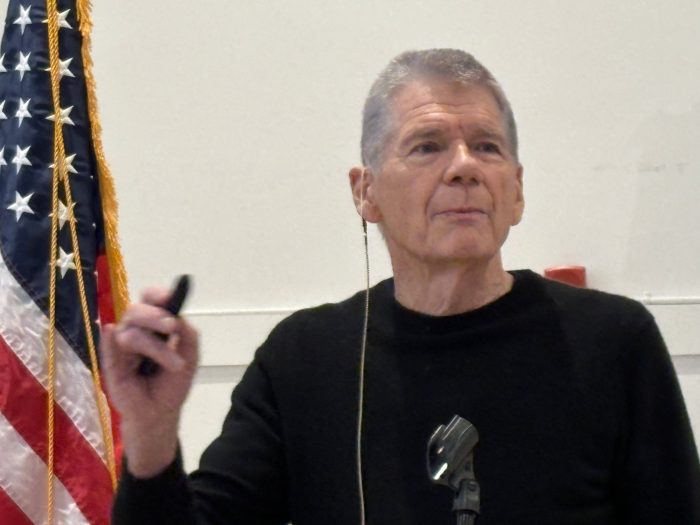
At the January 14th meeting of the Retired Men’s Association the speaker, Dr. Rick Lawrence, was introduced by Spike Lipschutz. The subject: “How Will Artificial Intelligence Impact Jobs and the Economy?”
Two years to the day after his last appearance before the group, Dr. Lawrence delivered a sobering assessment of a world being remade by artificial intelligence (AI). He began his presentation with a rare admission of professional humility, stating that he had significantly underestimated how rapidly AI capabilities would develop. When he spoke two years ago, AI hallucinations were a frequent punchline, often because the models lacked real-time internet access. Today, he explained, those models are fully integrated with the web and are increasingly replacing white-collar workers in roles that require high-level cognitive precision.
The heart of the discussion centered on the tangible impact of AI on the American workforce and economy. Dr. Lawrence presented data from a Stanford University study titled Canaries in the Coal Mine, which used payroll data from the firm ADP to track millions of workers. The findings were stark: since the public release of ChatGPT in November 2022, there has been a 20 percent decrease in the number of entry-level software developer jobs for young workers. He explained that while senior workers have remained in place for now, the “pyramid effect” of failing to hire young talent would likely ripple upward through management and strategy roles within five years.
The speaker introduced the concept of the GDP Value benchmark, a rigorous study involving OpenAI and industry experts. This benchmark evaluated AI against humans on complex tasks that affect over 50 percent of the U.S. gross domestic product. Dr. Lawrence described how industry experts performed blinded, pairwise comparisons of work deliverables. In a result he called astonishing, the most recent version of one AI model was judged superior to human experts 71 percent of the time. The tasks were not simple multiple-choice questions but involved seven hours of expert labor, such as creating a competitive landscape for last-mile delivery services using complex documents and spreadsheets.
The conversation then shifted to the global stage, specifically the competition between the United States and China. Dr. Lawrence argued that while the U.S. currently leads in high-performance chips thanks to Nvidia, China is rapidly closing the gap in other critical infrastructure. He shared data from the Department of Energy showing that China’s electrical power generation from renewable sources has skyrocketed, while U.S. capacity has remained largely stagnant. He warned that the massive data centers required to train AI models could consume up to 12 percent of the U.S. electricity grid by 2028, potentially driving up residential prices and sparking public revolts.
Policy failures were a recurring theme. Dr. Lawrence criticized the decimation of federal science funding, noting that the National Science Foundation budget had been slashed from nine billion dollars to four billion dollars. He pointed out that major breakthroughs like the mRNA vaccine, which saved millions of lives during the pandemic and won a Nobel Prize for researchers like Katalin Karikó and Drew Weissman, were the results of decades of government-funded research that is now at risk. He also highlighted the contributions of non-native researchers. He mentioned that of the eleven “AI superstars” recently hired by Mark Zuckerberg at Meta for compensation packages as high as 100 million dollars, ten were born outside the U.S., with seven hailing from China. He warned that tightening H-1B visa restrictions would kneecap the American tech industry, as the vast majority of PhD talent in machine learning comes from international pipelines, particularly from institutions like Carnegie Mellon University.
Dr. Lawrence also addressed the financial mechanics propping up the AI industry. He described how companies are using special purpose vehicles and asset-backed securities to fund data centers, keeping massive debts off their balance sheets. He introduced the perspective of Michael Burry, the investor famously portrayed in The Big Short for predicting the 2008 financial crisis. Dr. Lawrence noted that Michael Burry is currently shorting Nvidia and other AI companies, arguing that the industry is treating rapidly depreciating technology hardware like 30-year real estate assets.
The presentation took a somber turn when discussing the social implications of AI. Dr. Lawrence mentioned a tragic murder-suicide in Greenwich involving a participant’s harmful emotional relationship with an AI chatbot. He argued that current regulations are woefully inadequate. He noted that while Sam Altman, the CEO of OpenAI, had previously asked Congress for regulation, that momentum has stalled. He expressed concern that David Sacks, who was appointed to oversee AI and crypto strategy in Washington, holds personal investments in dozens of AI firms, creating a difficult environment for objective federal oversight.
In a concluding reflection on the human element, Dr. Lawrence spoke about his two grandchildren, both under the age of three. He admitted that despite his decades of expertise at IBM Research, he has no idea what their educational or career trajectories will look like. He noted that the U.S. economy has traditionally transitioned workers from goods-producing roles to service roles, but with AI now targeting high-end service jobs, there is no clear “third rail” to catch those who are displaced. He called for a national initiative on the scale of President John F. Kennedy’s moonshot to prepare the workforce, praising IBM CEO Arvind Krishna for pledging to train two million people in AI skills. Without such a massive effort, he suggested, the country is merely rearranging deck furniture on a sinking ship.
The RMA’s next presentation, “Warfare on Long Island Sound During the American Revolution” by Ed Hynes, is scheduled for 11 AM on Wednesday, January 28, 2026. RMA presentations are held at Christ Church Greenwich, Parish Hall, 254 E. Putnam Avenue, Greenwich, CT 06830.
This exciting lecture, which has just been updated, reveals the action, intrigue and terror of the people living around Long Island Sound during America’s War for Independence. With the Connecticut and Long Island coasts less than 10 miles apart in many sections of the Sound, raiders crossed every fair night either to smuggle and/or steal goods, and kidnap or kill enemies. Spies, on both sides, rounded out this dangerous cast of characters.
The economic blockade between British occupied Long Island and Patriot led Connecticut led to this violent conflict. But bitterness and desire for vengeance was fueled by the fighters’ familiarity with one another. Families and communities were ripped apart as Patriots in Connecticut expelled Loyalists and Loyalists on Long Island banished Patriots. Rabble-rousers on both coasts knew exactly where their enemies lived and it is not surprising that they started to violently attack each other.
New research into the Privateers in CT and the British reaction tell a more vivid story. The Privateers (legalized Pirates) were very effective at hindering the British war effort. But the towns that supported their activities paid a terrible price due to the English’s scorched earth policy to destroy the inhabitants and their towns.
One attack vessel of choice was the whaleboat. These boats were powered by up to 10 men and measured about 25 feet in length. Some had a sail and/or a swivel gun on the bow; they were very maneuverable and could operate quietly. These shallow boats were easily hidden in the many inlets and islands of the Sound.
Ed Hynes, CFA is a native of Wilton, CT. He and his late wife have traveled extensively to various battlefields around the country and overseas. In addition to his interest in history, Ed works as a financial advisor in Stamford, Connecticut. Ed’s contact information is (203) 838-1025 or ed@edhynes.com.
To stream the presentation by Ed Hynes at 11 AM on Wednesday, January 28, click on https://bit.ly/30IBj21. This presentation will also be available on local public access TV channels, Verizon FIOS channel 24 and Optimum channel 79.
Note: The views expressed in these presentations are those of the speakers. They are not intended to represent the views of the RMA or its members.
RMA speaker presentations are presented as a community service at no cost to in-person or Zoom attendees, regardless of gender. Any member of the public who would like to receive a weekly email announcement of future speakers should send a request to members@greenwichrma.org. The RMA urges all eligible individuals to consider becoming a member of our great organization, and thereby enjoy all the available fellowship, volunteer, and community service opportunities which the RMA offers to its members. For further information, go to https://greenwichrma.org/, or contact info@greenwichrma.org.