By Emma Barhydt
The Flinn Gallery, located within Greenwich Library and long valued as one of the town’s most reflective exhibition spaces, is currently closed for installation ahead of its next exhibition, Performative Stories, which opens January 15 and remains on view through March 3. The temporary closure—from January 8 to January 15—marks a moment of transition that aligns closely with the exhibition’s central concerns: movement, pause, and the spaces where meaning quietly forms.
Co-curated by Leslee Asch and Kate Sheridan Chung, Performative Stories brings together four multidisciplinary artists—Dan Hurlin, Maiko Kikuchi, Janie Geiser, and Jason Gardner—whose work explores how narratives can be carried not only through language or imagery, but through physical implication and suspended action. These are works that suggest performance without staging it, asking viewers to recognize motion even when none is directly shown.
At the core of the exhibition is the idea that some objects are not meant to resolve themselves at a glance. In live performance, movement unfolds in real time. In the gallery, that movement is interrupted—held long enough to be examined. The figures, images, and forms in Performative Stories appear to have paused mid-gesture. What precedes and follows that pause is left deliberately open.
Dan Hurlin’s work reflects his long engagement with puppetry, theater, and social history. His figures feel weighted by experience, marked by endurance and waiting. Even in stillness, they suggest prior action and future consequence. Hurlin’s practice resists clear categorization, and in this exhibition his work occupies a space between sculpture and performance— objects that feel temporarily stilled rather than fixed.
Maiko Kikuchi approaches storytelling through collage and color, layering acrylic paint, colored pencil, paper, and photographic elements into compositions that feel rhythmic and deliberate. Her images hover between abstraction and narrative clarity, offering structure without closure. Kikuchi does not instruct viewers on how to read her work; instead, she provides visual cues that allow meaning to remain flexible and personal.
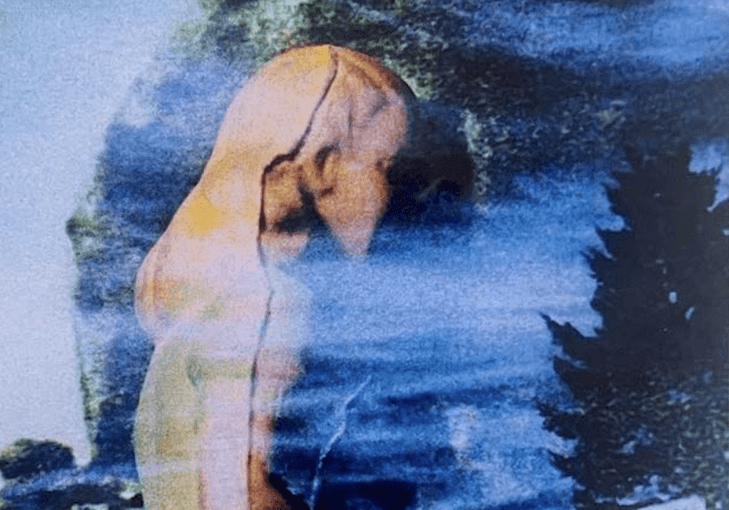
Janie Geiser, an experimental filmmaker, contributes work shaped by cinematic thinking. Her still images retain the atmosphere of motion, suggesting change through blur, layering, and tonal shift. In works such as Ghost Algebra #1: Girl and Wind, narrative is felt rather than stated, suspended between memory and dream. Geiser’s presence in the exhibition reinforces the idea that movement can exist as suggestion rather than event.
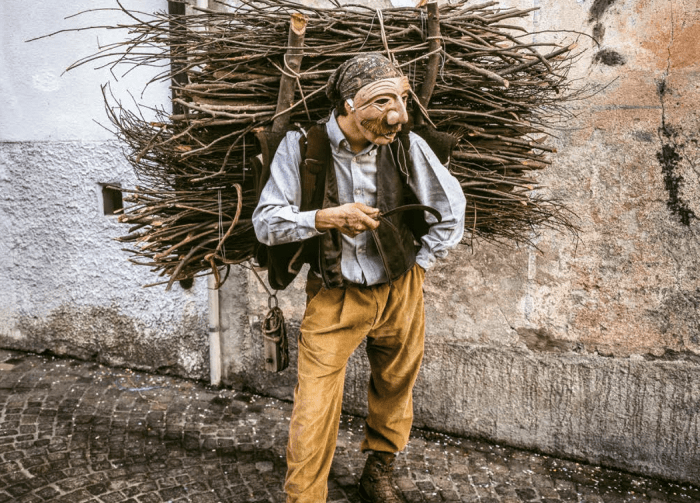
Jason Gardner’s photography grounds the exhibition in lived ritual and communal experience. His ongoing documentation of Carnival traditions across Europe captures figures transformed by costume and custom, moments when identity becomes collective and performative. In Ti Terjasti (The Thread Men) from Cerkno, Slovenia, Gardner records traditions rooted in place while acknowledging their continuity across generations. His images balance specificity with restraint, allowing the cultural weight of the subject to speak for itself.
The exhibition resists linear storytelling. There is no prescribed order, no single narrative arc to follow. Instead, Performative Stories assumes an engaged viewer—one willing to assemble meaning from fragments and pauses. That approach feels particularly suited to the Flinn Gallery, a space designed not for spectacle but for sustained public exchange.
Public programs will extend the exhibition beyond the gallery walls. An opening reception is scheduled for January 15 from 6:00 to 8:00 pm. On January 17 at 2:00 pm, an artist talk featuring Jason Gardner and Dan Hurlin will offer insight into two distinct approaches to storytelling— Gardner through documentary immersion and Hurlin through performative construction.
As the Flinn Gallery prepares to reopen, Performative Stories distinguishes itself by refusing to behave like an exhibition that wants to be quickly understood. These works are not illustrative, explanatory, or decorative. They operate more like prompts—fragments of action, ritual, and narrative that stop short of completion. What emerges is not a single story but a condition: the sense that meaning is provisional, assembled moment by moment by whoever happens to be standing in front of the work. In a space devoted to quiet public exchange, that restraint feels intentional rather than aesthetic. The exhibition does not perform for its audience. It allows the audience to do the work.