By Anne W. Semmes
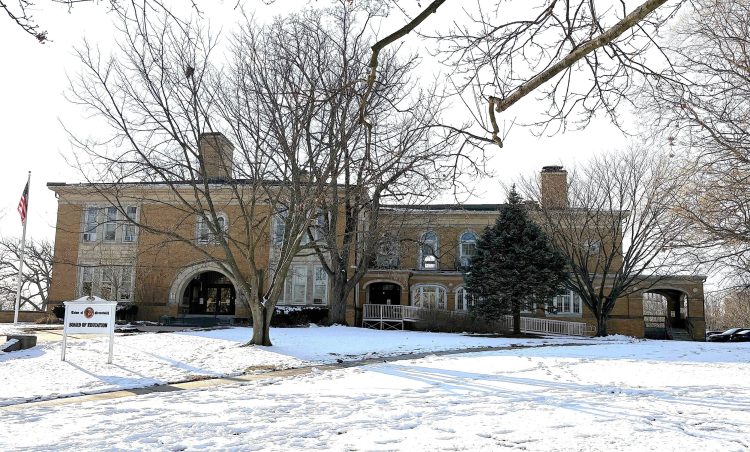
In downtown Greenwich is an area placed on the National Register of Historic Places, “a complex of public buildings, parks, and monuments developed during the period between 1893 and 1938” – centered on Greenwich Avenue often called the “soul” of Greenwich. Cite that 50-foot obelisk honoring WWI veterans, that statue of WWI aviator Col. Raynal Bolling standing on a corner of the Havemeyer Board of Education (BOE) building property soon to host, goes the news, a statue of the late President George Herbert Walker Bush, a Greenwich native.
But a dream yet to be realized is to transform that historic 1890’s Havemeyer BOE building into a major performing art center. How that dream came to be was pioneered decades ago by two individuals highly qualified: Peter Malkin (who with wife Isabel) has received a Lifetime Achievement Award from the National Trust for Historic Preservation, having restored the Greenwich Post Office (now Restoration Hardware), and having overseen the reimagining of the Greenwich Historical Society grounds. Sharing Malkin’s dream was Bea Crumbine, a leading performer and supporter of the arts of Greenwich and long serving the Town as Ambassador-at-Large.
Following on with his dream is Chuck Royce, heralded by the Greenwich Historical Society for his dedication to numerous historic preservations and revitalizations across New England, counting the Avon Theater in Stamford. And “recruited” by Malkin to serve on the National Trust for Historic Preservation.
Those dreams have been initially turned down by the Town – with those 100 Board of Education employees needing to be relocated with their building in dire need of restoration.
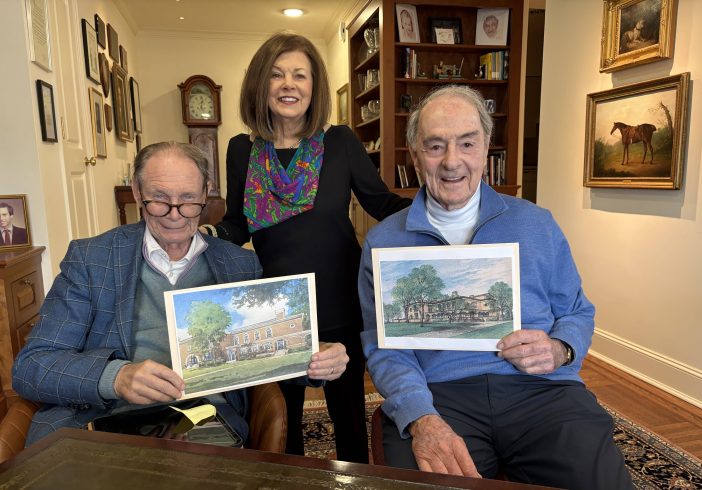
So, what are those dreams of an art center? What inspired them? To find out the Sentinel recently gathered Malkin, Crumbine, and Royce together in Peter Malkin’s Greenwich office to ask them to share their dreams.
“About 30 years ago,” began Malkin, “it came to my attention…including Bea Crumbine, that the Board of Education had decided that the Havemeyer Building really did not serve its purpose as a headquarters and was concerned about the need for a very substantial renovation at very major costs…. that it would be moving from the Havemeyer Building to an undisclosed alternative location. This led a group of us to think what could be a much better use of the Havemeyer Building, both to preserve the building, but also to serve the community, and we asked Marvin Berenblum to take the title of chair of the group because Marvin had attended the Havemeyer Building as his elementary school.”
An architect was brought in “who specialized in theaters and in restoration, Peter Gisolfi,” who cited the construction of the building lending itself to a variety of uses. “Each classroom worked very well as a rehearsal studio, a music place, with thick plaster walls… great for the sound. We came up with a theater of 300 seats.” But as the existing theater “did not have any backspace on the stage…we were going to turn the structure around internally, and instead of being east-west, we would turn it to be north-south and add enough space at one end to have a proscenium arch and backspace for the rehearsal space.”
“But there was one extra piece I thought terribly important,” added Crumbine. She’d learned from a theater architect working with Gisolfi that “if you are more than 74 feet away as an audience member from the actor or singer on the stage, you lose the entire facial appearance of that person, because you’re too far away. And so, by turning the theater, we’d get a far better sightline of what that actor is doing.”
Also notable was their idea to bring Broadway rehearsals to their art center. “There continues to be a tremendous shortage of space for rehearsals of Broadway productions,” told Malkin. “Instead of their rehearsals going maybe to New Haven, to Boston, to Philadelphia, the Broadway cast and their directors and producers would come to the Havemeyer Building to do their rehearsals and have dress rehearsals where townspeople could come and see these shows before the Broadway opening.”
Regarding parking issues, Crumbine shared. “Since the productions were going to be at night, the main use of the theater essentially would be at night. There could be a shuttle bus with people parking in the empty Town Hall parking lot, which is empty at night, and they could be bused down in a rather charming fashion down to Greenwich Avenue.”
“We came up with a design and a budget at that time in the year 2000 of $25 million,” said Malkin, “with firm commitments for $15 million of that $25 million before we went public with it. And the initial reaction was very favorable.” Westchester and Stamford music and ballet schools were interested in offering classes in the building. “And we had a group of potters interested… So, we had music, ballet, pottery, a lot of people anxious to come to Greenwich to create these schools.” With the title, “Greenwich Center for the Arts” at the Havemeyer Building.
Chuck Royce’s dream began having learned of Malkin’s. But he had a major project in Westerly, RI called Ocean House that would take two decades to complete. But he’d “fallen in love” with the Havemeyer art center idea. “That beautiful downtown street we have, Greenwich Avenue needs nighttime activity,” he said, “And of course, people will go to the restaurants et cetera. Deborah and I already had the Avon Theater, and we were excited by the use of that.”
Working with architect John Fareri the idea came to create a Black Box Theater format, in the right wing of the building facing Greenwich Avenue. Seeing the drawings, Royce saw that Black Box Theater as “exactly the same size as the black box theater we have in Ocean House. And that black box has exceeded any idea that I thought… We have a fashion show where people walk down the aisle… We have performances on the stage where people stand, they dance or whatever… we have lectures where you put seats in. We do 250 to 300 seats that come in and out. We have activities four or five nights a week.”
“Amazing,” Malkin responded, realizing the theater would take 250 to 300 seated. He likened it to Bryant Park in New York City behind the 42nd Street Public Library, which he’d been involved in the setting up. “All the chairs are movable and they don’t lose any.”
Along with that Black Box Theater, would be space for rehearsals and “smaller performance space, and office space.” Then came architect Fareri’s idea of 18 condos built upon the Havemeyer parking lot with underground parking. “It’s where John made the profit off the condos for everything else, for the art wing.” And that underground parking would provide 185 spaces, with adjacent parking for up to 50 spaces.
But Fareri’s plan of offering the displaced 100 BOE personnel free living space for 20 years in the Greenwich Office Park off West Putnam didn’t fly. “They hated being that far from Greenwich Avenue,” said Royce.
Talk then addressed the not-long-ago turn down by the Town of some five to six proposals – including Royce’s – of that Havemeyer Building redo, with one idea calling for a boutique hotel of 70 rooms. Royce recalled folks at the Delamar Hotel commenting on such a plan, “Insane – we’re not booked every day.”
“And I would love to add one thing that we learned about two years into our process of planning this concept,” added Crumbine. “That once a town loses a movie theater and/or a performing theater, everything goes down.”
“Exactly,” said Chuck, “And restaurants continue, but they don’t have that added impetus of people coming down for many different activities. And it’s a deadly scenario.”
Financing was addressed by Royce. “I haven’t gone public with it, but I’ve committed five million – three million to rebuild the theater and two million for operations for the first couple or five years, whatever. But it’s not a clear number. Do I believe money can be raised for the arts? Yes, we’d have a 501(c)(3) for the art wing.”
“Because the Havemeyer Building is a landmark,” added Malkin. “It’s another way to raise money. Even if someone is not interested in the arts per se but they want to preserve an historic building.”
“If we ever actually got a shot at it, we’d form a board,” said Royce, “and I’d love to have all of you on the board, et cetera…then officially go out and knock on doors. I can lead that charge.” And, he added, “I am committed to working with the Town to realize this initiative.”