By Julia Barcello
“Let’s be perfectly frank, it’s an uphill battle. [House Bill] 8002 is going to dramatically impact the quality of life and how this town will become,” said Connecticut state Sen. Tony Hwang.
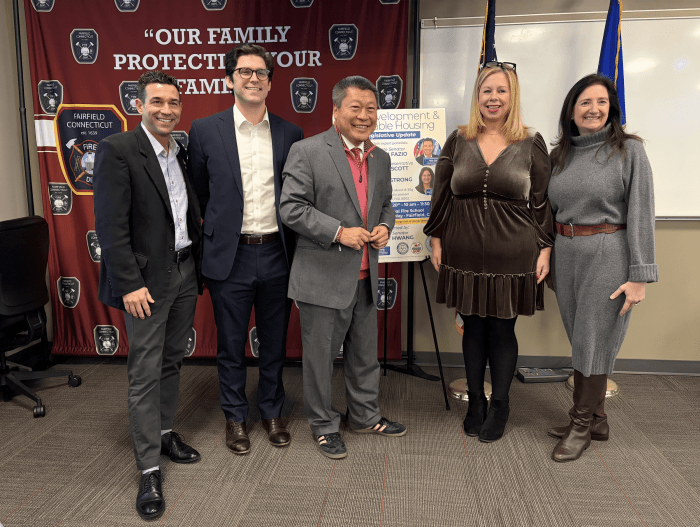
Legislators from across the state gathered in Fairfield Saturday, Dec. 20, to discuss House Bill 8002 and the 8-30g statute. The panel was open to the public ,and residents had the opportunity to ask questions and voice their concerns. Panelists included Sen. Ryan Fazio, Rep. Tony Scott and CT-169 Strong co-founders Alexis Harrison and Maria Weingarten. Sen. Hwang moderated the discussion.
Housing Bill 8002, “An Act Concerning Housing Growth,” is a reform intended to address the state’s housing shortage and affordability crisis. It entered a special session in early November and was signed into law Nov. 26. It is set to take effect Jan. 1, 2026.
The bill expands fair rent commissions, eliminates off-street parking requirements and requires towns to create housing growth plans. Some critics argue its “as-of-right” provisions allow developers and the state to override concerns of the community and limit the town’s input in zoning decisions. Supporters of HB8002 say it is intended to increase housing supply, lower costs and help the state meet long-term affordability.
Rep. Scott explained that less than an hour before the special session on Nov. 12, HB8002 was changed. Because of this, the financial impact statement form the Office of Fiscal Analysis was unprepared, leaving legislators without adequate time to analyze revisions.
“That’s tough for us, but for the public, the people we serve, it’s a slap in the face,” Scott said. “I have no problem debating a bill, losing, voting no, it passing. I have no problem with that, because we went through the process.”
The controversial bill has raised tensions across the state. Critics are worried it will eliminate local control and alter the character of towns. According to the Connecticut Department of Housing’s 2024 Affordable Housing Appeals List, Greenwich has roughly 5.9% of affordable housing. This is well below CT’s 10% threshold that would exempt it from the 8-30g appeals process.
Some residents across the state have taken to social media platforms like Nextdoor to express their concerns, describing it as a “shady deal” and “dismaying”. Linda Burrows of Saugatuck Shores, said, “This is the outcome of having a one party super majority… There is no question that this ruling will drive greater density in “low income” housing and raise property taxes. If it was a positive for towns they would not have passed it in the dead of night. Dirty politics out of Hartford.”
In a comment thread responding to a letter to the editor published by The New Canaanite, resident William Taylor also expressed his frustration with the bill.
“What are we afraid of? (1) Malevolence (2) People who believe that misery should be equally distributed (3) Tall, ugly buildings being erected in historic neighborhoods (4) Increases in traffic, accidents, crime, and pollution/litter (5) An increase in the number of people who don’t value local customs and traditions. I’m undoubtedly forgetting some things.”
Sen. Fazio, who has been vocal in preserving local control, said that HB8002 will do the opposite.
“It is much more pro-developer and much more anti-local control.” He added that while some provisions are optional, municipalities that do not comply risk losing eligibility for certain state funding programs.
“It is a, you know, nice local control you got there, nice local zoning you got there,” Fazio said. “It would be a shame if, with all the hundreds of millions of dollars that, maybe a billion of taxpayer dollars that Fairfield is sending to the state government every year, they wouldn’t be able to avail themselves of tens of millions of dollars of school construction funding or infrastructure funding that will be attached to acquiescing to the zoning plans of the state going forward.”
Disagreements continue with the impact on traffic. Connecticut ranks the fifth worst state for poor road conditions, including traffic congestion and critics say HB8002 may increase the issue. The bill states that for residential developments under 16 units there will not be a requirement for any parking. This leaves residents to park on the street, unless parking lots or garages are built. There is worry this will create more traffic congestion.
“We found that error, and they didn’t fix it,” Weingarten said. “Senator MD. Rahman said that they will hopefully fix that in this next session. That remains to be seen. But you know, so what do we do as municipalities? Do we say that we’re just not going to allow any 16 Plex developments now? Possibly, until they fix the bill,” said Weingarten.
Still in aims to resolve the housing affordability crisis, the 8-30g statute, Affordable Housing Land Use Appeals Procedure, allows developers to bypass local zoning laws to build housing in towns where less than 10% of the housing is considered affordable. The burden shifts to municipalities to prove that denying a qualifying affordable housing project is necessary.
Representative Scott discussed that 8-30g is not practical for the contrasting towns across Connecticut. “Easton… one of my towns in my district. There’s farms everywhere. The only way that they’re going to get to numbers that are successful, to the state, is by knocking down barns and building apartment buildings.” Easton has roughly 0.4% of affordable housing in 2024, well below the threshold of 10%, according to the Connecticut Department of Housing’s 2024 Affordable Housing Appeals List.
Together, the 830-g statute and HB8002 increase pressure on towns with less than 10% affordable housing. It makes it easier for developers to override local zoning concerns which can lead to further issues in towns. Under 8-30g, qualifying projects with affordable housing units can disregard zoning rejections. HB8002 can further incentivize towns by providing access to state funding for school construction or infrastructure grants. Legislators agree on the goal but republicans argue it can be done differently.