By Frank Scarpa
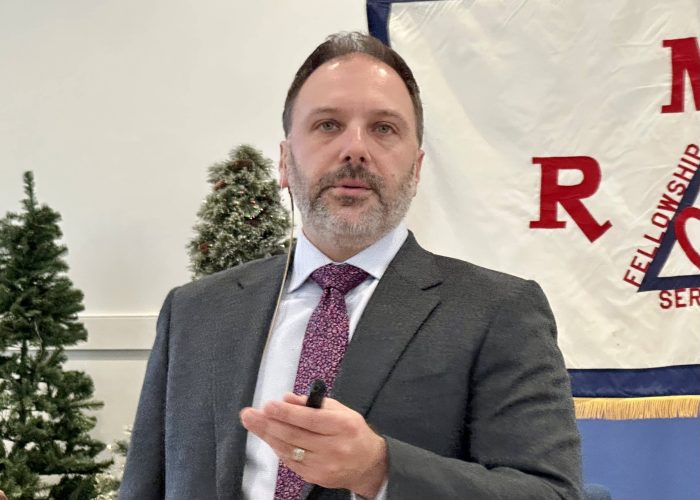
At the December 10th meeting of the Retired Men’s Association, in a presentation that illuminated the profound shifts in modern healthcare, Robert Blenderman, the president of Greenwich Hospital, offered a deeply personal perspective on the mission of healing, grounded in his own working-class roots in Queens, New York. Introduced by host Spike Lipschutz, Mr. Blenderman charted his career path from a young man inspired by the care his family’s matriarch received— his “giant” Italian grandmother— to becoming a leading voice in hospital administration. His desire to enter medicine was solidified while volunteering at Booth Memorial, a 600-bed Salvation Army hospital in Queens. He initially envisioned becoming a physician or a nurse, but an encounter with a professional named Gabe, whom he first mistook for a trauma surgeon, steered him toward becoming a physician assistant, allowing him the flexibility to avoid being limited to a single specialty for life. Mr. Blenderman’s early clinical experience was intense, including two years of trauma surgery at St. Vincent’s in Manhattan, where he was present during the September 11 attacks, an event that quickly steeped him in delivering highlevel care within a community setting.
His transition to administration began during a 15year tenure at Northwell Health, largely spurred by a specific administrative challenge. Working as the Chief PA to the open-heart surgery chairman, he frequently listened to the doctor complain about his administrator, who, in the chairman’s view, failed to grasp his goals. The chairman eventually instructed Mr. Blenderman to obtain an MBA in finance, an education that pulled back the “curtain of healthcare” for him, revealing the critical roles of planning, capital projects, and finance that happen outside the operating room.
After joining Greenwich Hospital last March, Mr. Blenderman faced the challenge of redefining the institution postCOVID-19. The hospital, part of the Yale New Haven Health System, had been hit hard by labor costs and staff disengagement, resulting in a sharp decline in volume over three years. Mr. Blenderman invoked the historical example of Venice during the plague, which forced the city to redefine itself while still respecting its past, to illustrate Greenwich Hospital’s current mandate: to grow complex services while maintaining the intimate patientcentered feel that defines its DNA. He emphasized that though many institutions claim to put the patient at the center, healthcare often feels “transactional”, like being a cog in the wheel of a factory.
To counter this, the new administrative approach demands hands-on engagement. Mr. Blenderman shared that the days of reading the morning paper in the office are long gone, noting that he begins his day rounding in the emergency room at 6:30 am to get direct feedback from staff.
Despite volume dips, Mr. Blenderman stressed that the hospital’s “True North” is quality, citing its status as a leader in patient experience within the Yale New Haven Health System. He highlighted Greenwich Hospital’s recognition as a complex community hospital ranking in the top 3% nationwide for quality outcomes by an organization called Vizient, placing it at number 14 out of 268 hospitals in its category.
He openly addressed the intensely aggressive competitive landscape, naming significant regional competitors such as Northwell Health’s Nuvance Health system, Stamford Health, New York-Presbyterian in Westchester, and White Plains Hospital.
A key priority for the hospital is expanding services that are foundational to the community, including emergency care (the “front door” of the hospital), pediatrics, and primary care. Mr. Blenderman detailed the strategic rebuilding of the pediatric department, which sees roughly 10,000 children annually in its emergency room, through the hiring of subspecialists like pediatric cardiologists and orthopedists. This effort is guided by Dr. Anthony Porto, the new Chair of Pediatrics and a pediatric GI doctor, who is focused on collaborating with the existing community of physicians. An excellent example of this collaboration is Dr. Katie Noble of Soundview Pediatrics, who has been appointed Associate Chair to ensure the hospital remains deeply connected to community needs.
Furthermore, the hospital is heavily invested in oncology, transitioning from a prior plan to build a freestanding center to dedicating 60,000 square feet on the hospital campus to the Smilow Cancer Center. This development will allow access to Yale New Haven Health System’s full clinical trials network and will consolidate care for patients under one roof, including dedicated inpatient rooms, multi-specialty clinics where all doctors see the patient in one place, and an infusion center. The five-year vision also includes preparing for the future of healthcare, where the hospital will primarily serve the “sickest of the sick” through specialized ICUs, larger operating rooms for advanced technology like robotics, and the ongoing conversion of nearly all rooms to private, single-bedded units.
Mr. Blenderman also noted that Greenwich Hospital is now able to offer a unique treatment modality for Parkinsonian tremor. Future plans include expansion of the hospital’s ambulatory footprint, including an ambulatory surgical center.
A lively Q and A period followed, discussing issues such as geriatric care. To facilitate this, the hospital has sought and achieved accreditation for Level III trauma care from the American College of Surgeons. (Falls and fractures are significant causes of death and disability in the elderly.) Greenwich Hospital aspires to have 95 per cent of its inpatient rooms private (single-bedded) in three years. The use and impact of AI, primary care physician availability and turnover, and the impact of cutbacks in federal funding (which is expected to spark a rise in Emergency Department visits) were all included in this well presented and interactive discussion.
The RMA’s next presentation, “The Radical Fund: How a Band of Visionaries and a Million Dollars Upended America,” by John Fabian Witt, is scheduled for 11 AM on Wednesday, January 7, 2026. RMA presentations are held at Christ Church Greenwich, Parish Hall, 254 E. Putnam Avenue, Greenwich, CT 06830.
In 1922, a young idealist named Charles Garland rejected a million-dollar inheritance. In a world of shocking wealth disparities, racism, and political repression, Garland opted instead to invest in a future where radical ideas—like working-class power, free speech, and equality—might flourish. Over the next two decades, the Garland Fund would nurture a new generation of wildly ambitious progressive projects.
The men and women around the Fund were rich and poor, white and Black. They cooperated and bickered; they formed rivalries, and made mistakes. But they all believed that American capitalism was broken, and that American democracy (if it had ever existed) stole from those who had the least. They believed that American institutions needed to be radically remade for the modern age.
By the time they spent the last of the Fund’s resources, their outsider ideas had become mass movements battling to transform a nation. A testament to the power of visionary organizations, The Radical Fund is a hopeful book for our anxious, angry age—an empowering road map for how people with heretical ideas can bring about audacious change.
John Fabian Witt is a professor at Yale University, where he teaches and writes on the history of American law and the law of torts. He has written several books, including “The Radical Fund,” “Lincoln’s Code: The Laws of War in American History,” “American Contagions: Epidemics and the Law from Smallpox to COVID-19,” and “To Save the Country: A Lost Manuscript of the Civil War Constitution,” as well as articles for The Atlantic, The Nation, The New Republic, The New York Times, Slate, The Wall Street Journal, and The Washington Post. He has taught at Columbia Law School, Harvard Law School, and the University of Texas at Austin.
To stream the presentation by John Fabian Witt at 11 AM on Wednesday, January 7, click on https://bit.ly/30IBj21. This presentation will also be available on local public access TV channels, Verizon FIOS channel 24 and Optimum channel 79.
Note: The views expressed in these presentations are those of the speakers. They are not intended to represent the views of the RMA or its members.
RMA speaker presentations are presented as a community service at no cost to in-person or Zoom attendees, regardless of gender. Any member of the public who would like to receive a weekly email announcement of future speakers should send a request to members@greenwichrma.org. The RMA urges all eligible individuals to consider becoming a member of our great organization, and thereby enjoy all the available fellowship, volunteer, and community service opportunities which the RMA offers to its members. For further information, go to https://greenwichrma.org/, or contact info@greenwichrma.org.