By Anne W. Semmes
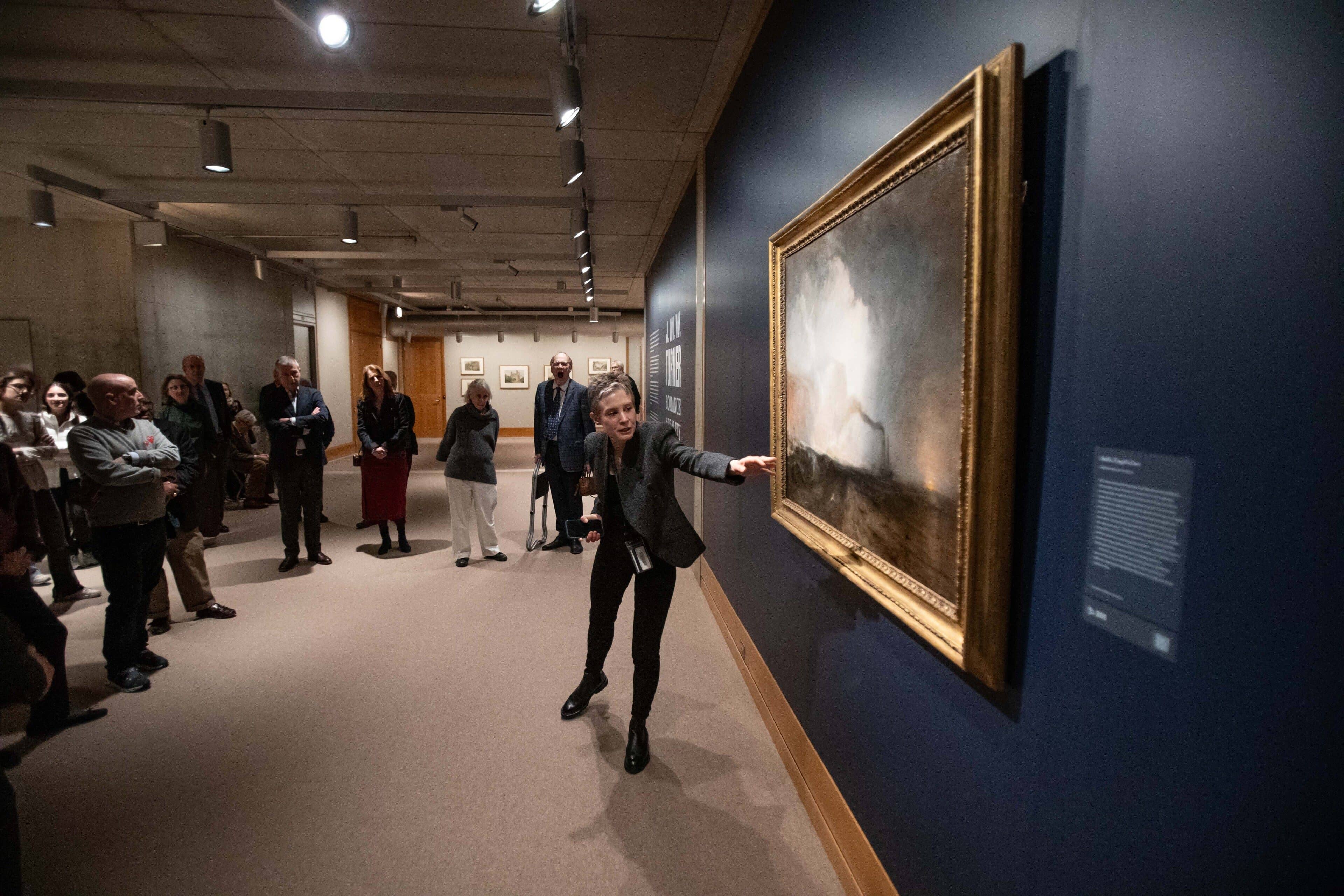
The Greenwich Branch of The English-Speaking Union or ESU was once again the deliverer of impressive art education, at its last meeting two weeks ago Thursday featuring Britain’s great land and seascape artist, Joseph Mallord William Turner, on his 250th anniversary. There to address Turner as “the founder of modern art” was British native Lucinda Lax, Interim Head and Curator of Paintings and Sculpture of the Yale Center of British Art (YCBA) in New Haven.
With the YCBA known to have the “greatest collection of British art outside of Britain,” Lax had organized earlier this year “J. M. W. Turner: Romance and Reality,” the first Turner exhibition at the Center since 1993. Lax had displayed Turner’s work to show his extraordinary evolving over six decades to becoming that pioneering modern artist. There were some 3000 Turner works to select from spanning his career, all collected by Paul Mellon, the founder of the Center, Lax cited as “one of the greatest collectors and philanthropists of the 20th century.”
In the 1950’s when Mellon began his collecting, said Lax, “British art was relatively cheap to buy” [she highly recommended reading Mellon’s autobiography, “Reflections in a Silver Spoon – A Memoir”] with his ending up with “iconic masterpieces in the canon of British art.” Mellon would accumulate the largest collection of Turner oils, watercolors and prints “in North America outside of the Tate in Britain.”
Enrolled in London’s Royal Academy of Arts at age 14, Turner had learned by age 18 “the accurate representation of architectural details and a highly systematic approach to rendering, form and color,” told Lax. “All these traits are readily in evidence in the earliest examples of his finished watercolors in the YCBA’s collection.” A favorite early watercolor of hers is of “St. Augustine’s Gate “in “the ancient cathedral city of Canterbury, painted in 1793… He was born in 1775…so we’re talking about somebody just emerging out of his late teens who had just finished his artistic training and was already at the level of skill and capability that he could create these really subtle renditions…. He’s already starting to think about how to romanticize the elements.”
Influence of Claude Lorrain
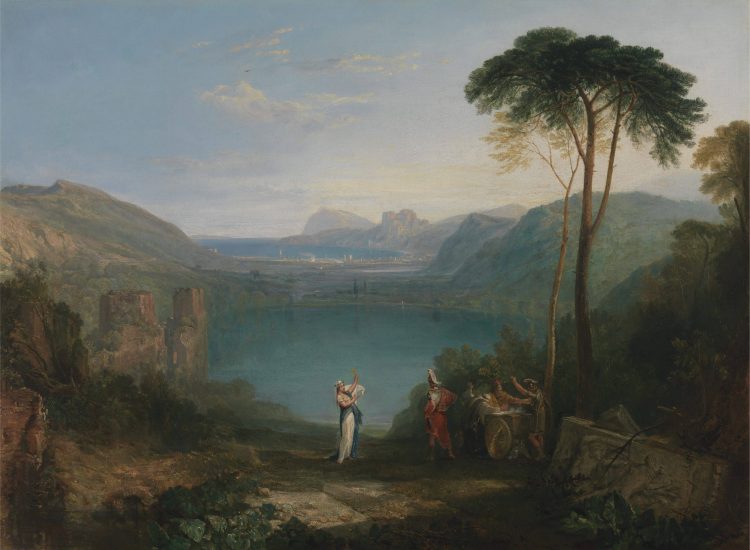
But it was the paintings of 17th century French landscape artist Claude Lorrain “that made the deepest impression on Turner,” told Lax, “one in particular, ‘Seaport with the Embarkation of the Queen of Sheba,’ that reportedly brought Turner to tears when he saw it and he lamented that he would never be able to paint anything like it… And Claude remained a touchstone for the rest of Turner’s life,” so illustrated in Turner’s painting of “Lake Avernus Aeneas – 1814-1815.” “This piece has gone to the Tate [on exhibit] and is a seminal work for showing how important Claude was in Turner’s life and his development as an artist.”
“Importantly,” Lax added, it was “that effect of seemingly infinite recession that Turner so skillfully achieves which is heightened by his choice of a similarly warm color palette… It’s informing the way that he’s building a landscape on canvas.”
Also, formative was Turner’s “willingness to brave the dangers and deprivations of continental travel in an age before planes, trains, and automobiles” – travel made possible post the French Revolution. “And the goal of Turner’s expedition through France and Switzerland was the dramatic landscapes of the Alps.”
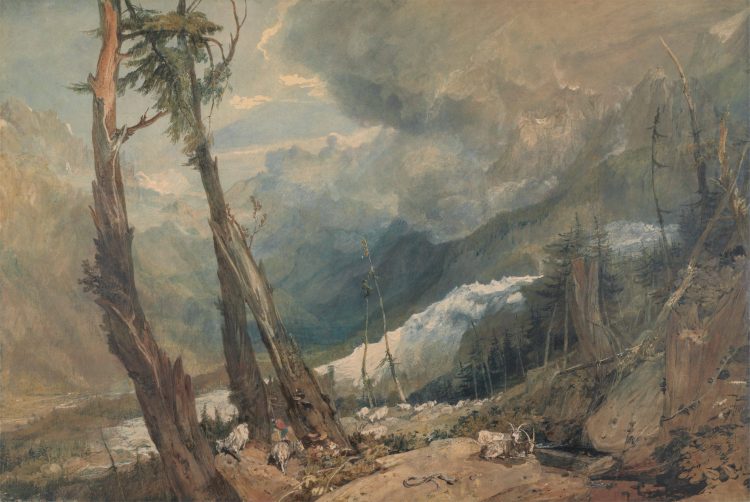
Lax showed “the spectacular watercolor of the great alpine ‘Mer de Glace in the Valley of Chamonix,’ 1815, completed some 10 years after he actually saw the subject. It took pride of place in the exhibition. Partly because of this amazing perspective that Turner creates on paper the way you look down…it’s a really precipitous view..” Plus, “notice the snake in these terrifying details that he adds to make us feel as though we are there… It’s a true tour de force of paint.” And, “fashionable for artists in that early 19th century, was to be working in watercolor on these large-scale pieces they would then exhibit in public exhibitions.”
Impressive landscape prints
Add Turner’s “sustained and unusually direct involvement in the field of printmaking…a reproductive medium offering the artist the potential to build both his wider reputation and to increase his income.” Thus, his Liber Studiorum, containing some 70 individual prints dating from 1806-1824 that Turner “would supervise and publish himself,” shared Lax. “It ranks among his most ambitious project.” Per example, an image showed of “The Evening Gun” of the River Wye in the UK. “It has this beautiful quality of light that he manages to render in black and white in two tone – it’s pretty phenomenal. It really speaks to his skill.”
“And once again this endeavor manifests his admiration for and rivalry with Claude Lorrain,” noted Lax. “And the result was some of the most expressive landscape prints ever made. So, Turner’s fascination with modern technology continued for the rest of his life, but in very different and increasingly complex contexts.”
Lax next introduced Turner’s magical painting of “Staffa – Fingal’s Cave,” as “one of YCBA’s most celebrated pictures, which has to be one of the most iconic Turner works produced in the second half of his career.” The painting shows the Hebridean island of Staffa off the west coast of Scotland…Turner had journeyed there in terrible weather conditions in 1832. And it’s this personal experience that he dramatized so convincingly in this canvas. The painting contains all the ingredients that make Turner work seem so fresh and different from that of all of his contemporaries… the broad impressionistic brushstrokes that punctuate the canvas takes Turner’s handling of forms towards the realm of abstraction.”
“Turner is almost working in an abstract expressionist way,” Lax noted, then ended her talk with a last watercolor image, “Stormy Sea Breaking on a Shore,”1840-1845. “Turner depicts a paddle steamer caught in the midst of a storm… Turner uses rapid gestural brush strokes and a limited color palette to convey the dizzying intensity of the sea and wind crashing waves. The overwhelming power of nature becomes an increasingly strong theme in Turner’s works from the 1840s.”
The Turner exhibition had revealed, concluded Lax, “with exceptional clarity how the stereotype of Turner as the first truly modern artist obscures a much more complex reality… He was at once an artistic rebel and a fervent upholder of tradition and its institutions, the pioneer of a new painterly style… An idealist who was also a shrewd businessman… a profound pessimist and a patriot who extolled Britain’s growing imperial and industrial power while remaining convinced of the ultimate futility of all worldly hopes.” All “amply captured in the exhibition’s title ‘J.M.W. Turner Romance and Reality’ which made clear these priorities in Turner’s life and work while uncovering the reality behind the romanticized image of the artist.”