By Anne W. Semmes
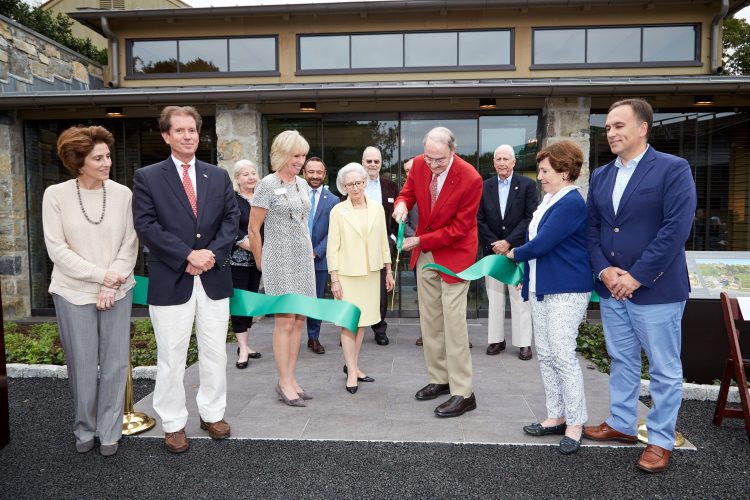
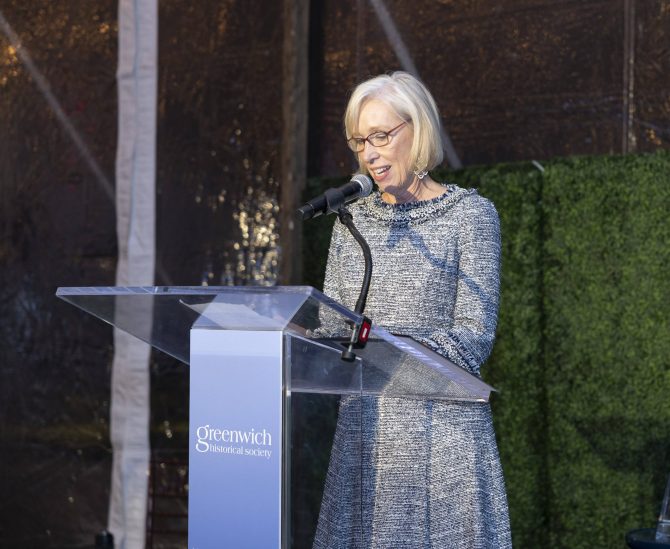
Debra Mecky, as of a month ago, was heralded for her 30 years as executive director and CEO of the Greenwich Historical Society at the Society’s “History in the Making Dinner.” She and her husband Carl, having lived next door to the Society campus, now live with family in Westwood, New Jersey. With such an accomplished career, the Sentinel reached out to Mecky in her retirement to look back and share what had inspired her leadership across the decades. She richly responded.
Q: With the Greenwich Historical Society now recognized as a nationally recognized history museum during your tenure, what do you see as the major “building blocks” that made that happen.
A: The building blocks necessary to obtain national recognition are outlined in the accreditation program of the American Alliance of Museums. National accreditation is a peer-based validation of operations and impact focused on how well the Historical Society achieved its stated mission and goals, and how well its performance met standards and best practices as understood in the museum field. Greenwich Historical Society was first accredited in 2005, and I remember our excitement at the time. It has since been reaccredited in 2020.
When I arrived in 1996, there was no emergency response plan or facilities plan or personnel manual. With so many administrative challenges, much of what I had to do was to attract skilled staff and consultants who could develop curatorial and education programs for the community, and who could support the board’s financial and fundraising plans. The work took time and included the completion of historic structures reports on each of the historic buildings, a historic landscape plan to outline how the site would be interpreted, a furnishing plan for Bush-Holley House, and a master plan to guide physical expansion of the campus.
Strategic planning was an ongoing process and required paying attention to emerging opportunities and risks. Almost three decades later, I am proud of what we accomplished and that Greenwich Historical Society has gained the trust of the community and the admiration of many similar organizations who are inspired by its success.
Q: Who are on your shortlist of major players during your tenure having helped to accomplish the Historical Society’s “boldly reimagined campus.”
A: The boldly reimagined campus in Cos Cob was the outcome of long-term planning and the commitment of major players in the community. The expansion solved major barriers to our success, including lack of accessible parking and walkways, and insufficient collections storage and undersized galleries to exhibit the collections and explore diverse themes in Greenwich history. There were major players who moved the project forward.
On my shortlist are Davidde Strackbein, the board chair during the expansion who held us to high standards; the late Bruce Dixon who headed the construction committee and kept the project on time and budget; and Peter Malkin, husband of the Historical Society’s longest serving board member Isabel Malkin. As Peter often said, it was “pillow talk” with Isabel that drew him in to take on the challenge of chairing the Reimagine the Campus Campaign from 2016 to 2018, which raised approximately 14 million dollars, including a challenge gift from anonymous donors early in the campaign to match every dollar contributed.
Q: You have shared in the early part of your career of finding “a greater appreciation and understanding of American history.” In what ways during your tenure did you witness that interest grow – with particular age groups? Are there instances you can share?
A: When I first entered the field of historic site interpretation at Historic Hudson Valley in 1981 (then known as Sleepy Hollow Restorations), the country was still experiencing the afterglow of the American Bicentennial. Historic house museums proliferated and became the most conventional type of museum in the United States. But by the turn of the 21st century, attendance was waning, even at major attractions like Colonial Williamsburg and Old Sturbridge Village. Sustaining them became increasingly challenging. The history museum field began to question the conventional business model of historic house museums and began to reimagine what their future use could look like.
Three themes that I took to heart from that time were to be a good neighbor in one’s own community, to create experiences visitors want, and to tell inclusive stories. Fortunately, Greenwich Historical Society is much more than a historic house museum. Its archives collections continue to grow and expand to tell a fuller history. Some highlights of that time in Greenwich were exhibitions on African American, Jewish, Italian and Japanese communities, done in collaboration with each community. There was a tremendous response to these exhibits and an outpouring of appreciation from people from all parts of town.
I’m proud that the Historical Society has been a good steward of its resources and continues to prioritize education and community; for example, through working with the Greenwich Public Schools to support experiential education programs for students, or through creating and sustaining the Greenwich Preservation Network, a wide cross-section of community leaders who share a common goal to protect significant buildings and landscapes and who can speak more powerfully through collaboration.
Q: What year did the Bush-Holley House become a National Landmark – as the seat and center of the Cos Cob Art Colony? And if you could meet up with one of the primary individuals in the formation of the site of the Greenwich Historical Society, such as Justus Luke Bush, or Constant Holley, or Elmer MacRae, as a member of the Cos Cob Art Colony, who would it be and why.
A: Bush-Holley House became a National Historic Landmark (NHL) in 1991 and remains the town’s only site to be so designated by the National Park Service. This sometimes confuses people because there are many important sites in Greenwich listed on the National Register of Historic Places. But the NHL designation is unique in that it speaks to the power of the site to shape our national history in significant ways. The Holley boarding house was a cradle of American Impressionism, and Cos Cob is the first art colony in Connecticut, established a decade before the art colony in Old Lyme for example. As documented by art historian Susan Larkin, it was also a place of innovation and creativity over a 30-year period from 1890 to 1920.
The Historical Society (founded in 1931) purchased the house in 1957 from the wife of the artist Elmer MacRae, a student of John Henry Twachtman. Constant (Holley) MacRae had inherited the house from her parents Josephine and Edward Holley, who ran it as a boarding house for an artists’ clientele.
If I could go back in time to the founding of Greenwich Historical Society, I would choose to attend the board meeting when the writer Anya Seton objected to architectural plans to demolish the two-story front porch of Bush-Holley House in order to “restore” its colonial appearance. It could so easily have been removed without her passionate objections. She strenuously objected because she had a deep appreciation of the house’s art colony history (which she had experienced first-hand). It took another 30 years for the Historical Society to gain that same understanding. It’s amazing that she prevailed, but our good fortune today.
Q: What in your view is the most extraordinary time of Greenwich history? And how do you see that period of history inspiring appreciative interest in America’s 250th anniversary?
A: Bush-Holley House is also an important local landmark of the American Revolution. Having just finished watching Ken Burns moving documentary film series (and simultaneously reading Scott Smith’s cheeky time travel adventure, A Most Revolutionary Watch), I’d like to request an audience with David Bush. Would he entertain an interview with a woman? If so, please, Mr. Bush, explain how you kept your Patriot neighbors at bay when you persistently would not sign the oath of allegiance; and how do you defend their charge that your house and possessions were spared during General Tryon’s raid of Greenwich in 1779 while your neighbors lost property and life? And, Mr. Bush, now that we are approaching the 250th anniversary of the signing of the Declaration of Independence, how do you defend your failure to create a path to freedom for the enslaved members of your own household?
Q: In what way will your love of history continue to play a part in your life, especially in America 250? (coming in June for Dutch tall ship?)
A: I am truly looking forward to the sesquicentennial of the Declaration of Independence, and was pleased to have been part of the team inspired by board member Tom Galvin and Scott Frantz that ensured Greenwich Historical Society would bring the Dutch tall ship, Osterschide, into Greenwich harbor in June 2026, a week before the parade of ships in New York. Having attended the bicentennial events in New York in 1976, I am looking forward to the opportunity and privilege of celebrating July 4, 2026. My hope for all of us this coming year is to find inspiration from the courage and lessons from the suffering during that revolutionary time to keep the American dream alive and accessible to all.