By Elizabeth Barhydt
Rob Mathes does not just bring a holiday show to Westchester each December. The festival convenes a summit of New York’s A-list players, a choir that sings like a conservatory, and a book of original songs braided with Ellington-grade horn writing and English-choral glow. The room is the PepsiCo Theatre at The Performing Arts Center, Purchase College— just over the state line in Harrison, at 735 Anderson Hill Road—close enough for Greenwich to claim it as home turf.
The show’s Greenwich roots run deep. Mathes grew up here, studied with revered local teachers, and traced his catalyst to a Greenwich High School jazz-ensemble performance in the old Hollister auditorium where, as a ninth grader from Eastern Junior High, he watched his uncle, trombonist and composer Skip Kelly, solo and realized he needed to write for instruments. “It was literally like an explosion went off in my head,” he recalled. “I need to write for instruments and be a part of what that is.”
The origin story of the holiday concert is local as well. It began with a small rhythm section and a 20-voice choir at Second Congregational Church in 1993–94, then grew as Mathes’ studio life connected him with horn players and gospel singers who could make a December stage sound like Jazz at Lincoln Center powered by R&B voltage. “These were not just cute horn arrangements,” he said. “It’s more in the style of like Steely Dan meets Ellington meets Wynton… a six-piece horn section… and extraordinary gospel singers.”
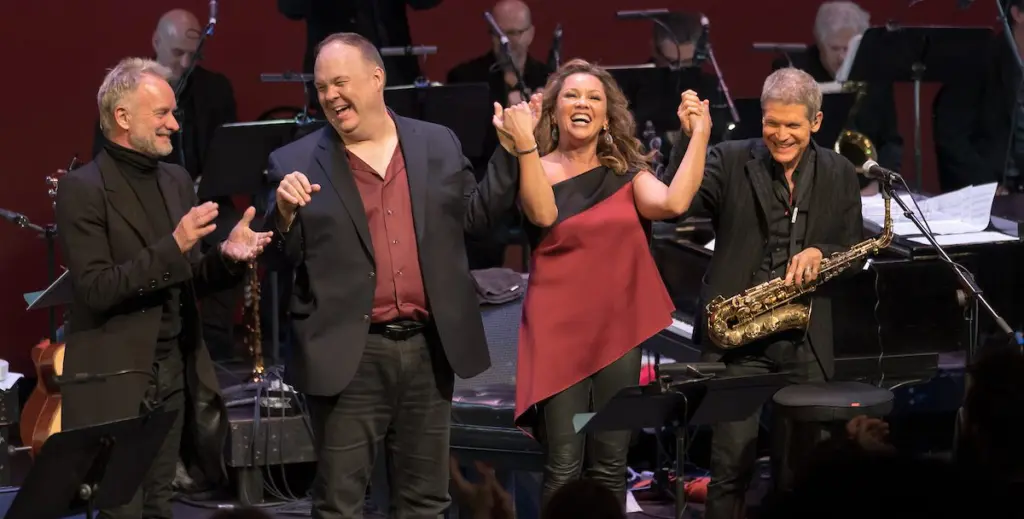
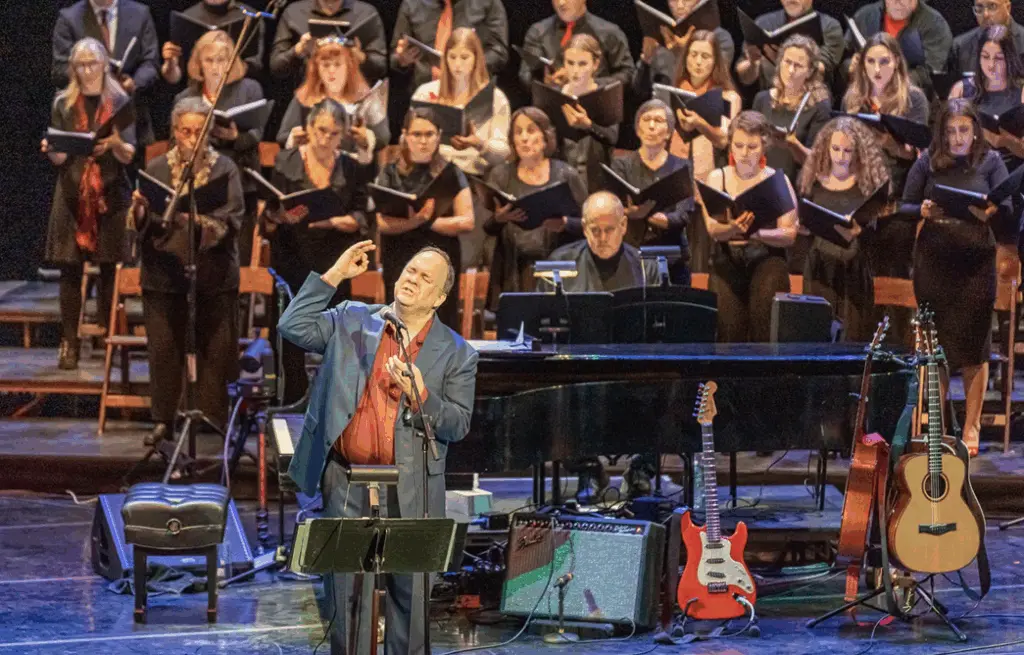
The present-day production functions like a musical summit compressed into two hours. Mathes will field a 40-voice choir, a six-piece horn line, a five-piece band, featured vocalists James “D-Train” Williams and Vaneese Thomas, and a string quartet led by Jonathan Dinklage [yes, if you are wondering, brother of Peter]—then layer intimate carols, original ballads, and big-band detonations across the set so that no section overwhelms the others. “It has its really delicate moments,” he said. “This is not a ‘I Saw Mommy Kissing Santa Claus’ evening… it’s a Lincoln Center quality evening of some of the best musicians in New York City and the world.”
The bench is as serious as the claim. The concert is known for an “all-star band” and a “high-energy evening of rock, jazz, and blues,” with Mathes’ originals and rewired classics that “rival performances seen on the world’s best stages.” Those previews track the lineage of players who rotate through: world-class rhythm sections, New York brass stalwarts, and storied soloists with Broadway, television, and rock-tour credits.
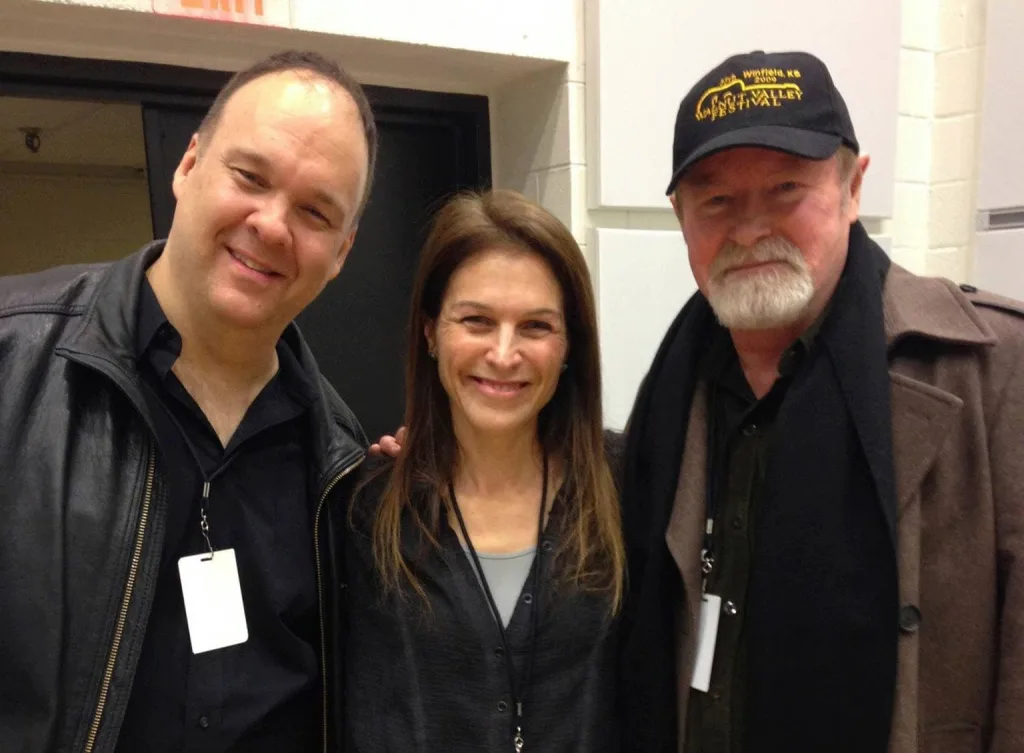
The ensemble around him is built from relationships earned across three decades of session work and tour direction. The show benefits from that network. Players who have anchored late-night television bands, toured with the Rolling Stones, and recorded platinum albums treat the Purchase stage like a year-end reunion.
The PepsiCo Theatre’s scale—intimate sight lines, audio that flatters both brass punch and choir blend— lets you hear the arranging choices that define Mathes’ reputation. The auditorium is designed for acoustic clarity and professional production; Mathes prefers doing two performances in the smaller hall rather than one in the larger concert hall because a 700-seat space keeps the music close and the dynamics honest. “I want something a little more intimate where there’s not a bad seat in the house,” he said. “In fact, the balcony sounds great—it’s a good seat—and we can do it twice.” He calls the hall “really perfect… set up for all the different needs—the dressing rooms, the lighting—they just have everything.”
Greenwich has watched Mathes grow into the role and he remembers too. When the Greenwich High Performing Arts Center opened, Mathes came back as alumnus and parent with new music for students and tributes to mentors, connecting his current stage life to the classrooms where it began. And when asked to be the GHS graduation speaker – he said yes. Mathes delivered a talk that mirrored his concerts—equal parts gratitude and musicianship— sharing stories about mentors like Myron Fink and John Mehegan and telling students to “chase beauty, not fame.” Those ties are not incidental; they animate December.
Mathes defies labeling. He defies genres.
Expanding the Frame
Mathes treats December as repertoire, not routine. He speaks about Ellington’s Nutcracker Suite with unguarded joy—“you put that on… it’s the greatest thing you’ve ever heard”— and writes horn charts that move with that vocabulary. He admires the English choral canon and anchors his ballads in that harmony: “In the Bleak Midwinter,” early Vaughan Williams, carols that combine modal melody with counterpoint. He revisits spirituals and gospel standards with the rhythmic sophistication he absorbed from jazz. He also keeps expanding the frame.
One year, inspired by the best performance he has ever seen of Beethoven’s Missa solemnis in Philadelphia, he invited the Philadelphia Orchestra’s concertmaster, David Kim, to join him. Mathes explained that Missa solemnis “was almost unperformable because the choir parts are so demanding,” with “high B-flats for ten minutes,” yet it contains “some of the most sublime music ever written.”
What moved him most was “this long violin solo in the Benedictus movement,” which he called “perhaps my favorite Beethoven music.” He recalled turning to his wife in Verizon Hall and saying, “I have never heard the violin played like that in the Missa solemnis.” When he met Kim again months later while working with Sting, he told him from the stage, “I can’t believe you’re here, David… I’ve never heard and will never hear the Missa solemnis played that beautifully.” Kim replied, “Can you say that again? I didn’t quite hear that,” and soon after agreed to appear in the holiday concert.
Another season he re-voiced “Dreidel, Dreidel” as “Strayhorn Dreidel,” a wink to the Duke–Strayhorn partnership and a nod to the show’s regular Hanukkah segment.
The Hanukkah segment is not token; it is crafted. Mathes has made a habit of writing a Hanukkah song “almost every year,” studies the history with rabbis and friends, and composes new work that carries narrative weight rather than novelty. “Teach me everything you know about Hanukkah,” he once asked Rabbi Golub. From that afternoon’s lesson on Judah Maccabee and the miracle of the oil, he drew themes of humility and endurance. “The Hanukkah story is beautiful,” he said. “It’s a story of a small group of people changing the world in different ways.” He uses that spirit to write pieces like “Strayhorn Dreidel,” “Too Many Stars,” and others that balance swing, modal harmony, and story. “Some of the greatest music ever written was written by Jewish composers,” he noted, “but the Hanukkah music is terrible… so I try to change that.”
The result feels less like a standard holiday revue and more like a living anthology.
The setlist toggles between Mathes’ own cycle and recalibrated favorites. “William the Angel,” a narrative about a disheveled guardian bent on saving one soul before returning to heaven, has become a call-and-response with the audience; on the one year he tried to rest it, he heard about it in the lobby. “If I don’t do that every year, I’m in trouble,” he said. “Wake Up, It’s Christmas Morning” and “When the Baby Grew Up” sit beside close-harmony carols, blues-choir shouts, and horndriven instrumentals.
Mathes often calls the audience “part of the band,” a family that renews itself when new listeners show up and longtime fans return with friends. The lore includes a supporter who flies in annually from Utah and brings two additional people each time, seeding future regulars. “We had heard about the concert… We will never miss one again,” is how Mathes summarizes many conversions.
Mathes’ own account of why the concert endures puts the focus back on the people who come. He calls it a “family reunion” with “the emotional architecture of Dickens.” In his words, A Christmas Carol “is a miracle… a story of humility and redemption.” He says the combination of that story with “the story of innocence entering the world with God entering the world, not with a mighty army but in the most fragile of ways,” is what gives the concert its heart.
The event also raises funds for Food Rescue US – Fairfield County, linking a night of virtuosity with local need. For Greenwich readers, that matters: the music is worldclass and the impact is local.
The production values show a composer/arranger’s obsession with proportion. Horn voicings arrive like sentences that resolve grammatically; the string quartet articulates counter-melodies with chamber articulation; the choir is fed syllabic lines that reinforce groove rather than sit on top of it. The band can drive a gospel vamp hard enough to lift a balcony and then decay into near-silence for an a cappella benediction. The pacing is as considered as the harmonies: a groove-forward opener, a choral tableau, a secular standard reframed in minor-key melancholy, original songs sung by each of Mathes’ daughters, a jazz interlude that quotes Ellington or Strayhorn without pastiche, then a climactic pairing that marries revival-tent joy to cathedral resonance.
The concert’s frame also includes the Bitter End in Greenwich Village, where Mathes will run warm-up sets with his core band—no choir, no strings— before the Purchase weekend. The club’s place in New York music history gives those nights a historic throughline back to Dylan, Baez, and Lady Gaga.
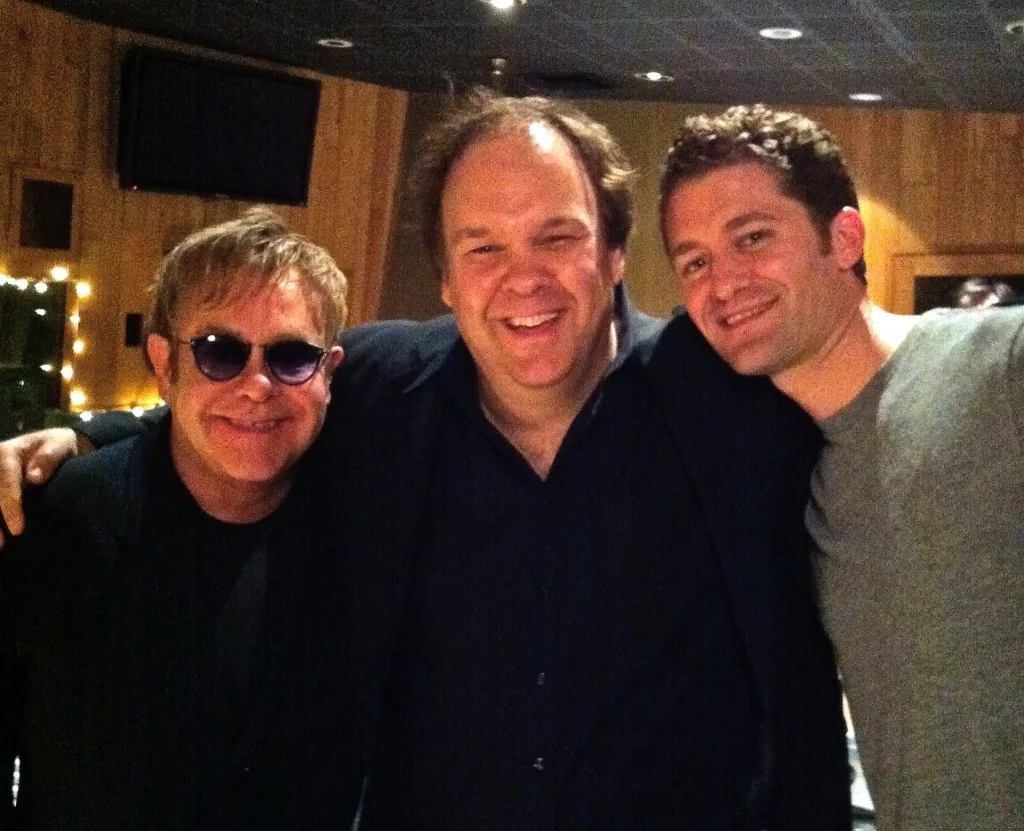
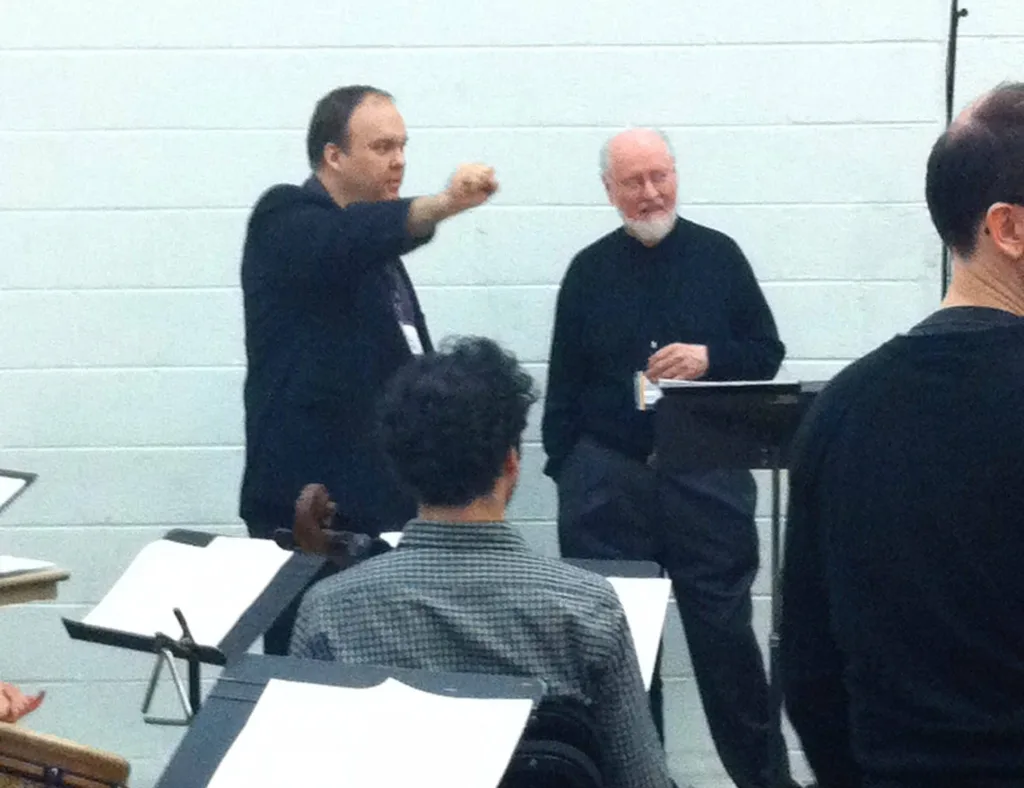
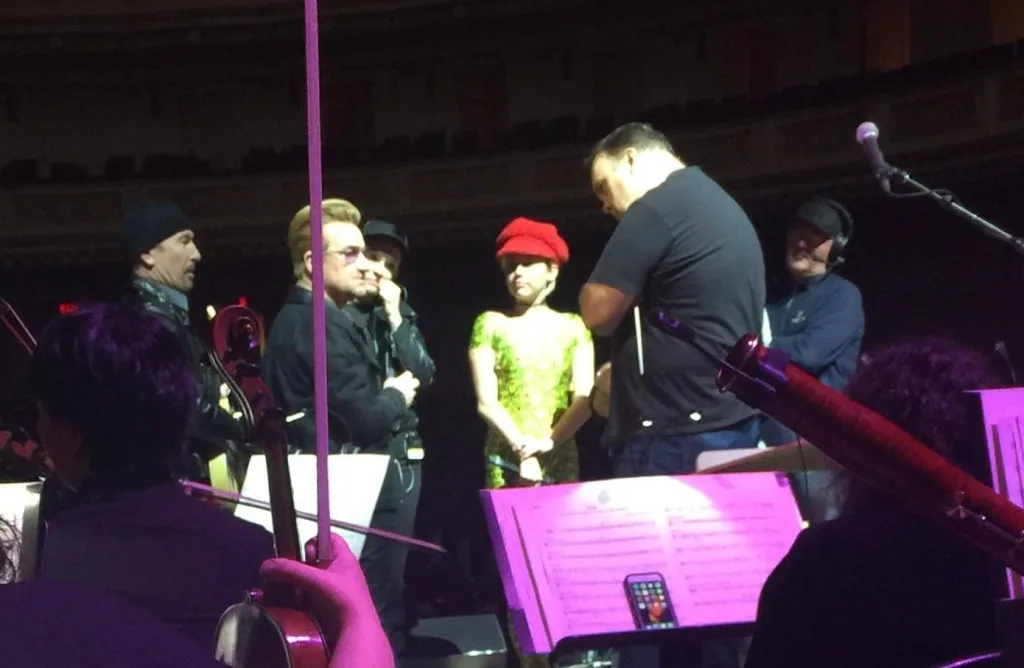
For all of the headliners he has served—Sting’s Symphonicities project, the Broadway musical The Last Ship, Springsteen sessions, Weezer’s orchestral record—December is where Mathes stands alone. He writes the charts, hires the players, sings the songs, and conducts from the keyboard or the guitar. It is also where his Greenwich story is onstage: teachers’ names spoken from the mic, neighbors in the choir, families in the rows who have passed tickets down like season seats. If you live here, this is not a destination event across a river; it is a twenty-minute hop to a space that would be worth a pilgrimage even if it were two states away.
For a Greenwich audience, the argument is simple. If you love music, the most complete version of December in the New York region is in your backyard. The concert is built by one of your own, educated by the teachers who still shape students in town. The venue is close enough to treat like a neighborhood theatre, yet the band plays with a skyline résumé.
“If they stop coming, we can’t give the concert,” Mathes said of the audience, half-joking but making a point. He spends the rest of the year watering other people’s gardens—arranging, orchestrating, conducting—then asks his neighbors to meet him once a year so he can bring the whole toolkit home.
Tickets are available through The Performing Arts Center, Purchase College website (https://www.artscenter.org/events/therob-mathes-holiday-concert-2/)