By Elizabeth Barhydt
This three-part series examines how one Greenwich family’s loss has sparked a broader effort to change the landscape of pediatric cancer care. The series follows the creation of the Vivienne C. Finn Foundation, launched in memory of 11-year-old Vivienne Cecilia Finn, who died in 2020 from a diffuse intrinsic pontine glioma, one of the most aggressive childhood brain tumors.
Part One traced Vivienne’s life and the path that brought her family from “Diagnosis Day” to the founding of the organization that now bears her name. Part Two brings readers inside Yale New Haven Children’s Hospital, where pediatric neuro-oncologists describe the medical, emotional and systemic challenges facing families.
Through this series, readers will see how a single child’s story has inspired a mission aimed at better treatments, stronger support systems and lasting structural change.
When Vivienne Finn arrived at Yale New Haven Children’s Hospital days after her diagnosis, her parents were ushered into a space that hardly resembled a conference room. “It was really a broom closet,” Dr. Vidya Puthenpura recalled. Yet into that small room came the neurosurgeon, an ICU physician, a social worker, residents, and two doctors who would become central figures in the family’s life: Dr. Puthenpura and Dr. Asher Marks. It was an early signal of what pediatric neuro-oncology requires—a full team, crowded in close, because the work is too complex and too human to be done by one physician alone.
Dr. Puthenpura’s path to this field began far from Connecticut. At 19, studying engineering in college, she traveled to India to visit relatives and spent time in a pediatric cancer hospital. The hospital served both wealthy and poor families, and the children she met there— “fighting for their lives and so happy and full of energy,” she said—changed her direction. She returned to school and changed her major. Looking back on that decision, she called it “very life altering.”
Dr. Marks describes himself as “a reluctant oncologist,” but not for lack of interest in medicine. He always expected to become a pediatrician and admired the primary-care doctor he saw growing up. During residency, he imagined hanging a shingle and treating neighborhood families. “I loved working with kids,” he said. But by his second year of training, he felt something missing. Primary care was becoming, in his words, “a business model,” leaving less time for deeper conversations with families. He found himself drawn to the oncology rotation, where he could sit, listen and learn about a child’s life.
He made one promise he later broke. “I told my wife I would never go into oncology— her father died of cancer,” he said. “Then I said I would never do brain tumors, because that’s what he had. And I ended up doing brain tumors.” He has spent more than a decade at Yale working with children from diagnosis through treatment, often for months at a time.
The difference between pediatric and adult neuro-oncology is stark. Pediatric neuro-oncologists are trained first as hematologist-oncologists and then trained further in brain and spinal tumors. Adult neuro-oncologists often come from neurology. That distinction shapes treatment. Children metabolize chemotherapy differently and can endure higher doses. Their cells recover faster, but the intensity of their care means they may spend weeks in the hospital with suppressed immune systems and require frequent blood transfusions. “We bring them to the brink and then pull them back,” Dr. Marks said.
With diffuse intrinsic pontine gliomas and other diffuse midline gliomas, the defining challenge is biology. Historically, physicians relied on MRI scans alone to diagnose these tumors, because surgical removal is not possible. In recent years, neurosurgeons have become more comfortable performing targeted biopsies, and laboratory advances allow physicians to identify the specific molecular mutations that drive aggressiveness. That information has begun to reshape treatment pathways, though it has not produced a cure.
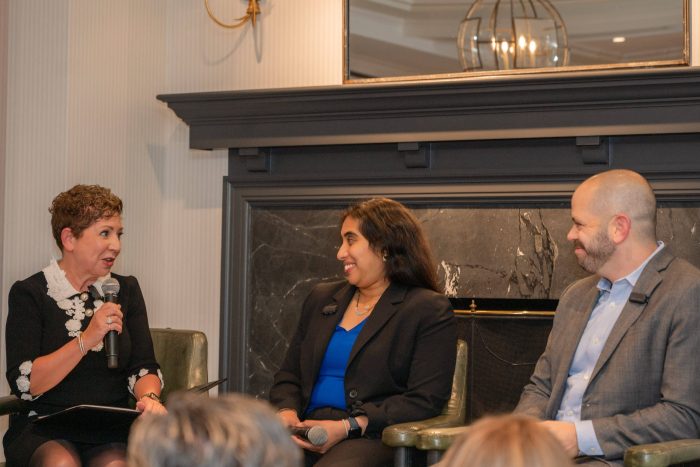
Dr. Puthenpura emphasized the collaborative nature of the field. “The pediatric brain tumor community is very small and we all know each other,” she said. They participate in national and international tumor boards, debates that bring together clinicians from major centers to examine hard cases. There is no competition among institutions when the disease is this unforgiving. If a trial is open at Memorial Sloan Kettering that might suit a child in New Haven, the Yale team will call Sloan directly. The goal is simple: “They want to go to school. They want to be around their siblings,” she said. If a trial can be opened at home, the team will work to make it happen.
Families face more than medical decisions. Many have to weigh whether traveling across the country for a trial is worth the strain. Dr. Puthenpura noted that a young person’s own voice matters: “It’s their body. We want them to have a say.” Adolescents who have returned to school may resist further scans because they want distance from their diagnosis. “Sometimes you have to let them live,” she said.
Supportive care forms the backbone of Yale’s program, and the doctors make clear that it affects outcomes. Dr. Puthenpura’s research shows that nearly half of families treated at Yale have at least one unmet basic need—food, housing, utilities or transportation. Those families often arrive later in the disease course, experience more severe treatment side effects and face higher financial instability. Parents working hourly or inflexible jobs may lose employment because of the time required for treatment. “These are just very basic things that every human should have, not just a family whose child is fighting cancer,” she said.
Insurance adds another layer. “No treatment takes place until insurance approval is obtained,” Dr. Marks said. Medicaid often authorizes treatment more quickly than private carriers. The team regularly spends hours on the phone seeking approval for chemotherapy, imaging or supportive medications. Each delay, they stress, adds burden to families already navigating fear and uncertainty.
The strain on clinicians is evident. Hospital finances have narrowed the availability of non-revenue roles such as psychology, social work and nutrition—roles that are essential to treating the “whole child,” as the team describes it. Dr. Marks said that when he started 13 years ago, a clinic day was eight complex patients supported by several staff members. “Now I have to see 16 just to keep afloat,” he said.
Coping requires boundaries. Dr. Marks drives home from New Haven each night and crosses a particular bridge that marks the point where he forces himself to let the day go. His wife works with victims of human trafficking, so the rule in their home is strict: neither brings work across the threshold. Dr. Puthenpura relies on humor and a group text thread among colleagues that serves as a place to decompress. They build Lego sets—a ritual that grounds them through cycles of grief.
They still speak of Vivienne often. She was direct, witty and fiercely curious. “She used to call me ‘V-Dizzle,’” Dr. Puthenpura said. Dr. Marks remembers her humor and sharpness: “She gave it back just as hard as you do.” They also remember the day she died. After leaving the ICU, the two physicians walked away from each other without speaking, each needing space before they could talk.
Despite the weight of the work, both insist they cannot imagine doing anything else. They measure success not only in survival but in honoring a family’s goals: allowing a child to remain at home, preserving moments of normalcy, providing clarity during frightening choices, and, when cure is not possible, offering peace at the end of life.
They also return to the importance of community. A room full of people willing to hear the stories and understand the gaps—financial, scientific and emotional—gives them confidence that the work can move forward. As Dr. Puthenpura put it, “It’s a hard conversation to have, but being willing to have it matters.”
For the Finns, the Yale team’s honesty and compassion provided the guidance they needed during the worst months of their lives. For the doctors, Vivienne’s story—and the foundation now built in her name—is a reminder that the smallest patients can leave the deepest imprint on the science and the care that will follow.
Learn more at the Vivienne C. Finn Foundation online at https://vcfinnfoundation.org/
Part Three in next week’s issue will explore the foundation’s pillars—drug development, family support and legislative reform underway in Connecticut and Washington.