By Emily Raudenbush Gum
Fred was a fairly typical kid. He grew up in Connecticut and, much to his family’s pride, found himself at Yale. He thought he would be pre-med and studied accordingly. As with many young people, when he was finished with college he moved home to try to figure out what was next. He picked up teaching at an independent school and found that he was incredible at connecting with young people. A new passion was formed, and a new calling. Fred was a commanding and jovial presence, loved sports, and often spent time in the woods that surrounded the school, hiking or fishing. He incorporated these things into his teaching, prioritizing character development, experiential learning, love of place and nature, civic responsibility, and competition. Students adored him.
Five years into teaching, Fred was committed to the work, but was starting to find himself at odds with the social and political culture of the parents of his students. He was principled almost to the point of being stubborn, and he was committed to maintaining his moral sense of self. This misalignment with parents, however, cost him his job, and Fred found himself on the road, eventually settling at a school in Pennsylvania that was more aligned to his vision of teaching and learning.
His heart, however, was in Connecticut, as was the woman he was trying to marry. It took several years, but Fred’s approach was eventually more widely shared, and he was able to come home and resume his calling alongside his now wife, Abby. Together, they built a school based on a series of beliefs: that public character and active citizenship are the purpose of education; that a sense of rootedness and place not only grounds kids, but helps them to build a sense of obligation and responsibility to the natural world and their neighbors; and that there is wisdom and goodness in an intentionally broadly representative school community focused on cultivating independent, critical thinkers. Fred and Abby also operated their school with an understanding that kids are going to make mistakes, and that is precisely where trust between students and their teachers can have the most meaningful and direct impact on the ability of the young, especially teenagers, to take risks and innovate. The year was 1850 (and his school is today known as The Frederick Gunn School).
Frederick Gunn (Fred to his friends) was an educator his entire life, and there is only one speech that remains to capture his vision, which he delivered to a room of fellow educators in 1871. At that point, 30 years into his craft, he began with the following words: I have in mind an ideal of a school. It is a disarmingly relevant vision in 2025.
Human scale design. In every decision made, the question needs to be about what the actual students that we have need to thrive. If schools do not begin with a vision of a thriving student, they cannot build programs and infrastructure that will get kids to their goal. As large-scale disruptions reach our schools, with generative artificial intelligence being the latest, maintaining the value of human scale design is essential to building the schools of the future.
Teachers are mentors. You might think that in 1850, an innovative and wildly successful educator would have been focused on what we would now call the content and skills of teaching and learning. Not so for Frederick Gunn. He had an acute sensibility that the keystone variable to good schools is trust. Trust manifests itself in the interactions between teachers and students as mentorship, where faculty set impossibly high standards for their students to reach and then walk them towards growth. Mentorship is always about setting students up to be ambitious for success.
Greatest possible growth. High standards, high support —when a mentor holds these two things, we watch students take risks and hit gears they (and their parents) didn’t know they had. Students leave high school with a sense of self and a sense of purpose, the combination of which opens up an ambitious future (and college list). Students are set up with a vision of learning that extends through and beyond the formal structures of degrees.
……………………
AI is going to disrupt education. The verdict is in, and social media and cell phones are already dramatically transforming the experience of our children in schools. As educators, we are being asked to act and lead before the outcomes of these transformations are known to us. This increased pressure on schools is putting a strain on the relationships between parents and educators. College admissions is increasingly a moving target.
In response to these disruptions, it can be tempting to do one of two things: throw out all that we know about what kids need most and embrace a digital revolution, or put our heads down and hope the revolution will pass by before our jobs are at stake. There is a third option, however, and it is to lean into our best instincts as educators, ensuring that our kids are not facing the complexities of the future without the wisdom of the past. This was Fred and Abby’s approach in the face of a civil war, political polarization around abolition, industrialization, and increased technologies for global connectivity. While much has changed, these deep resources exist to help us navigate our own time.
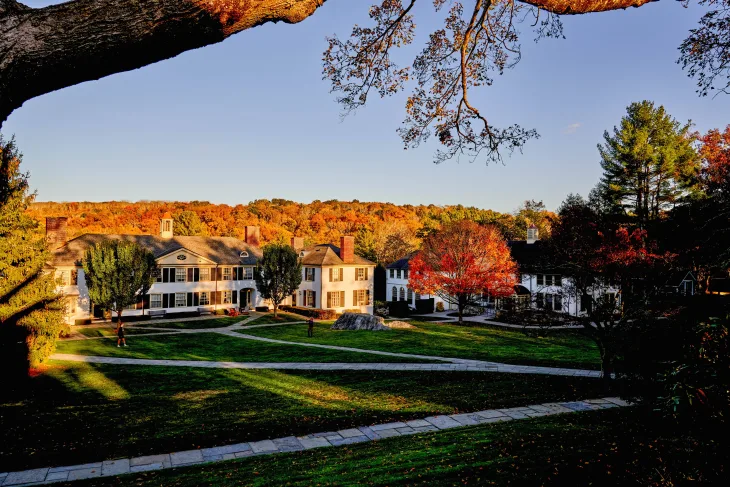
Abigail and Frederick Gunn’s school was located in Washington, Connecticut, and it is still here today. It was known endearingly for a great part of its history as The Gunnery — an honorific nod to the affection that students had for Fred and Abby. Many schools do not have a relatable founder. Either that person was lost to history or there are substantive disagreements between their founding ideals and those of the school presently. We are lucky as a school to have as our founders not one but two moral exemplars. Pushing with hope and determination towards the future of education is deep in our DNA.
Emily Raudenbush Gum is the 12th Head of School at The Frederick Gunn School in Washington, CT, celebrating its 176th year.