By Anne W. Semmes
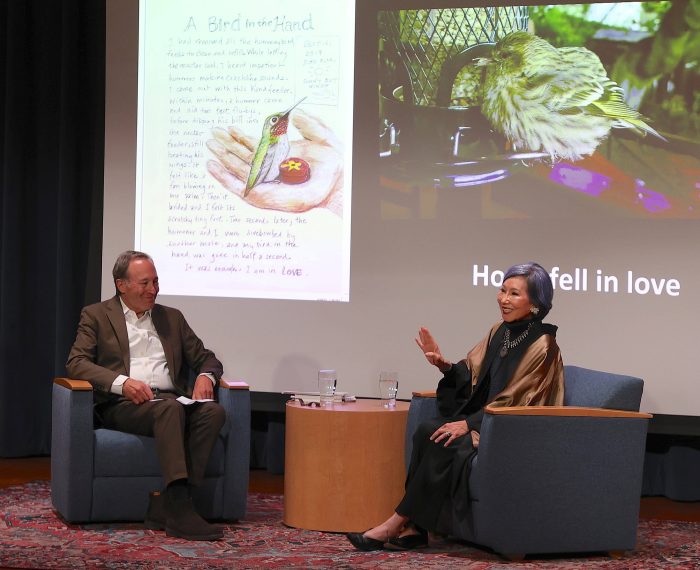
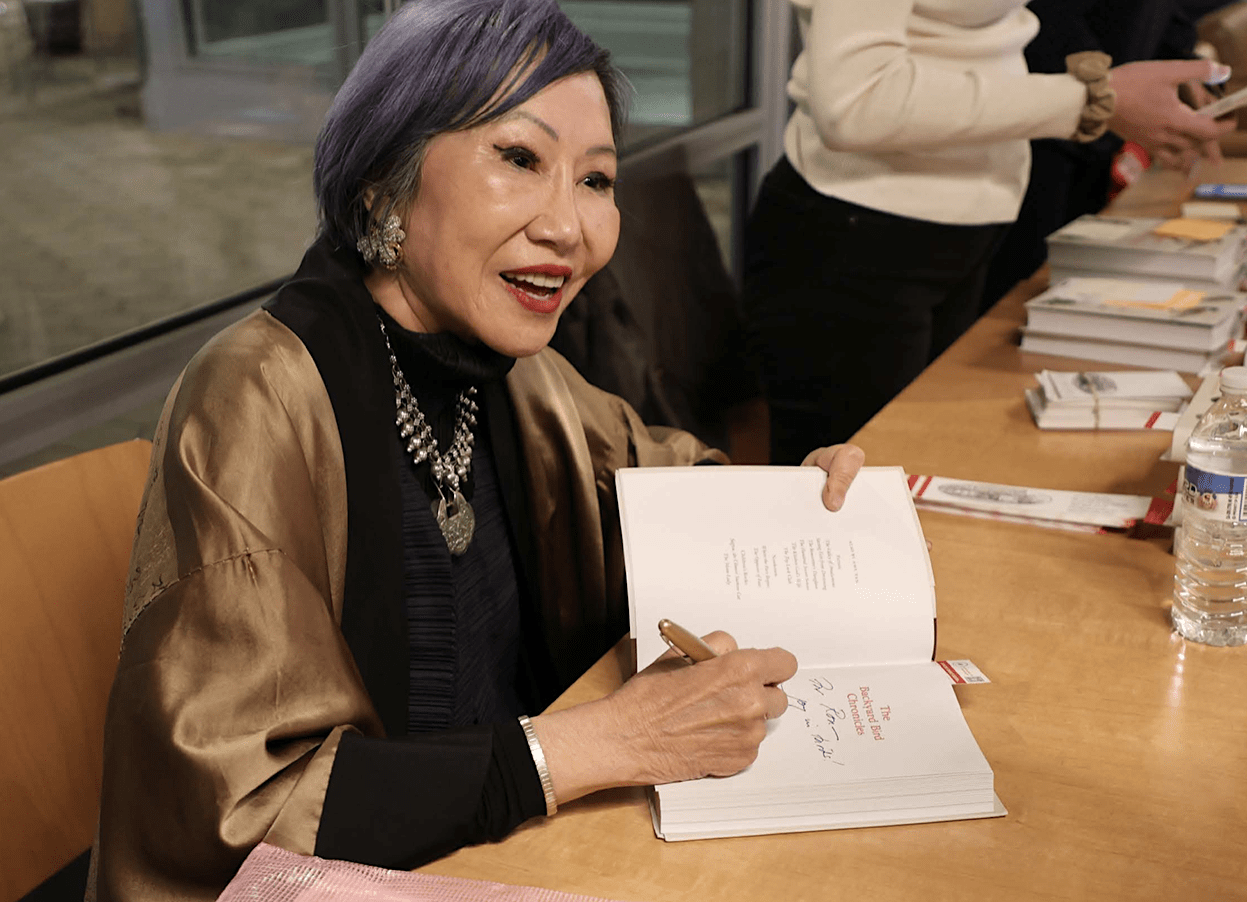
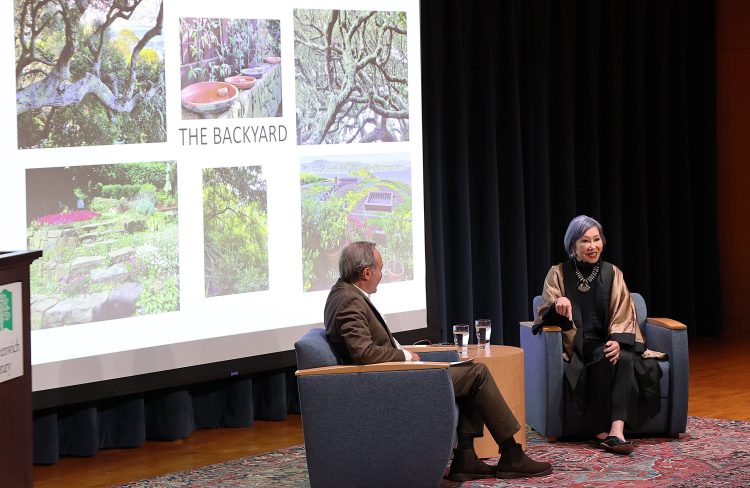
The wonder of the discovery of birds in one’s backyard captivated over 350 attendees as shared by world-wide best-selling author Amy Tan at the Berkley Theater at Greenwich Library on October 23. Tan’s novels that often address her experience as the daughter of immigrants from China, have been translated into 35 languages, but she has had a life changing experience getting to know the birds up close and personal in her Marin County backyard in California.
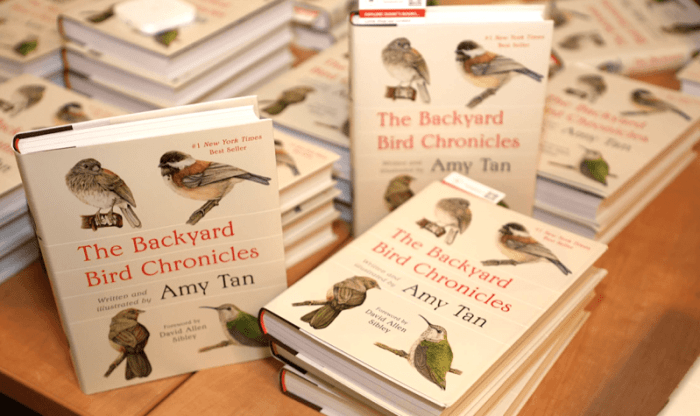
There to question Tan was noted PBS Newshour Senior Correspondent Jeffrey Brown, who right off confessed he’d been in Tan’s backyard. Addressing Tan’s now year-old self-illustrated and best-seller book, “The Backyard Bird Chronicles,” Brown first questioned what had kicked off Tan’s bird passion in the midst of her esteemed novelist life? “It started off as a very personal journal that I was keeping in response to my feeling very depressed and in despair because of a lot of racism that had broken out directed to Asians. So, I wanted to counteract ugliness with beauty and went into nature.”
Following her fantasy of drawing from childhood, she began drawing those birds. “When you look at birds from dawn until night,” she shared, “and you are drawing the whole time and taking notes and not doing your novel, that’s called obsession because there’s this risk…these angry people… I’m not finishing the novel.” But, being in nature, she learned, “felt so good – it increases your serotonin being out in nature.”
Seeing the wizardry in birds
“You know what a crow looks like,” she told, “but have you ever watched it for five hours or 12 hours every single day?… Crows are intelligent at solving puzzles. It turns out jays are the same way. Mockingbirds are the same way. And even the tiniest songbird can do amazing things that prove how smart they are. That’s what really turned me on to observing and being curious.”
Then a young mentor came her way. “My mentor was 13 years old.” Tan learned from her the importance of questioning what she was observing. “It was being the child, assuming I don’t know anything…learning how to look. The more you pay attention, the more that becomes love…I fell in love with these birds.”
She would photograph those birds, then with erasable colored pencils draw them from those photographs, with Brown pulling up images of those colorful drawings. “Each of these drawings takes about 12 hours to do,” shared Tan. From all that observing she would choose birds that would be “eating and dating or something and suddenly look up and see me. And when they started to stay and just look at me, I felt absolute love that this creature stayed, and did not fly away.”
“It became a strange kind of relationship,” she continued, “not that we were friends, not that they trusted me, absolutely. They didn’t love me the way I love them. I was just part of their habitat.”
Honoring the female birds
“So, every bird here pictured is a bird that looked at you?” Brown queried. “Yes, and I tried to choose poses a little different from what you’d normally see as profiles of birds.” She would often choose female birds, pointing to images of a female Anna’s hummingbird and a female Townsend’s warbler. “Because males get all the glory, they tend to be more colorful,” she said, “I decided females do a lot of the work reproduction, and we need to give more credit to female birds for all the work they do.”
Brown pointed out an image showing Tan’s journaling. “So, you’re not just drawing them, you’re thinking about them. You’re asking questions?” Tan told of having seen hummingbird feeders, with a hummingbird coming to a man’s hand, she would invest in a feeder. “They immediately claimed it,” she said, and the day came with a male hummingbird perching on her hand. “I could feel these little scratchy feet… And I’m looking down at it saying, ‘you’re so beautiful, you’re so beautiful.’ I started calling out the features of the bird because doing nature journaling, you’re supposed to say things out loud so you will remember what to draw later.”
Those “reticulated patterns, with the feathers going from small to larger,” she was sketching while eyeing the bird. “It could have been there for 10 seconds or two minutes. This is the quality of the moment when you are in nature… you’re transfixed and it’s limitless what you’re going to see.” Tan would become acquainted with 73 bird species in her backyard.
Learning the emotions of birds
Her crows would introduce her to their emotions, their memories. “I’m a writer. I have a good imagination. I like to write dialogue,” she noted. “Crows can remember people who treated them badly… Not only do they grieve when one of their members has died, they will hold these so-called funerals… going into a tree… screaming and screaming.” To test this Tan hung a dead crow in her backyard. “The weird thing is they left and they didn’t come back. They actually can pass on lessons to the next generation… like humans do.”
So, asked Brown, had the pandemic turned people to their back yards and to birding? Yes, said Tan. “People had that time to sit still and start noticing because of their confinement.” She had met up with “a lot of people falling in love with one particular bird in their yard as a result of the shutdown. And they felt great gratitude for having a new relationship.” Astonished with the sales of her book, she would learn, “90 million people like or love birds. That’s one third of the population.” Surely, she noted, that number “holds great promise for the possibilities of what birds can bring overall to our world.”
But Tan does not define herself as a birder. “I consider myself more of a bird watcher. I’m not good at identifying birds from a distance. They have to be like 10 feet away.” She likened her impulse to observe birds to “the same impulse that led me to become a fiction writer.” As a child, Tan was observing as “a survival technique” with a suicidal mother. “Like the birds I had to be on guard, cautious. I was always looking for signs that she was going to implode or go into a rage and turn furniture upside down, threatening to kill herself…I could never dismiss it as just a bluff.”
Observing birds as a novelist
“The instigation for a novelist,” she added, “is that you are observing out of necessity. And behind this observation …are crises or contradictions you need to make sense of it…and find meaning in life… Being by myself in my room and conjuring things up, whether I was drawing or writing letters to friends, those were the things that made me feel I was intact.”
Observing those birds close up, “seeing the mother birds grooming and feeding their young” had Tan thinking “about those similar qualities in humans. What is mourning? What is mortality? What is survival?” She knew that “if a baby bird does not eat within 24 to 48 hours, it’s probably not going to live.” She learned that “75 percent of songbirds and raptors do not make it to breeding age. So, when you see a bird sitting out there, that bird has achieved the equivalent of a miracle staying alive.”
Questioner Brown asked lastly if there was one question Tan was never asked. “No one ever asks about the language of writing, the craft of writing,” she replied. “You’re putting together a story, but all the elements really matter…You have to pick the language that keeps it together, keeps it fresh, keeps you and the reader focused on what this world is about. And the language includes imagery. It’s the particular metaphors that you use. It’s the way that you structure the sentence and the rhythm of it. It’s playing with the words, and it’s an obsession to make every word count.”
“And so, when I write a novel,” she continued, “I revise no less than a hundred times per page. I am constantly tinkering with the language, reading it aloud, seeing if it comes out clunky. If I stumble over something that I know is probably false, I have to redo it until it comes out as natural, as seamless. That is what you hope you present to your reader. But nobody ever asks about that. The craft of the writing is fully half of what you’re doing as a writer. Not just the stories, not just the emotions, the imagination, the memory. It is the language.”