By Tom McDermott & Elizabeth Barhydt
The Round Hill Association’s 2026 candidates forum brought four contenders into one room Wednesday night and produced a useful election-year argument over taxes, housing, energy, transportation and what a legislator from this corner of Connecticut should do after reaching Hartford.
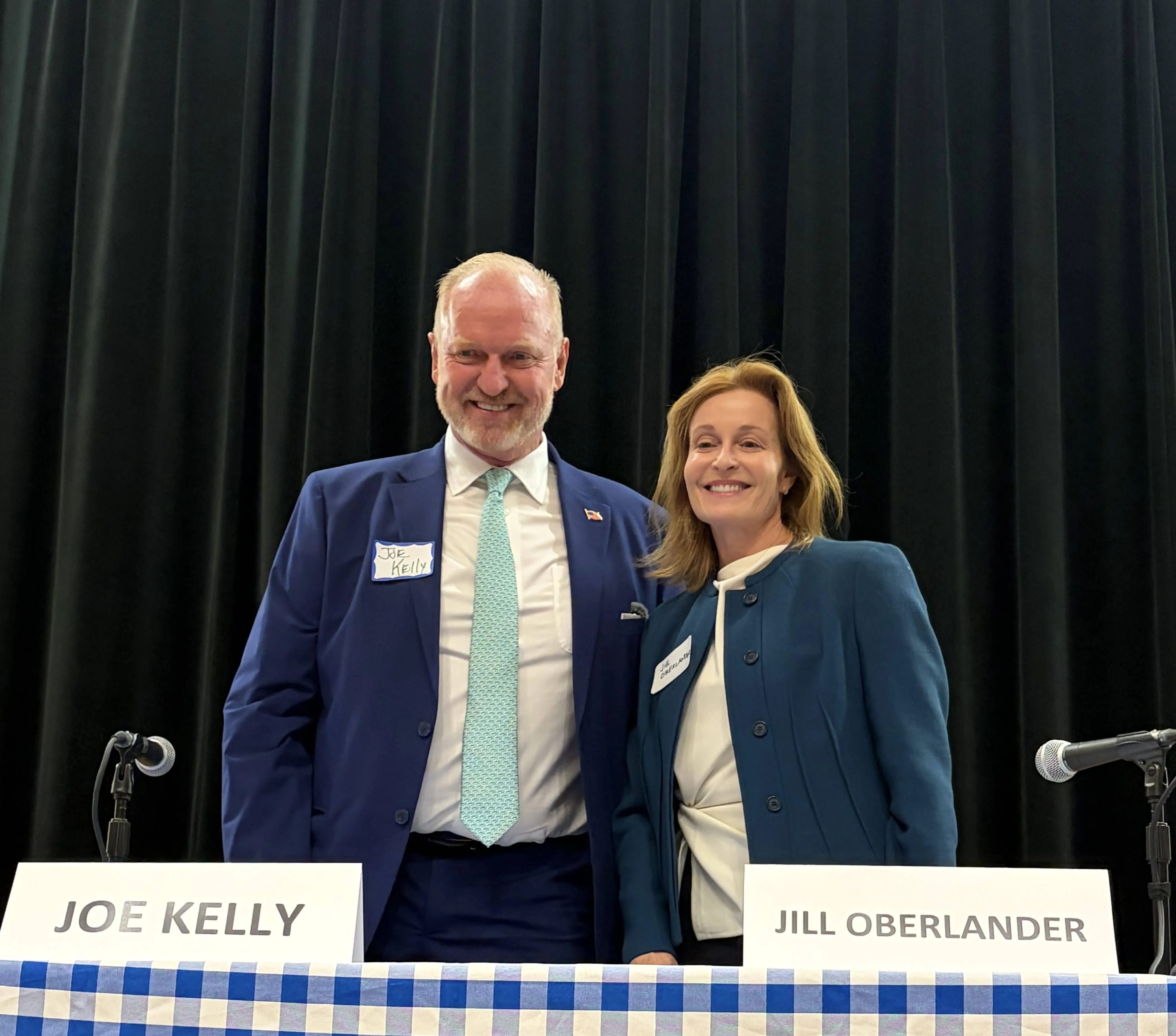
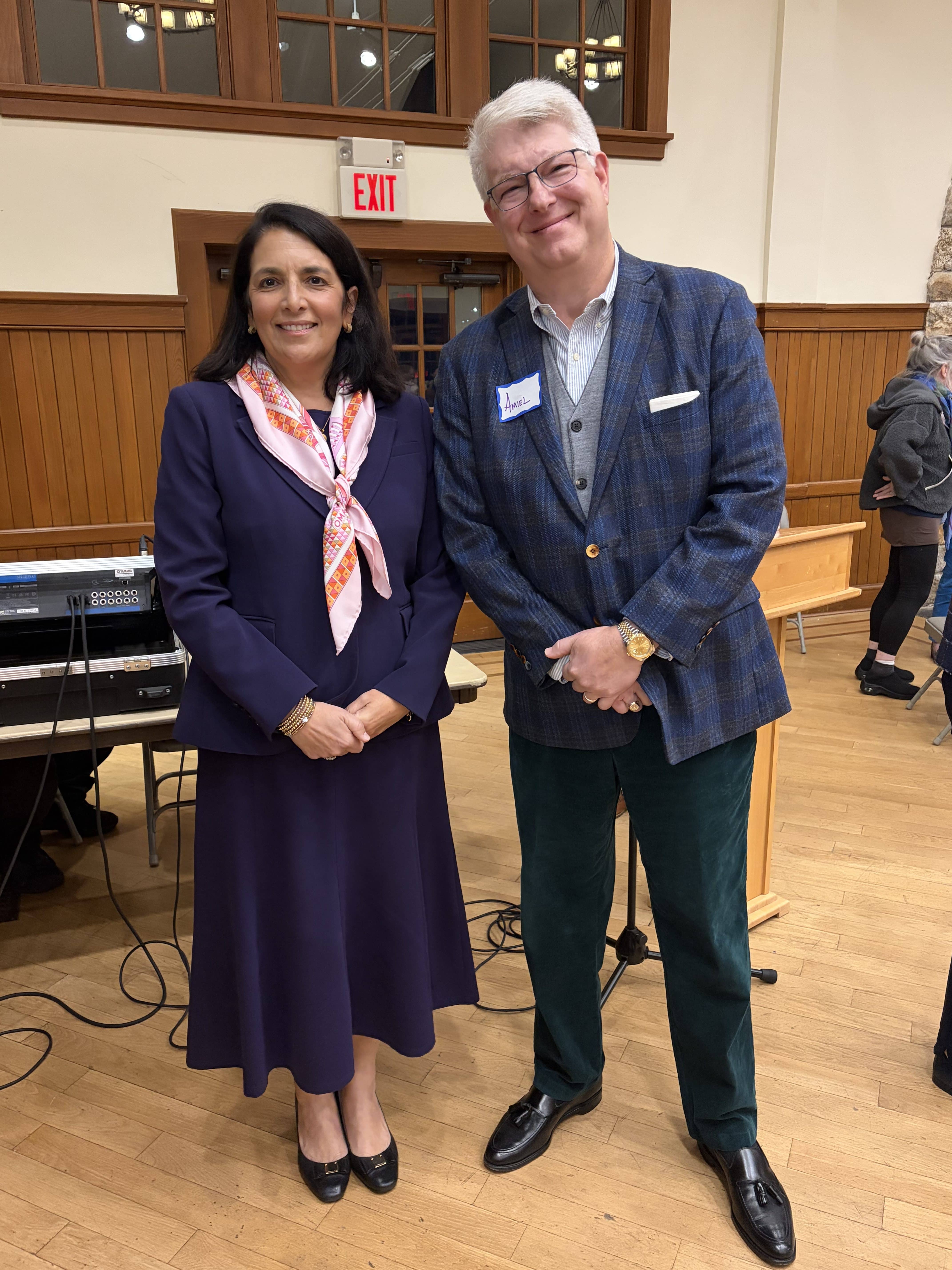
The setting was the Round Hill Community House, the format two 45-minute debates, and the questions came from the community and members of the association’s board. Republican Joe Kelly and Democrat Jill Oberlander, candidates for the 36th Senate District seat, went first. Republican state Rep. Tina Courpas and Democratic challenger Amiel Goldberg followed in the 149th House District contest.
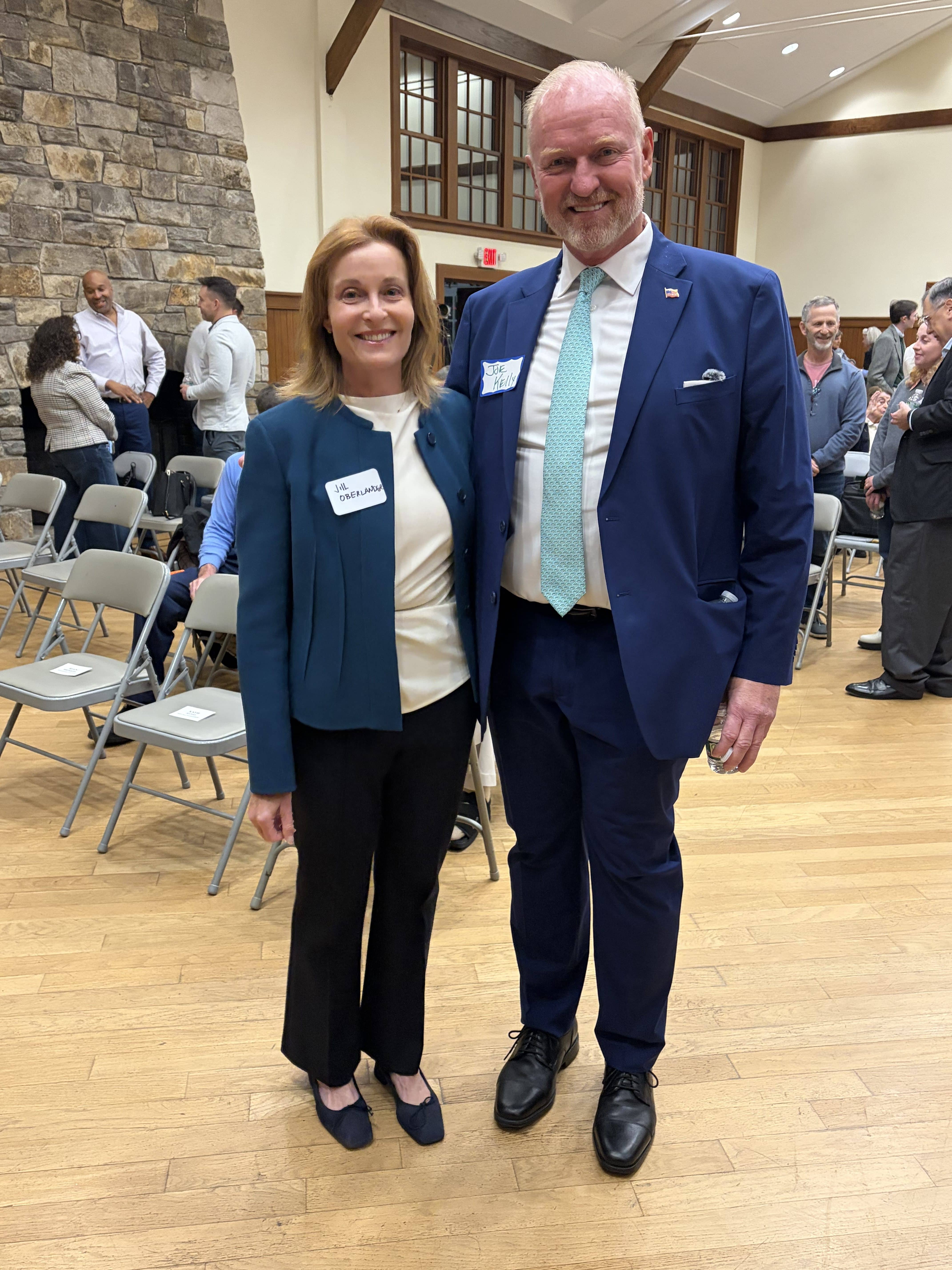
There were disagreements, but the deeper division was strategic. Kelly and Courpas argued that Connecticut’s political balance has shifted too far and that legislators from Greenwich must be willing to resist state overreach. Oberlander and Goldberg argued that resistance without influence can leave a district outside the negotiations where bills are shaped.
The Senate: Agreement, Then a Fault Line
Oberlander and Kelly began with biographies that sounded different but shared an old local theme: work, family and service.
Oberlander spoke of parents and grandparents who taught her “hard work, care for others, commitment to community and love for country,” then traced 13 years in Greenwich government through the RTM, Board of Estimate and Taxation and Board of Selectmen.
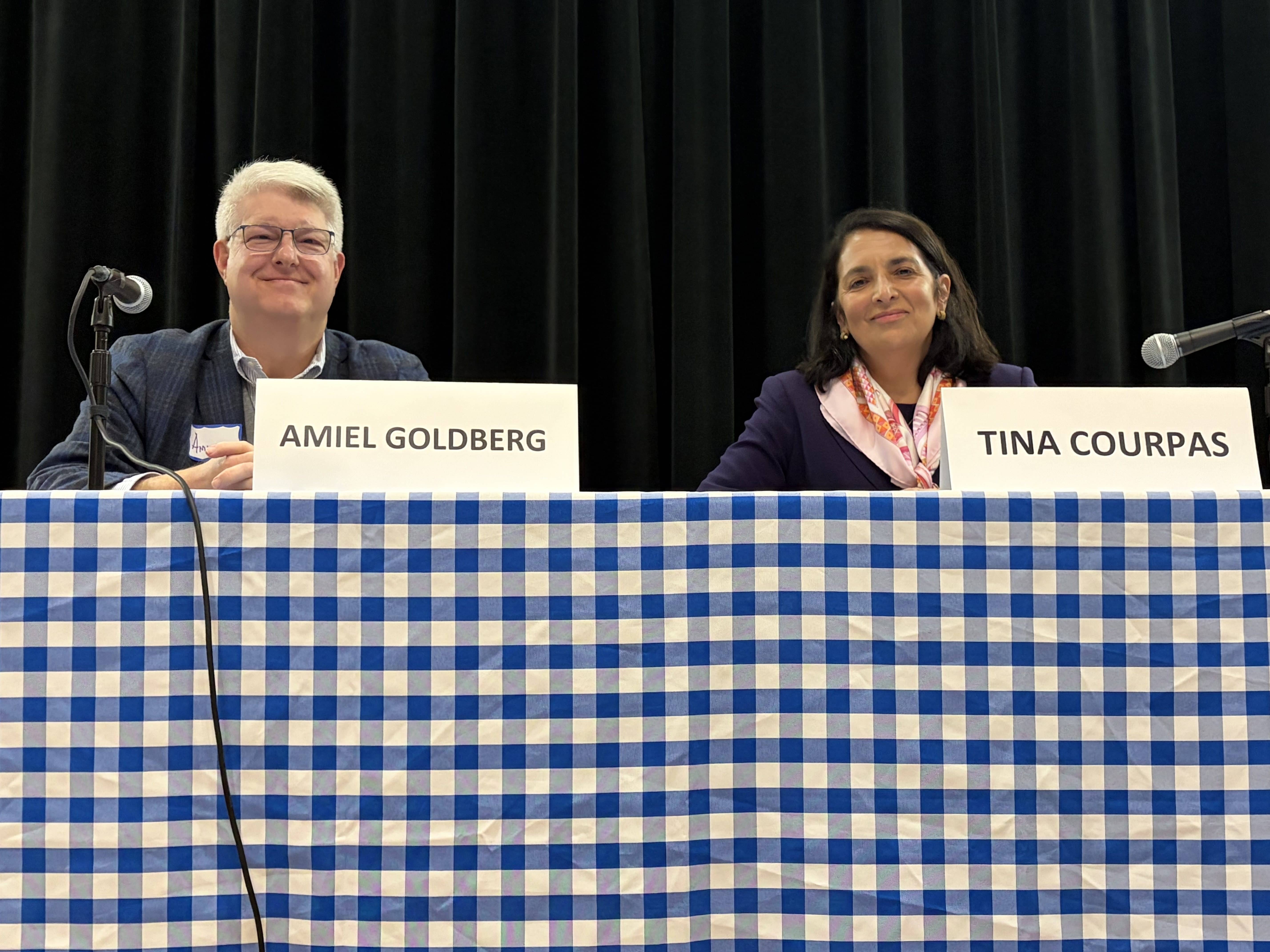
Kelly described growing up poor in Queens after losing his father at age 10, delivering newspapers, starting a business at 16, working his way through college and eventually building a career on Wall Street and in business. He also described years of volunteer work, coaching, firefighting and foster parenting.
On Connecticut’s fiscal guardrails, both defended fiscal discipline, but not the same interpretation of it. Oberlander said the guardrails had helped strengthen the state’s finances and argued that lawmakers retained authority to make one-time exceptions in extraordinary circumstances. Kelly framed the issue more simply: a budget is a discipline, and government should not abandon it when pressure arrives.
That disagreement resurfaced later, when candidates were asked to name a difficult Hartford vote. Oberlander cited the decision to redirect funds in response to federal cutbacks and other needs as a legitimate hard choice contemplated under the guardrails. Kelly called the same action a breach of discipline.
Housing produced more agreement. Kelly said 8-30g had created an adversarial relationship between Hartford and municipalities and called for electing legislators willing to remove it. Oberlander called the law “passed its prime and not working,” supporting a moratorium, repeal or replacement while insisting local officials should control zoning.
Both were wary of data centers. Oberlander said Connecticut should pause consideration until the state better understands their energy demands and costs. Kelly said data centers made little sense in a state with expensive electricity and few long-term jobs attached to them. On artificial intelligence itself, Kelly offered one of the evening’s more candid lines: “AI scares the hell out of me.”
Public safety brought an unexpected moment of levity. Oberlander emphasized fire coverage, speeding and traffic. Kelly agreed on fire coverage and speeding, then added bears to the list. Later, after another area of agreement, he observed, “Well, so far we agree on everything but the bears.”
The Senate debate’s sharpest difference emerged over effectiveness. Kelly promised independence from political pressure and pointed to his work on the Board of Education, RTM and BET as evidence that cooperation can replace dysfunction. Oberlander said voters should judge her on whether she shows up, listens and works with people across party lines.
“I don’t believe policy has parties,” she said. “I don’t believe solutions belong to one side or the other.”
Her argument was that a legislator must negotiate with the governing majority rather than remain “shouting at the wind.” Kelly’s argument was that influence begins with firmness: say what you believe, keep your word and build cooperation without surrendering principle.
 The House: A More Defined Divide
The second debate sharpened that same question.
Courpas, seeking a second term, opened by presenting her first term as a record of fiscal restraint, opposition to state housing mandates, special-education funding and bipartisan legislation. She described Connecticut as politically “out of balance” after years of one-party control.
Goldberg, a Stamford Board of Representatives member and retired financial-risk executive, offered himself as a problem solver whose professional instincts are to measure risk, examine trade-offs and repair systems that are failing.
Their first clash came over the fiscal guardrails. Courpas called them the most consequential state fiscal reform in decades and criticized recent decisions to redirect revenue that otherwise could have gone toward pension liabilities. Goldberg said the guardrails remain sound but argued that financial strength exists partly to give government choices when federal funding disappears or human needs rise.
On electricity, they found common ground. Both supported moving public-benefit costs off electric bills and into the state budget, though Courpas also pressed for changes in energy contracts and expanded natural-gas supply while Goldberg emphasized infrastructure, fuel mix and price stability.
Their approaches to artificial intelligence were more distinct. Goldberg described AI as a powerful tool requiring risk management. Courpas cited three legislative votes, supporting protections involving minors and personal data while opposing a broader bill she believed imposed excessive liability and restrictions on employers.
Transportation exposed another clear split. Courpas called for greater investment in Metro-North and relief from I-95 congestion but rejected tolls. Goldberg said Connecticut should at least study whether out-of-state drivers should contribute more, noting that neighboring states charge Connecticut motorists on their roads. Courpas countered with support for a temporary gas-tax holiday; Goldberg called that a short-lived answer to a structural problem.
Housing brought the evening’s most revealing exchange.
Goldberg said communities should retain a strong voice but argued that Connecticut municipalities derive zoning authority from the state and therefore need relationships in Hartford. He criticized backward-looking affordable-housing measurements and said Greenwich and Stamford require different solutions.
Courpas answered that the “seat at the table” theory had not impressed her during her first term. “I have not seen any evidence whatsoever,” she said, arguing that Fairfield County legislators are frequently outnumbered on key votes.
Goldberg rejected the premise that Connecticut has an “out of control majority,” saying the legislature reflects choices voters made district by district. Courpas replied that cordial relationships across the aisle do not erase serious differences in voting philosophy.
That exchange gave the forum its central question. Is Greenwich best served by legislators who can work inside the majority’s coalition, or by legislators willing to oppose that coalition when they believe local interests require it?
Courpas closed by asking whether Connecticut had become too politically imbalanced to fix, then answered herself: “All our issues are fixable and no, we should not all move to Florida.”
Goldberg closed by invoking responsibility, risk management and “Out of many, one,” saying government should be a practical force for good.
The evening ended without rancor. That may have been its most useful feature. The four candidates did not pretend their differences were trivial, but neither did they treat disagreement as a character defect. In an election likely to turn on Hartford’s reach, Connecticut’s finances and the meaning of effective representation, voters were given four recognizable governing philosophies and a clearer choice among them.