On my watch – Arlene Mark Honors Orangutan Champion friend Biruté Galdikas –with Her Own Borneo Visit Story
By Anne W. Semmes
Arlene Mark has made an imprint in town as an author of young adult books, including her engaging children’s book “To the Tower – A Greenwich Adventure” based on a real Tower located on Shell Island off the Byram shore. But with her adventurous life she is rich with material, as learned from her sharing the recent death of an extraordinary friend as headlined in The New York Times: “Biruté Galdikas, Champion of Endangered Orangutans, Dies at 79…With Jane Goodall and Dian Fossey, she was one of three prominent researchers of great apes,” with all three mentored by the great Louis Leakey.
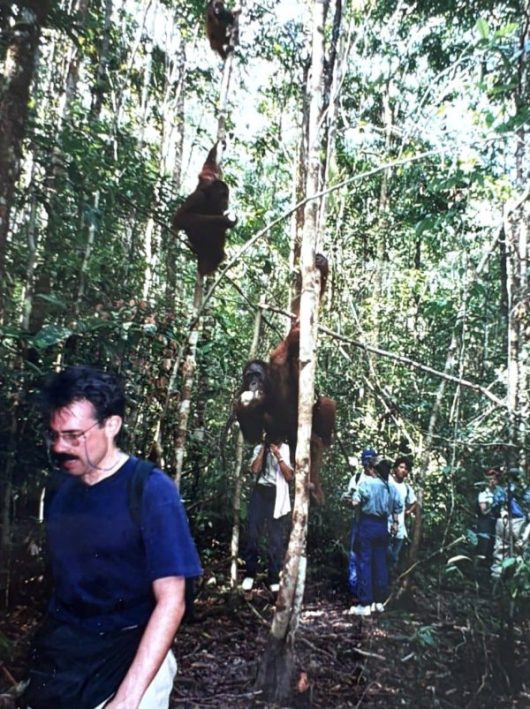
Arlene would tell of being with Dr. Galdikas in 1995 at her research camp on the Indonesian island of Borneo, getting to know her and the orangutans. But before that trip Arlene had visited the camp site of Dian Fossey in Rwanda in 1988, three years after Fossey’s death. Having been introduced via husband Reuben’s business contacts to Ruth Keesling, the philanthropist daughter of the founder of the Morris Animal Foundation, Arlene would be invited to join Keesling on a mission to bring penicillin to the gorillas in Rwanda.
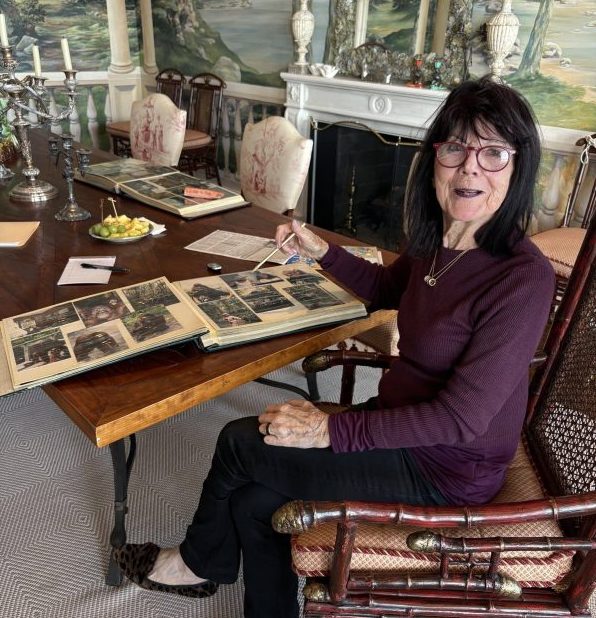
That need for penicillin Arlene would learn came with the logging… “The gorillas were moving up the mountain and getting respiratory diseases.” Add that “The poachers were killing the gorillas, leaving the bodies and taking their hands to make ashtrays! It was head shaking… We had to climb up carrying everything.” Arlene had visited where Fossey lived – all seen in a heavy album of photos. “You’d pass through all this Spanish moss hanging in the cemetery where she was buried…This was her bedroom where she was killed in bed by the poachers she was trying to stop, just like Biruté Galdikas was trying to do to stop their cutting down the trees.”
Arlene wrote an article on her Rwanda visit in the Greenwich Time in 1989 that spells out impressively what she learned of the life of gorillas, and of her witnessing the placement of a bronze plaque on Fossey’s grave. But today her thoughts are on that 1995 visit with Biruté Galdikas and what she would learn about orangutans.
“The orangutans are just so friendly. The mom would probably hurt you if you’re trying to hurt the baby – they’d just paw you,” said Arlene. Again, it was Ruth Keesling that invited Arlene to join a team effort to observe Biruté’s work with orangutans. And perhaps, “some Americans with some clout (not me),” Biruté thought could influence the government to stop the loggers. “But the government mostly gave the loggers permission because they paid them. So, it’s all a lot of corruption… We sat in meetings with government officials and everybody shook hands, then we went back to Biruté’s.”
Arlene would observe Biruté at work. “Her life was spent all day in the forest, just watching one of the orangutans for days, seeing what he ate from the feces, what he was eating, and keeping notes. And she had interns working at her camp.” Biruté would receive support from an Orangutan International Foundation, “set up by her Bornean husband, a founder and head of the Foundation, and she was always fundraising,” with her years of service to stretch across 50 years.bought in a market they would treat like children. Some of them put clothes on them and some had them serve them at table.”
The moment came when Arlene said, “Stop the car I see it.” That found chained “baby” orangutan would follow Biruté and Arlene to its house. “We knocked at the door, and the man came to the door – his name was Pac. He unchained the orangutan that came in with us.” Biruté would explain her efforts to rescue orangutan “babies” by bringing them to her forest preserve “where young people were there helping the babies.”
So, during Arlene’s stay had they found other babies in their search? “We didn’t see any others… We heard people talking about them in villages that the finders wouldn’t give them back. They would tell us stories about them but not tell us where they were.” And it proved a challenge for them to bring that found baby to the forest preserve.
“It took the whole day sitting there – about eight bottles of soda each – trying to convince him, ‘It’ll be better.’” His response: “My wife would never let me give him up.” Arriving at the end of the day the wife would finally agree, with, “It’s best for Biki to go.”
That baby orangutan, likely a two-year-old said Arlene, would grow “bigger than a person. And then the people can’t control him. He’s knocking things over in the house. Then they let them go.” And now, “They get shot out on the streets…They’re probably being slaughtered because people want the land to farm.”
Indeed, today orangutans are critically endangered with a population decline of over 82 percent, with an estimated 104,700 remaining. “Driven by deforestation for palm oil, logging and hunting.”
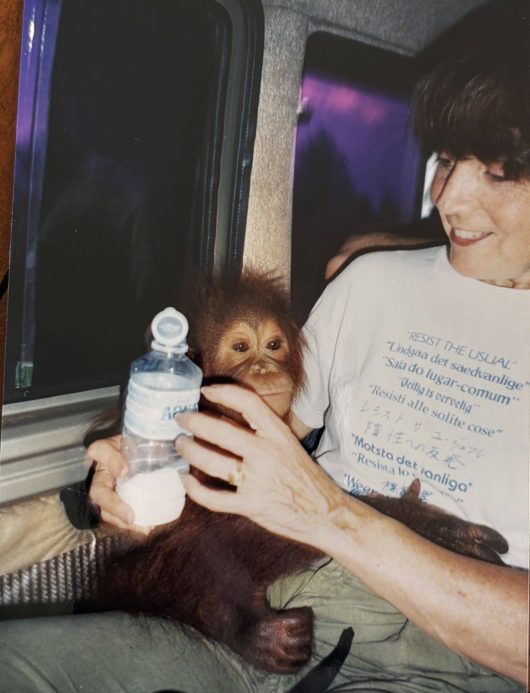
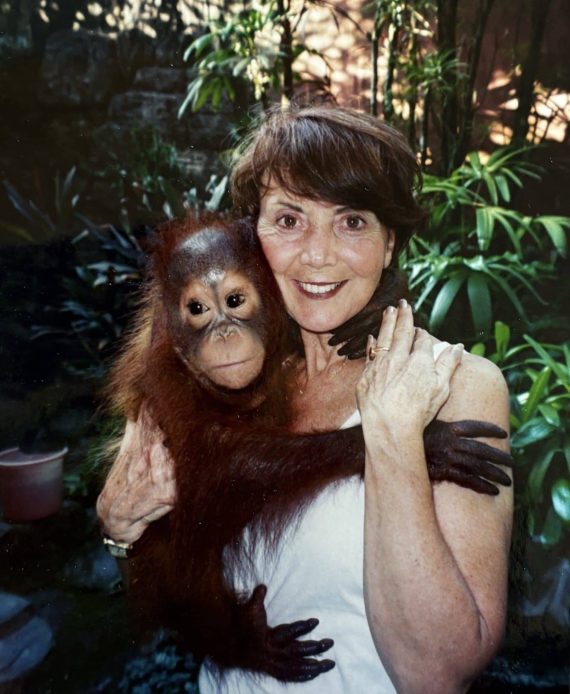
“But we brought Biki back,” said Arlene, “but only if Pac, the husband, could come with us – it took two days to return to the reserve where Biki was going to be.” And during that journey, Arlene would bond with Biki, nursing him like a baby, feeding him milk from a bottle, with his “owner” Pac sitting beside.
Today, with Biruté’s obituary laid out before her, picturing Biruté enwrapped with orangutans, the question was asked of Arlene just what has lingered the most in her memory of her experience in Borneo? “That there are species endangered and probably disappearing as we speak,” she said. That subject had her writing a story called “Do Best Friends Do That?” “It’s about how towns are slaughtering Canada geese… People wouldn’t want to save Canada geese today, but they deserve to be preserved in a way where humans and geese can coexist.”
And she’s not wishing to return to Borneo. “Now that Biruté is not there, it’s likely filled with tourists going on buses,” without “the true people of the forest who loved Biruté for her work.” The thought did come a few years ago to take husband Reuben back with some grandchildren “but it just didn’t work out with vacation times. I would have loved for them to see Biruté at work.”